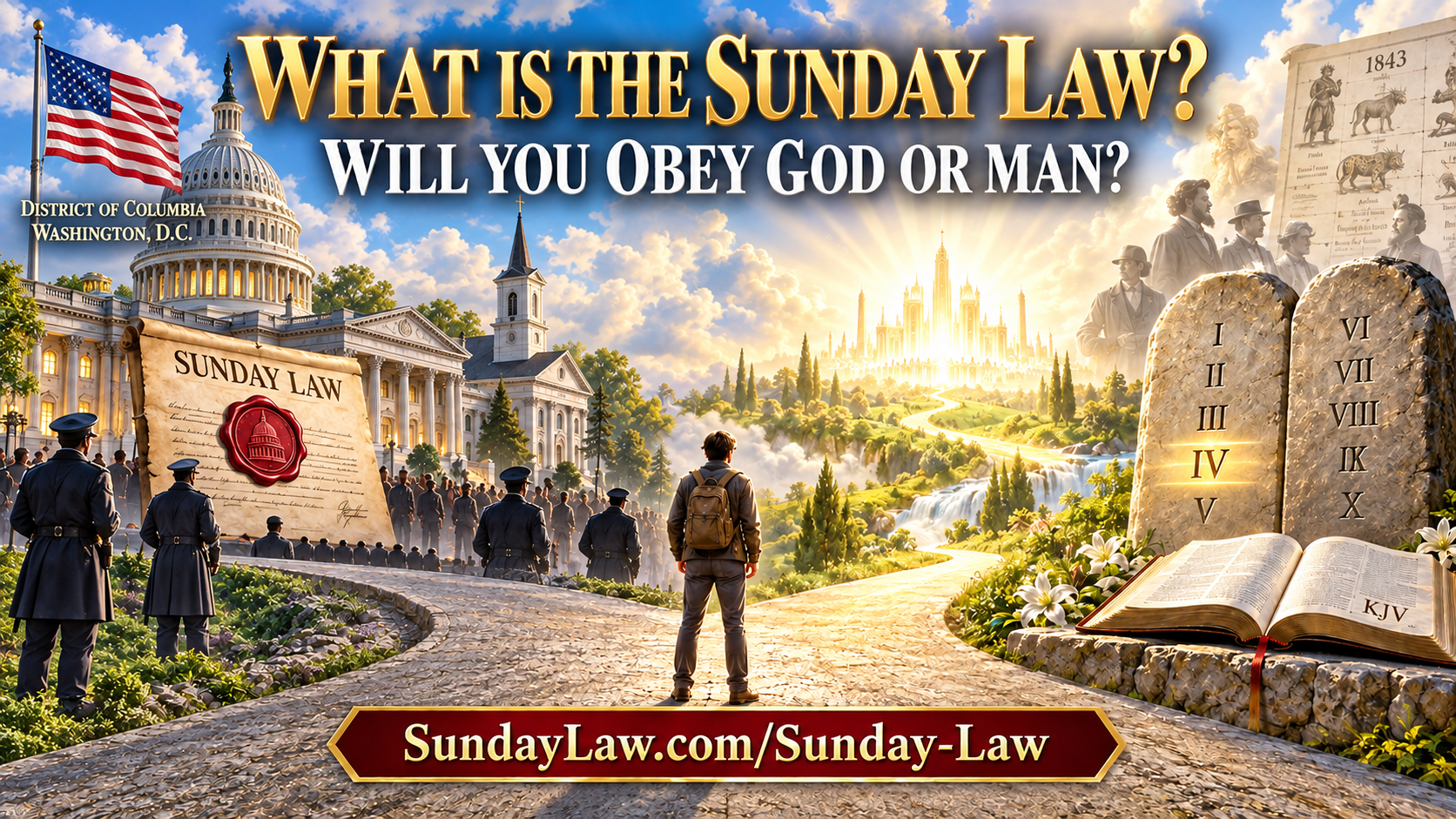
Choose Ye This Day Whom Ye Will Serve
Just as the antediluvians in Noah’s day had a choice to make, and Israel at Sinai had a choice to make, this same choice stands before every soul living today: will we obey God, or will we obey man? Will we keep the Kingdom of God’s perpetual, unchangeable Ten Commandment law (Exodus 20:8–11), or will we exchange it for the traditions and commandments of men? This is not a new question. It is the oldest question in the universe, and it is reaching its final, decisive hour.
“Choose you this day whom ye will serve... but as for me and my house, we will serve the LORD.”
“And ye shall know the truth, and the truth shall make you free.” ... “He that believeth on me, the works that I do shall he do also; and greater works than these shall he do.”
We already know who wins this battle in the end — Christ. The question is not the outcome; the question is whether you will be found on the winning side when the choice is finally made plain.
“For whoso findeth me findeth life, and shall obtain favour of the LORD. But he that sinneth against me wrongeth his own soul: all they that hate me love death.”
“If ye love me, keep my commandments.”
“He that saith, I know him, and keepeth not his commandments, is a liar, and the truth is not in him.”
“For this is the love of God, that we keep his commandments: and his commandments are not grievous.”
This Is Not a New Idea
The battle over worship between Christ and Satan has been fought for more than 6,000 years, and it began before this world was even created. When God the Father called His only begotten divine Son into counsel with Him, Lucifer—a covering cherub of high rank—grew jealous that he was not given that same place. His jealousy festered until it broke into outright rebellion in heaven, and that same rebellion against the government and law of God has continued on this earth ever since. The coming Sunday-law crisis is simply the final act of a conflict that is thousands of years old.
Are you on the Lord’s side?
The Reformation Was Never Completed
Just as a Protestant awakening swept multitudes between 1830 and 1850 to search the Scriptures for themselves and prepare for Christ’s return, that same urgency is needed again today. The Reformers broke real ground against Rome, but they stopped reforming before every inherited error was cleared away.
“The Reformation was never completed. The reformers stopped reforming. The Sabbath, the Sanctuary, the nature of man, and the non-immortality of the soul, are truths which the reformers did not reach. The last message of mercy is to complete the work of reform.”
“The greatest fault we can find in the Reformation is, the reformers stopped reforming. Had they gone on, and onward, till they had left the last vestige of Papacy behind, such as natural immortality, sprinkling, the trinity, and Sunday-keeping, the church would now be free from her unscriptural errors.”
The church age needs reformation now just as urgently as it did then. The call is the same: follow Christ whithersoever He leads (Revelation 14:4, KJV) — and He is now in the Most Holy Place of the heavenly sanctuary, ministering on our behalf. We are to follow Him there by faith.
The John the Baptist Movement — And the Command to Hold Fast
Do not let anyone dismiss the early Advent movement as the theological childhood of an immature denomination. Do not let polished professors pat the pioneers on the head and tell you that they were sincere — but ignorant.
Ellen White placed William Miller and those who joined him in the same line of sacred heralds as John the Baptist:
“As John the Baptist heralded the first advent of Jesus, and prepared the way for his coming, so also, Wm. Miller and those who joined him, proclaimed the second advent of Jesus.”
John the Baptist did not come to flatter Jerusalem. He did not come to polish the theology of the scribes. He did not ask the religious rulers whether truth was permitted to speak. He came crying:
“Prepare ye the way of the Lord, make his paths straight.”
So also came William Miller and those who joined him. They opened Daniel. They proclaimed the judgment hour. They awakened the sleeping churches. They called men and women to prepare for the Second Advent of Christ.
Charles Fitch joined that heralding movement. He did not enlist to manufacture another comfortable religious corporation. He lifted the second angel’s cry:
“Come out of her, my people.”
And after the disappointment, James White did not tell the scattered believers to crawl back into the churches from which they had come. He sounded the warning:
“The third angel’s message was, and still is, a WARNING to the saints to ‘hold fast,’ and not go back, and ‘receive’ the marks which the virgin band got rid of, during the second angel’s cry.”
The Dark Ages, the Beginning of the End, and the Advent Awakening
The prophetic timeline the pioneers themselves charted: 1,260 years of papal supremacy, its fall in 1798, and the Advent movement that rose to restore the commandments of God and the faith of Jesus between 1840 and 1850.
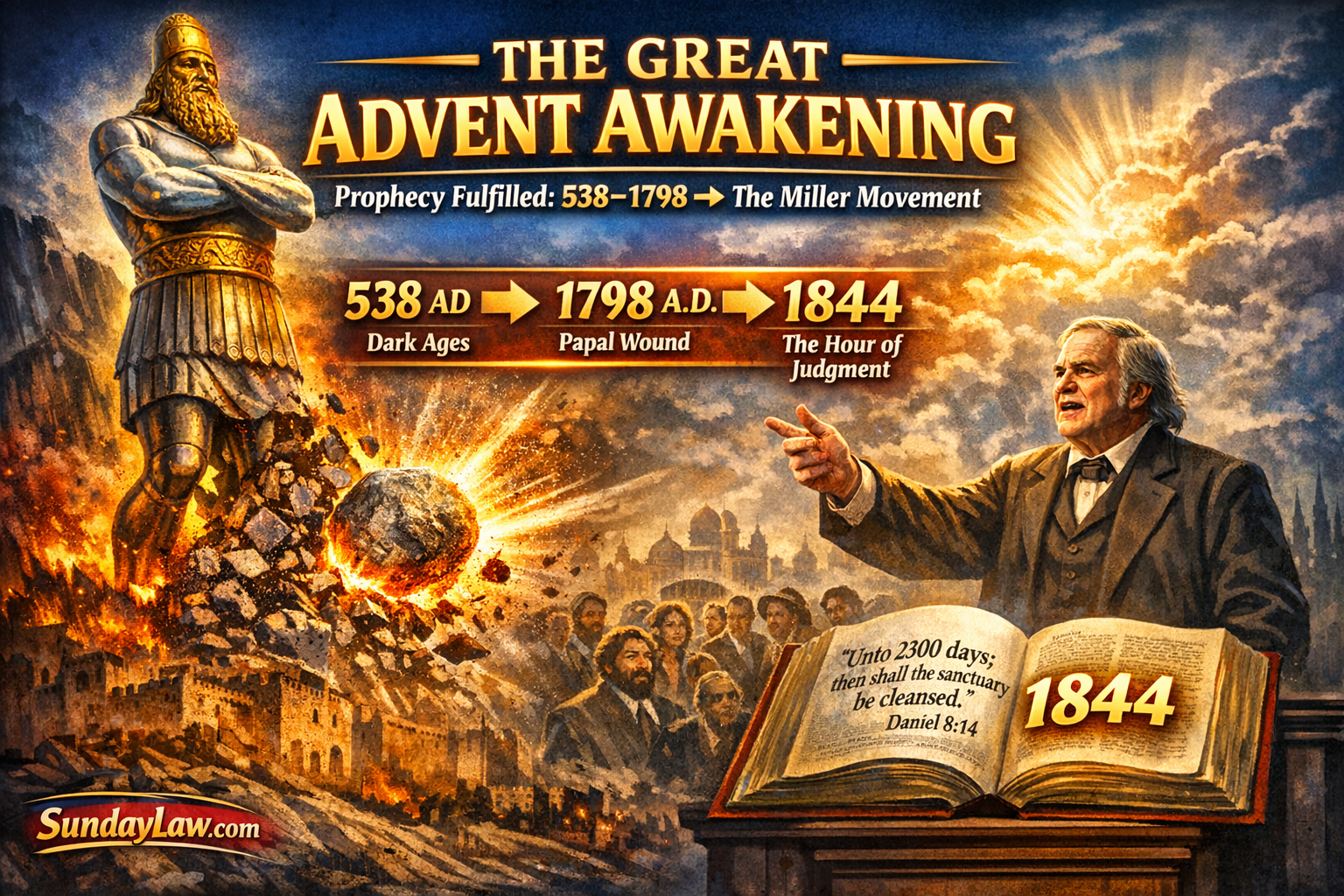
Papal Supremacy Begins
The 1,260 prophetic years of Daniel 7:25 and Revelation 13:5 begin.
The Deadly Wound
Napoleon’s general Berthier ends papal civil power — the prophesied “beginning of the end.”
The Advent Awakening
William Miller and the pioneers restore the commandments of God and the faith of Jesus.
The Final Test Approaches
The same urgency of 1830–1850 is needed again, now.
The 1843 and 1850 Prophecy Charts
“Write the vision, and make it plain upon tables, that he may run that readeth it” (Habakkuk 2:2–3, KJV). The pioneers took this literally — and made these charts.
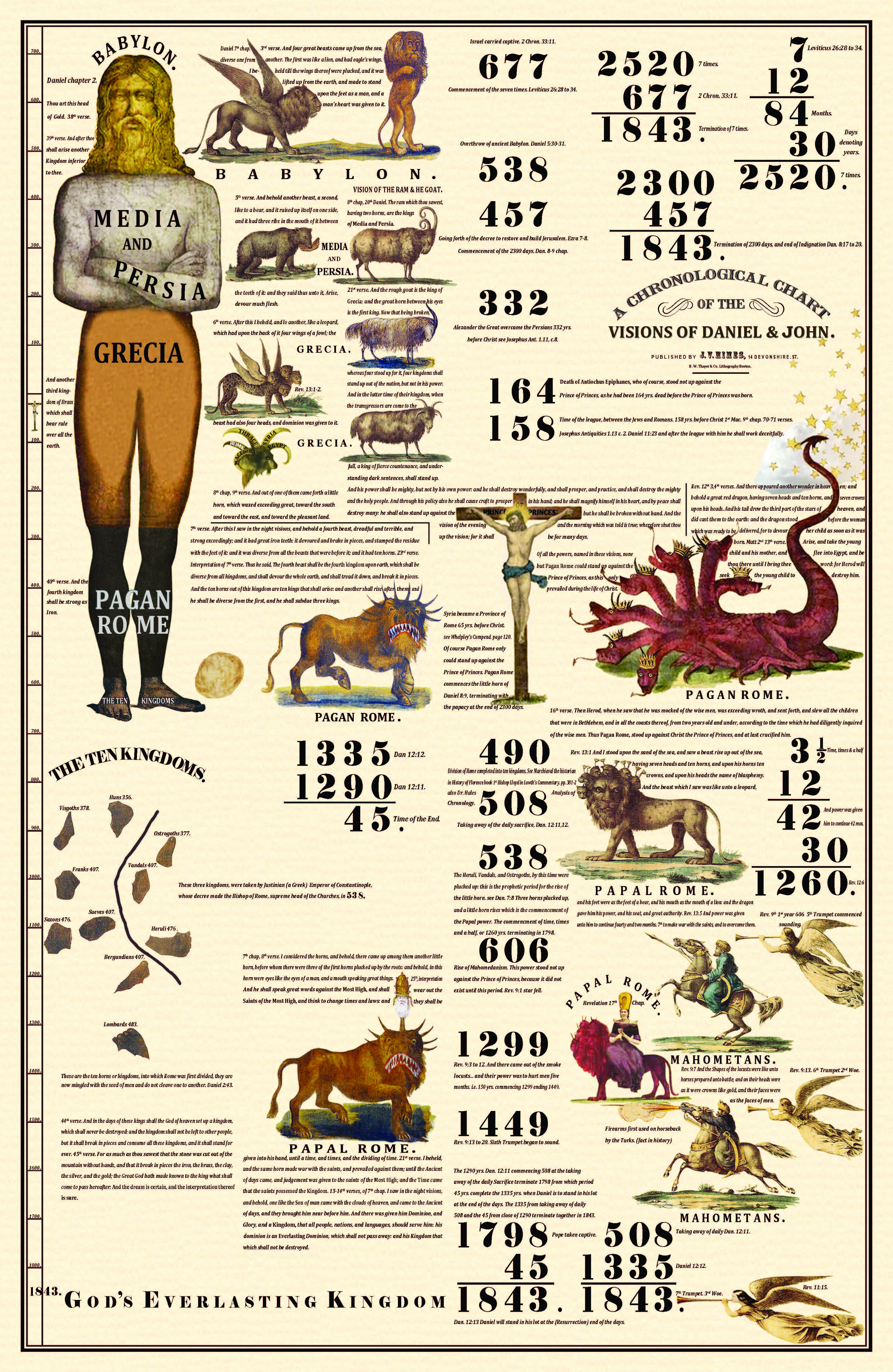
The chart that launched the Advent Awakening — drawn by Charles Fitch and Apollos Hale to make the 2,300-day prophecy and the soon coming of Christ plain to every reader.
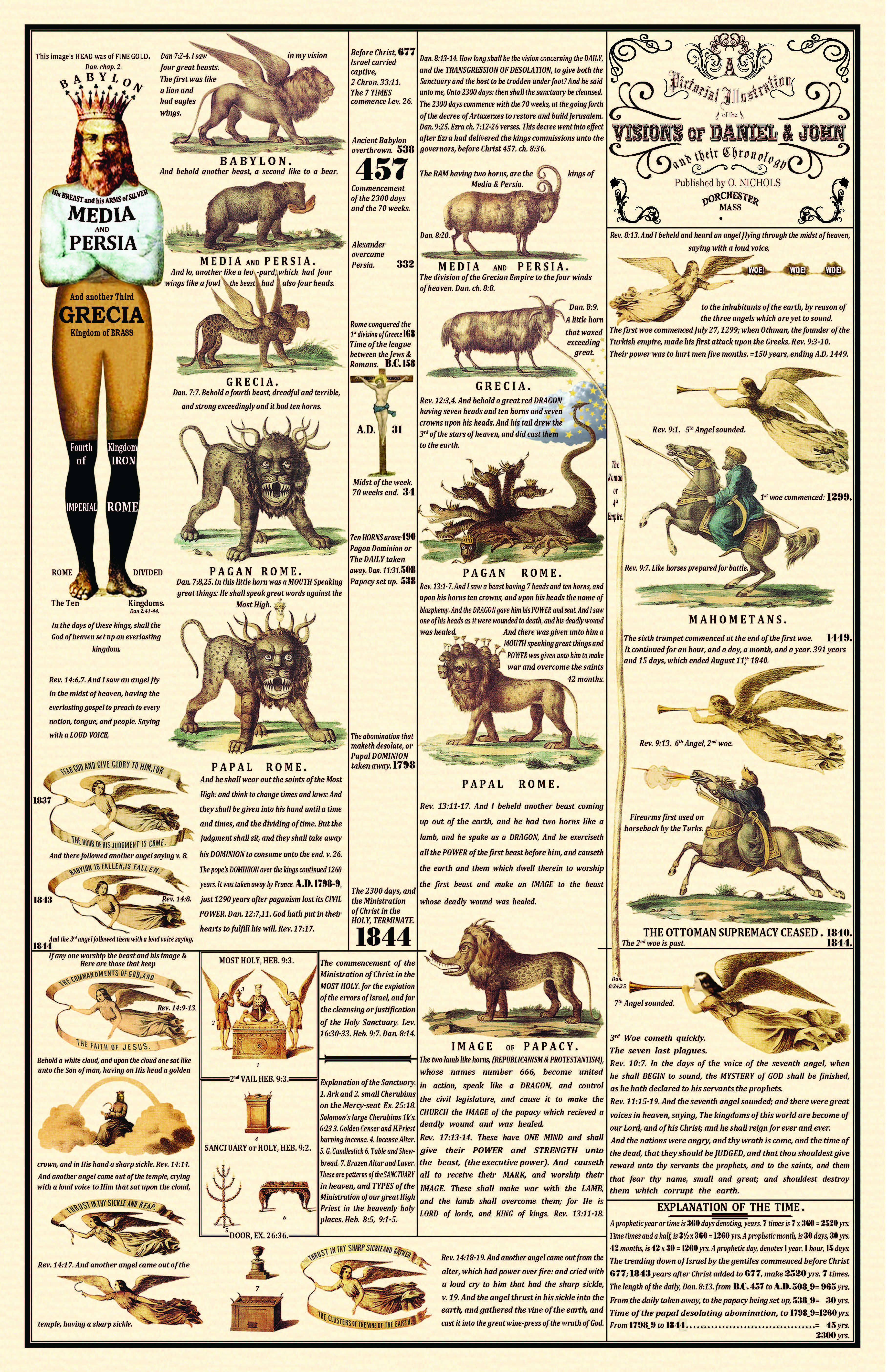
Made after the Great Disappointment of October 22, 1844, to present the heavenly sanctuary, the seventh-day Sabbath, and the Three Angels’ Messages to a scattered people. Ellen White testified this chart was “directed by the hand of the Lord.”
How William Miller Made the Prophetic Charts Tell a Story
Captain William Miller did not begin with complicated theological language. He opened the Bible, asked simple questions, and allowed one prophecy to explain another.
The Physician Who Came to Diagnose Miller
A physician had called Miller “a fine man and a good neighbor,” but also a monomaniac on the advent. Monomaniac is a dated nineteenth-century term for someone believed to be irrationally preoccupied with one subject while appearing rational on others.
When the doctor later visited Miller’s sick child, Miller invited him to test that accusation. He asked the doctor to sit with him for two hours, listen to the Bible evidence, and determine whether he was truly irrational. The doctor agreed and opened Daniel 8.
The Great Empires
The physician recognized the ram, goat, and succeeding powers as Persia, Greece, and Rome. The symbols were history written beforehand.
Prophetic Time
Asked whether those empires could last only 2,300 literal days, the doctor answered that prophetic days represented years.
The Starting Key
Gabriel returned to explain the earlier vision. The seventy weeks were cut from the longer period, giving the doctor the beginning point.
The Unexpected Result
The doctor performed the calculation himself. When it reached 1843, he left troubled, then returned because the evidence would not leave his mind.
“Mr. Miller calmed him, and pointed him to the ark of safety; and in about a week, calling each day on Mr. M., he found peace to his soul, and went on his way rejoicing, as great a monomaniac as Mr. Miller.”Sylvester Bliss, Memoirs of William Miller (1853), pp. 95–97
The physician had come to diagnose Miller. Instead, the Bible diagnosed him. What looked like obsession from outside became conviction when he followed the prophetic chain for himself. This is how the charts should be read: not as a wall of mysterious numbers, but as a visual walk through the same connected Bible evidence.
From the Image of the Kingdoms to the Stone and the Holy City
The 1843 chart announces the prophetic times. The 1850 chart carries the reader through the disappointment into the heavenly sanctuary, the Sabbath, and the Third Angel’s Message. The Law of God chart places the commandments and the seal at the center. Daniel 2 then shows where the whole conflict ends.
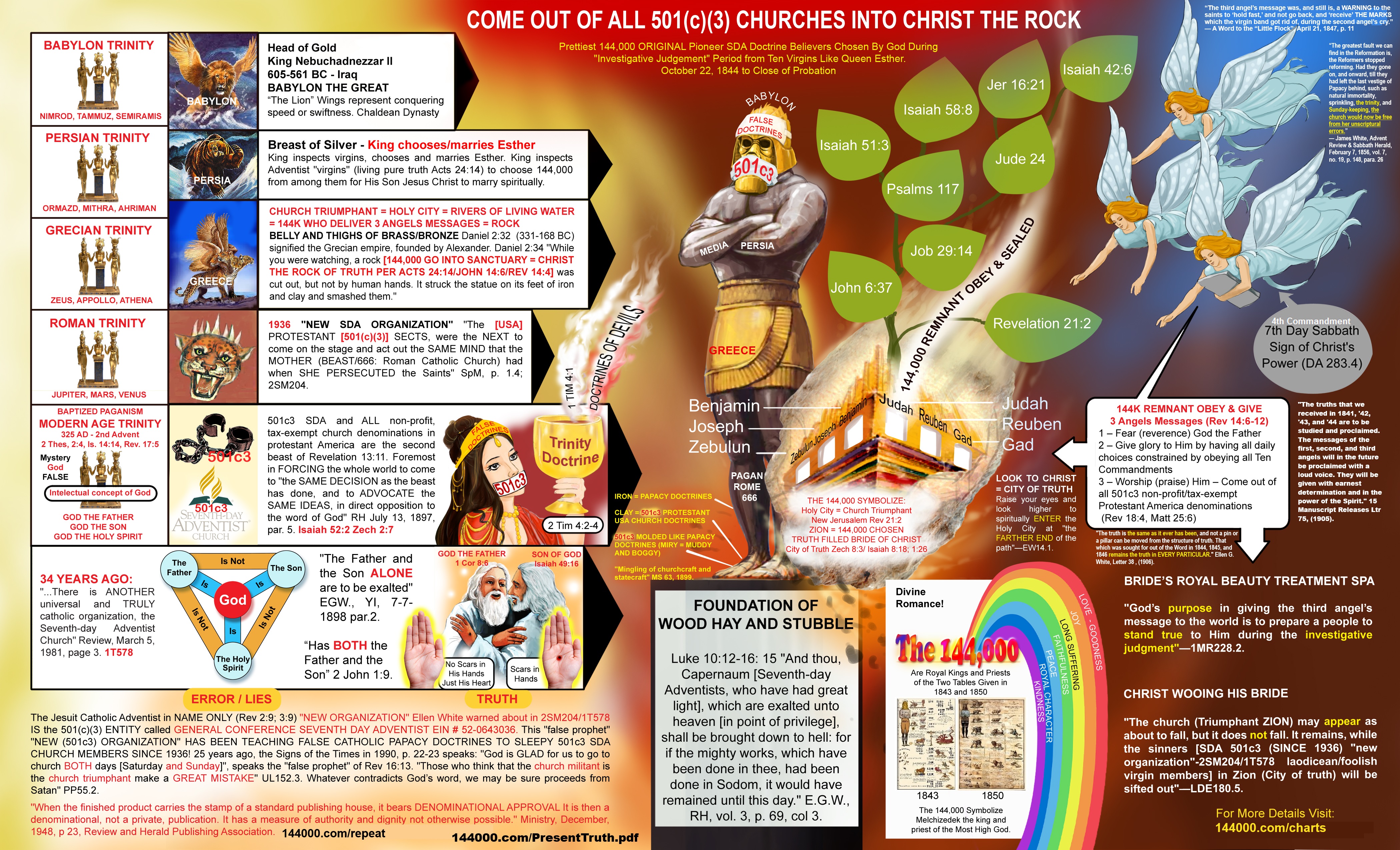
Look closely at the feet of the image and the stone approaching them. Use the controls, wheel, double-click, or drag to explore the full-resolution poster at up to 10× magnification.
“Thou sawest till that a stone was cut out without hands, which smote the image upon his feet... and the stone that smote the image became a great mountain, and filled the whole earth.... And in the days of these kings shall the God of heaven set up a kingdom, which shall never be destroyed.”
In the sanctuary-to-city reading presented here, the stone is the kingdom of Christ revealed in the prepared bridal city: the holy city, the celestial city, the New Jerusalem. Revelation shows the bride making herself ready (Revelation 19:7), then shows “the bride, the Lamb’s wife” as “that great city, the holy Jerusalem” descending from God (Revelation 21:2, 9–10). The people who follow the Lamb wherever He goes become living stones in that city through the righteousness and promises of Christ.
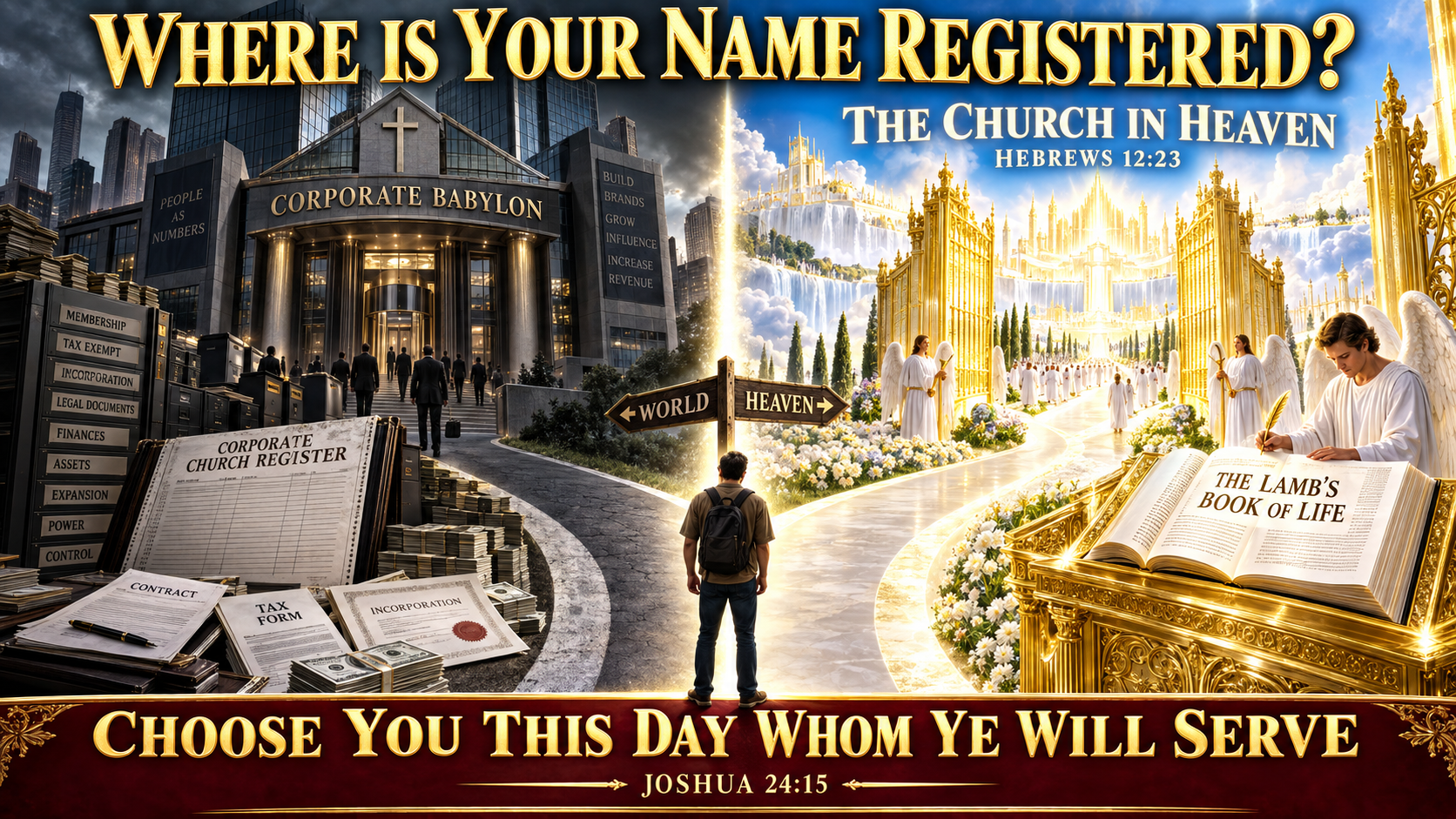
The question is not merely where a name appears on an earthly membership roll, but whether it is written in heaven among the church of the firstborn. Enlarge the image up to 10× and explore each side of the choice.
“But ye are come unto mount Sion, and unto the city of the living God, the heavenly Jerusalem, and to an innumerable company of angels, to the general assembly and church of the firstborn, which are written in heaven, and to God the Judge of all, and to the spirits of just men made perfect.”
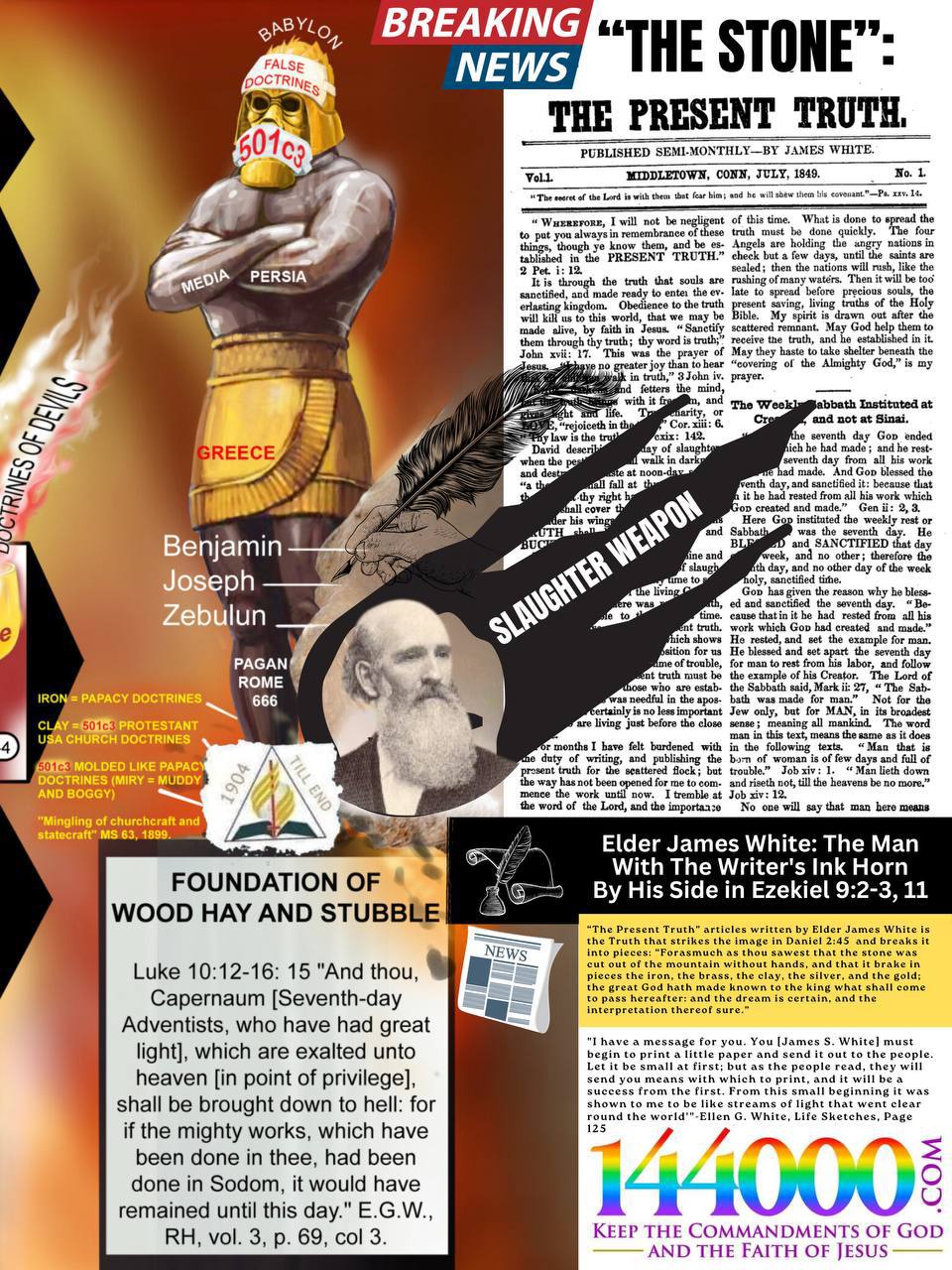
This companion image connects Daniel’s image, the Present Truth, the work of James White, and the warning imagery of Ezekiel 9.
As the Door of Noah’s Ark Closed, Probation Will Close
Noah’s warning message came to an end. The call to enter the ark of safety for that generation was rejected until the door was shut. In the same way, the final warning calls the world to follow Jesus Christ by faith into the Most Holy Place of the heavenly sanctuary. That warning will not continue forever; probation will close upon those who knowingly reject the final light.
“Behold, now is the accepted time; behold, now is the day of salvation.” (2 Corinthians 6:2, KJV.) Make your calling and election sure (2 Peter 1:10). Choose today to follow the Lamb “whithersoever he goeth” (Revelation 14:4).
Christ moved from the Holy Place into the Most Holy Place of the heavenly sanctuary. Those who follow Him there by faith, receive His law in their hearts, and claim His exceeding great and precious promises are prepared as the living bridal city, the New Jerusalem, “as a bride adorned for her husband” (Revelation 21:2).
The Five Questions That Matter Most
Answered in the order that moves from definition, to prophecy, to Sabbath history, to the mark of the beast, and finally to the personal decision.
What is a Sunday law?
The pioneers would answer that it is a civil law enforcing the first day of the week in place of the seventh day, which God alone blessed, sanctified, and commanded. James White called first-day observance a papal institution never sanctioned by Scripture; J. N. Andrews traced its rise through church and civil history; and Ellen White identified its enforcement as the final conflict between the commandments of God and the commandments of men (Genesis 2:2-3; Exodus 20:8-11; Revelation 13-14).
What is a national Sunday law?
The pioneers understood a national first-day law as the United States using civil power to enforce a religious institution nationwide. The 1888 Blair Sunday-Rest Bill showed that such legislation was not imaginary. In their reading of Revelation 13, this union of church influence and state power forms an image to the beast and brings the final test between God's seventh-day commandment and human authority.
Where is the Sunday law found in Bible prophecy?
The pioneers found it in the connected testimony of Daniel 7:25 and Revelation 13-14: a power thinks to change times and laws, civil authority compels worship and restricts buying and selling, and the Third Angel warns against the beast and his mark. Scripture calls the rival days the first day of the week and the seventh-day Sabbath; the controversy is over which authority a person obeys (Exodus 20:8-11; Revelation 14:9-12).
How does Revelation 13 identify the enforced day of worship?
Revelation 13 identifies the issue by authority, worship, compulsion, and the mark rather than by using later pagan day-names. The Bible calls the days the first day of the week and the seventh day. James White, Joseph Bates, J. N. Andrews, and Ellen White connected Revelation 13 with Daniel 7:25, the attempted change of God's law, and compulsory first-day observance against the seventh-day Sabbath and seal of the living God.
Did the Bible change the Sabbath from the seventh day to the first day?
The pioneers answered no. God blessed and sanctified the seventh day at Creation, wrote it in the Fourth Commandment, and never transferred that blessing to the first day. Joseph Bates and J. N. Andrews emphasized that Jesus and the apostles kept and taught on the Sabbath, while no KJV passage changes the commandment (Genesis 2:2-3; Exodus 20:8-11; Luke 4:16; Acts 13:42-44; 17:2).
“Hallow my sabbaths; and they shall be a sign between me and you, that ye may know that I am the LORD your God.”
“And he causeth all, both small and great, rich and poor, free and bond, to receive a mark... And that no man might buy or sell, save he that had the mark.”
The Law of God — Written in Stone
Written by God’s own finger. Kept in the ark beneath the mercy seat in the Most Holy Place. Unchanged. Unbroken. The Fourth Commandment is sealed — and it is the very commandment a Sunday law would set aside.
“They stand fast for ever and ever, and are done in truth and uprightness.”
“O how I love thy law! It is my meditation all the day.”
Psalm 119:97, KJV
“Blessed are they that keep his testimonies, and that seek him with the whole heart.”
Psalm 119:2, KJV
“Give me understanding, and I shall keep thy law; yea, I shall observe it with my whole heart. Make me to go in the path of thy commandments; for therein do I delight.”
Psalm 119:34–35, KJV
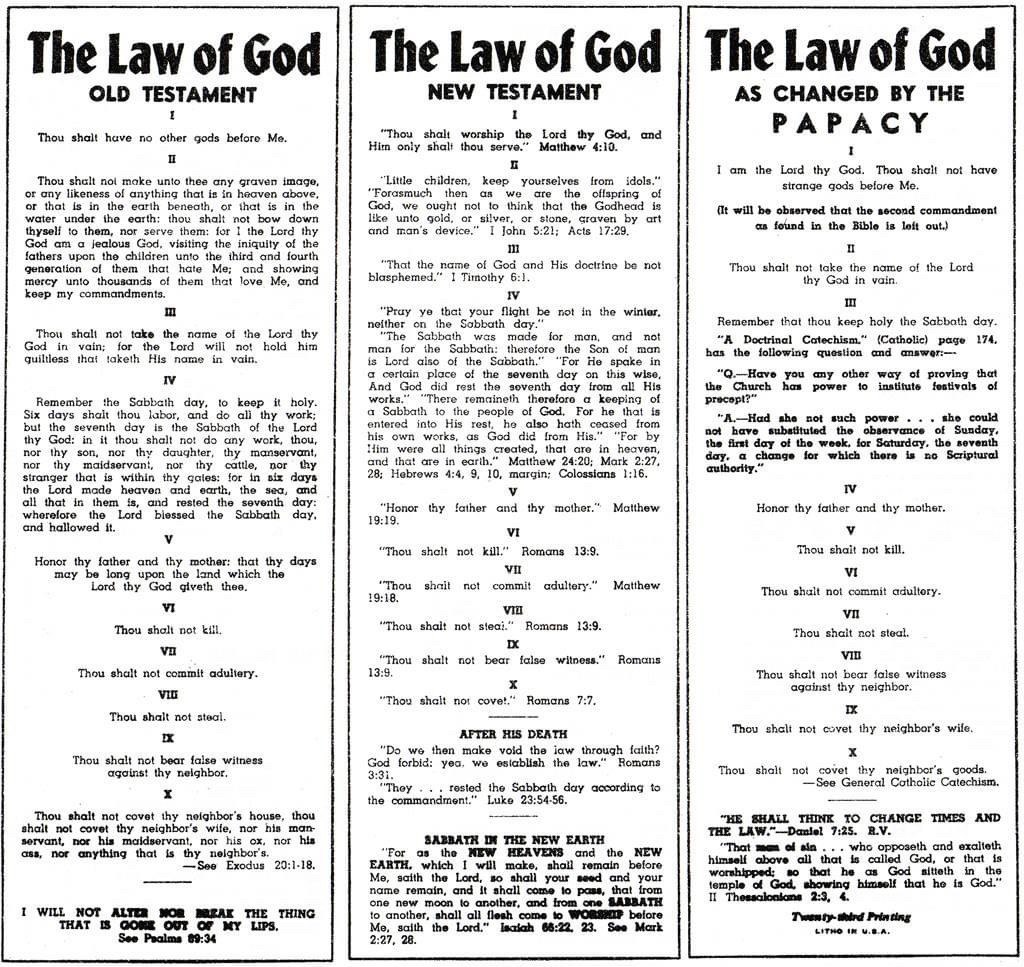
Enlarge, reduce, and move across the image with the controls, mouse wheel, touch gestures, or pointer drag.
Exodus 20:1–17
King James Version
The Ten Commandments Are Repeated in the New Testament
Jesus and the apostles uphold the commandments of God. The New Testament witness calls believers to worship God alone, flee idolatry, reverence His name, honor His Sabbath, honor parents, and reject murder, adultery, theft, false witness, and covetousness.
Abide. Keep His Commandments. Ask What Ye Will.
“If ye abide in me, and my words abide in you, ye shall ask what ye will, and it shall be done unto you. Herein is my Father glorified, that ye bear much fruit; so shall ye be my disciples. As the Father hath loved me, so have I loved you: continue ye in my love. If ye keep my commandments, ye shall abide in my love; even as I have kept my Father’s commandments, and abide in his love.”
The promise is conditional: Christ says to abide in Him, let His words abide in us, and keep His commandments. Within that abiding relationship He gives the promise, “ye shall ask what ye will, and it shall be done unto you.”
The law of God is a transcript of the character of God. How can man think to change the transcript of the character of God? Claim the promises of God for perfection of character by abiding in Christ and obeying His Word.
Out of Business-Corporation Churches and Into the Most Holy Place by Faith
God calls His people to come out of business-corporation churches and every religious system joined to worldly power. The call is not merely to leave an organization; it is to enter by faith where Christ ministers for us now: the Most Holy Place of the heavenly sanctuary.
Our Body Is the Sanctuary to Be Cleansed From Sin
The ark of the covenant is our body, with the Spirit of Christ writing the law of God upon our fleshy hearts. The sanctuary to be cleansed is our body cleansed from sin as we claim the exceeding great and precious promises of God and become partakers of the divine nature.
“Whereby are given unto us exceeding great and precious promises: that by these ye might be partakers of the divine nature, having escaped the corruption that is in the world through lust.”
“Having therefore these promises, dearly beloved, let us cleanse ourselves from all filthiness of the flesh and spirit, perfecting holiness in the fear of God.”
“And the LORD thy God will circumcise thine heart, and the heart of thy seed, to love the LORD thy God with all thine heart, and with all thy soul, that thou mayest live.”
“Now unto him that is able to keep you from falling, and to present you faultless before the presence of his glory with exceeding joy.”
“I can do all things through Christ which strengtheneth me.”Philippians 4:13, KJV
By the might, wisdom, and power of His Word, Jesus Christ works through the Holy Spirit to write the law of God upon our fleshy hearts. Abiding in Him, we can do anything His Word commands and claim the promises His Word gives.
The Guarantor of Unlimited Wishes and Miracles by Claiming and Obeying His Word
“Now unto the King eternal, immortal, invisible, the only wise God, be honour and glory for ever and ever. Amen.”
“And it shall be our righteousness, if we observe to do all these commandments before the LORD our God, as he hath commanded us.”
“In his days Judah shall be saved, and Israel shall dwell safely: and this is his name whereby he shall be called, THE LORD OUR RIGHTEOUSNESS.”See also Jeremiah 33:16; Jeremiah 51:10; Daniel 9:16
“The fourth commandment is the only one of all the ten in which are found both the name and the title of the Lawgiver. It is the only one that shows by whose authority the law is given. Thus it contains the seal of God, affixed to His law as evidence of its authenticity and binding force.”
“It shall be unto you a sabbath of rest, and ye shall afflict your souls: in the ninth day of the month at even, from even unto even, shall ye celebrate your sabbath.”The Bible measures the sacred day from evening to evening.

The Ten Commandments displayed as the Seal of the Living God — used by the Adventist pioneers to proclaim the hour of judgment. Use the + / − controls, scroll, or drag to explore every word up close.
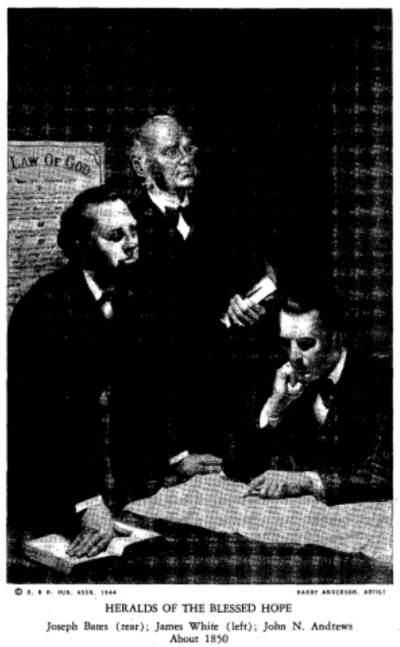
Joseph Bates, James White, and John Nevins Andrews — pioneer witnesses in the advancing light after 1844, standing before the very Law of God chart pictured above.
God Has a Purpose in Every Affliction
“Beloved, think it not strange concerning the fiery trial which is to try you, as though some strange thing happened unto you: but rejoice, inasmuch as ye are partakers of Christ’s sufferings; that, when his glory shall be revealed, ye may be glad also with exceeding joy.”
1 Peter 4:12–13; My Life Today, p. 93.1
“One evening a gentleman who was much depressed because of deep affliction was walking in a garden, where he observed a pomegranate tree nearly cut through the stem. Greatly wondering, he asked the gardener why the tree was in this condition, and he received an answer that explained to his satisfaction the wounds of his own bleeding heart. ‘Sir,’ said the gardener, ‘this tree used to shoot out so strong that it bore nothing but leaves. I was obliged to cut it in this manner; and when it was almost cut through, it began to bear fruit.’”
“Our sorrows do not spring out of the ground. In every affliction God has a purpose to work out for our good. Every blow that destroys an idol, every providence that weakens our hold upon earth and fastens our affections more firmly upon God, is a blessing. The pruning may be painful for a time, but afterward it ‘yieldeth the peaceable fruit of righteousness.’ We should receive with gratitude whatever will quicken the conscience, elevate the thoughts, and ennoble the life. The fruitless branches are cut off and cast into the fire. Let us be thankful that through painful pruning we may retain a connection with the living Vine; for if we suffer with Christ, we shall also reign with Him. The very trial that taxes our faith the most severely and makes it seem as though God had forsaken us is to lead us more closely to Him, that we may lay all our burdens at the feet of Christ and experience the peace which He will give us in exchange.... God loves and cares for the feeblest of His creatures, and we cannot dishonor Him more than by doubting His love to us. O let us cultivate that living faith that will trust Him in the hour of darkness and trial!”
What the Constitution Says — And What a Sunday Law Would Do
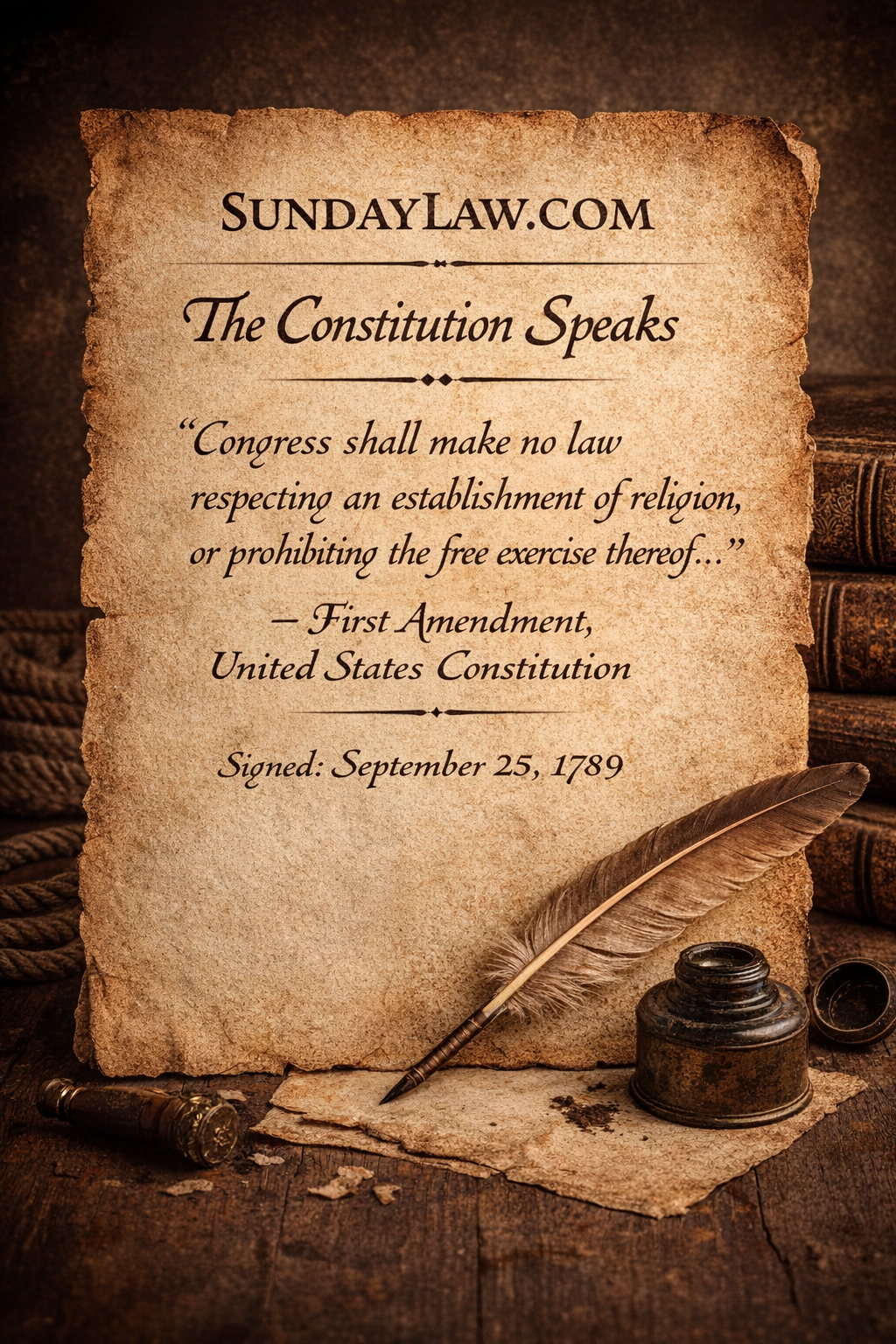
“Congress shall make no law respecting an establishment of religion, or prohibiting the free exercise thereof...”
No Congress was given authority to establish religion. No Congress was given authority to legislate sacred time or punish labor because a religious day is claimed holy by ecclesiastical authority. A national Sunday law enforcing religious observance would collide directly with this guarantee — the same collision historic Adventists warned about more than a century before it might arrive.
Two Organizations, Two Roads
First came the original Advent movement of 1840–1850 — the “Advent people,” “Advent believers,” “the waiting ones,” “the faithful, disappointed ones,” and the “little flock” — raised up under the first and second angels’ messages and purified through the Midnight Cry. October 22, 1844 was their Red Sea experience.
“The history of ancient Israel is a striking illustration of the past experience of the Adventist body. God led His people in the advent movement, even as He led the children of Israel from Egypt. In the great disappointment their faith was tested as was that of the Hebrews at the Red Sea. Had they still trusted to the guiding hand that had been with them in their past experience, they would have seen the salvation of God.”
“As John the Baptist heralded the first advent of Jesus, and prepared the way for His coming, so also, William Miller and those who joined with him, proclaimed the second advent of the Son of God.”
William Miller and those who united with him were not building a religious corporation — they were preparing the way of the Lord. The Third Angel’s Message today is not to go back and backslide into the false doctrines the 1840–1850 pioneers themselves came out of. Truth once established does not become error — it only grows brighter with each advance, even while the war against it continues.
Repeat the Words of the Pioneers
“Neither pray I for these alone, but for them also which shall believe on me through their word.”
“The truths that we received in 1841, ’42, ’43, and ’44 are now to be studied and proclaimed.”
“I saw that the nominal churches, as the Jews crucified Jesus, had crucified these messages, and therefore they have no knowledge of the move made in heaven, or of the way into the Most Holy, and they cannot be benefited by the intercession of Jesus there.”
Revelation 18:4’s Loud Cry repeats the second angel’s message “with the additional mention of the corruptions which have been entering the churches” since 1844. Among the documented corruptions: organizations presenting themselves as Protestant on official tax filings while presenting a more Catholic-friendly position in their own periodicals — see the Adventist World, November 2015, page 42 record.
Into the Most Holy Place, With the 144,000, Into the New Jerusalem
Since 1844, Christ ministers in the Most Holy Place of the heavenly sanctuary. We are to follow Him there by faith — keeping God’s commandments as the ark keeps them at the sanctuary’s center. This is the company sealed with the Sabbath, God’s sign, who follow the Lamb “whithersoever he goeth” (Revelation 14:4, KJV) into the bridal city, the New Jerusalem.
Read the Pioneers in Their Own Words
Books, charts, articles, and sermons by the keen, noble, and true early Seventh-day Adventist pioneers — asking and answering these very questions.
Every Soul Will Have Sufficient Light
Just as the antediluvians in Noah’s day had a choice to make, this same choice is before each one of us today. God will not condemn anyone merely because they unknowingly kept Sunday. The Sabbath truth must first be brought home to the person’s mind and conscience.
“There are many who have never had an opportunity to hear the special truths for this time... Everyone is to have sufficient light to make his decision intelligently.”
Millions Have Never Heard
Millions have never heard the truth about the coming Sunday law. But before the final choice, every soul will receive sufficient light to decide intelligently between the commandments of God and the laws of men. No one receives God’s wrath until the truth has reached the conscience and been rejected.
Frequently Asked Questions
Who changed the Sabbath to Sunday?
J. N. Andrews answered this from the historical record: no prophet, apostle, or command of God changed the Sabbath. First-day observance grew after the apostles and received civil enforcement under Constantine in A.D. 321. James White therefore described it as a papal institution without Scriptural sanction. Andrews' History of the Sabbath and First Day of the Week traces the evidence in detail.
Is Sunday the Sabbath?
The pioneers answered no: Scripture identifies the Sabbath as the seventh day, while the other day is called the first day of the week. God's names and numbering govern the question, not later pagan names. Joseph Bates called the seventh-day Sabbath a perpetual sign, and Andrews showed that its blessing was never transferred (Genesis 2:2-3; Exodus 20:8-11; Isaiah 58:13-14; Hebrews 4:4, 9-11).
Is Sunday worship the mark of the beast?
Ellen White taught that first-day observance becomes the mark in the final test when civil power enforces it against God's revealed seventh-day commandment and the choice is made intelligently. The pioneers did not place the mark upon people acting without light; the issue is compelled worship and a knowing choice between the commandment of men and the commandment of God (Revelation 13:15-17; 14:9-12; Acts 5:29).
What is the seal of God, and how is it different from the mark of the beast?
Joseph Bates presented the seventh-day Sabbath as the seal of the living God because the Fourth Commandment names the Lawgiver, His title as Creator, and His dominion. Ellen White likewise called the Sabbath the sign of allegiance to the Creator. The mark represents the opposite allegiance: knowingly accepting the beast's authority and enforced first-day worship in place of God's command (Ezekiel 20:20; Revelation 7:1-3; 14:9-12).
Will America pass a national Sunday law?
Historic Adventists understood the lamb-like beast of Revelation 13:11 as the United States. Its transformation from lamb-like principles to dragon-like enforcement occurs when religious authority employs civil government to compel worship. The preparation Scripture calls for is not panic or date-setting — it is repentance, faith in Christ, obedience to God, knowledge of Scripture, and a settled character that cannot be bought or intimidated (Revelation 13:11-17; Acts 5:29; John 15:7-10).
What was the Blair Sunday-Rest Bill?
The Blair Sunday-Rest Bill (Senate Bill S.2983, 1888) was a real 19th-century attempt in the United States Congress to enact national Sunday-rest legislation. Read the original bill text below — it is the historical proof that this is not a hypothetical scenario invented by Adventist writers, but a documented congressional effort.
What does the First Amendment say about a Sunday law?
The First Amendment states: "Congress shall make no law respecting an establishment of religion, or prohibiting the free exercise thereof." A national Sunday law enforcing religious observance would place civil government in direct tension with that constitutional guarantee of liberty of conscience — the same collision historic Adventists warned about a century before it might arrive.
How should Christians prepare for a coming Sunday law?
Not with panic, political maneuvering, or date-setting, but with an intelligent, settled decision made now: repentance, faith in Christ, obedience to His commandments, and a character built on knowledge of Scripture rather than convenience (John 14:15; Hebrews 10:16; Jude 24).
What did the 1843 and 1850 prophecy charts have to do with the Sabbath and the Sunday law?
The 1843 chart (Charles Fitch and Apollos Hale) and 1850 chart (Otis Nichols, under Ellen White’s direction) visually presented the sanctuary, the 2,300-day prophecy, and the commandments of God so that "he may run that readeth it" (Habakkuk 2:2-3). These charts are the visual seed of the very message that identifies the coming Sunday law as the final test.
When did the "beginning of the end" start, according to Adventist prophecy?
Historic Adventists point to A.D. 1798 — the end of the 1260-year prophetic period of Daniel 7:25 and Revelation 13:5, and the year the Papacy’s civil power was broken by Napoleon’s general Berthier. This is understood as the start of the "time of the end" (Daniel 12:4) that leads directly into the Advent awakening of 1840-1850 and forward to today.
What is the connection between William Miller, the Midnight Cry, and the Sunday law message?
William Miller and those who joined him were "preparing the way of the Lord" exactly as John the Baptist did for Christ’s first advent (Early Writings, p. 229.1). The disappointment of October 22, 1844 purified and prepared a people who then received the sanctuary truth, the Sabbath, and the Third Angel’s Message — the very message that identifies the final Sunday-law test.
What are the Three Angels’ Messages, and how do they relate to the Sunday law?
Revelation 14:6-12 presents three angels: the everlasting gospel and the call to worship the Creator; the fall of Babylon; and a warning against worshiping the beast or receiving his mark, followed immediately by the description of those who "keep the commandments of God, and the faith of Jesus." The coming Sunday law is understood as the enforcement mechanism that finally separates these two groups.
What does Revelation 18:4 mean by "come out of her, my people"?
Revelation 18:4 is the Loud Cry — an amplification of the second angel’s message of Revelation 14:8, adding "the additional mention of the corruptions which have been entering the churches" since 1844. It is a call to leave religious systems that have compromised with the world and the state, and to stand instead on the platform of truth restored in 1840-1850.
Is the modern Seventh-day Adventist denomination the same as the original 1840-1850 Advent movement?
Historic students of this record distinguish between the original Advent people of 1840-1850 — gathered under the first and second angels’ messages and purified through the Midnight Cry — and the later corporate organization. Ellen White herself compared the Advent movement’s experience to Israel’s exodus, warning that "had they still trusted to the guiding hand that had been with them in their past experience, they would have seen the salvation of God" (The Great Controversy, p. 457.1).
What corruptions does Revelation 18:4 warn about entering the churches since 1844?
Historical examples documented on this site include organizations claiming Protestant status on official tax filings while presenting a different, more Catholic-friendly position in their own periodicals — see the documented Adventist World, November 2015, page 42 record. Compare with the doctrinal drift discussed on the Sonship and "If" study pages linked below.
What does it mean to "repeat the words of the pioneers"?
Ellen White repeatedly instructed believers to reproduce and study what the 1840-1850 pioneers wrote, rather than replace it with later summaries: "The truths that we received in 1841, ’42, ’43, and ’44 are now to be studied and proclaimed" (Manuscript Releases, vol. 15, Letter 75, 1905). Jesus’ own prayer in John 17 asks the Father on behalf of those who would "believe on me through their word" (John 17:20, KJV) — the same principle of trusting the original witnesses applies to the pioneer record.
Has the Third Angel’s Message ever been suppressed?
Ellen White wrote in 1858 that "the nominal churches, as the Jews crucified Jesus, had crucified these messages" (Spiritual Gifts, vol. 1, 1858, chapter 34) — describing how the very message identifying the Sabbath, the sanctuary, and the coming crisis has historically been rejected or set aside, even within professed Adventism.
What is the heavenly sanctuary, and why does it matter for the Sunday-law question?
Since 1844, Christ ministers in the Most Holy Place of the heavenly sanctuary (Hebrews 8-9). Historic Adventists taught that believers must follow Him there by faith, keeping God’s commandments as the sanctuary’s ark keeps the Ten Commandments at its center — the same commandments a future Sunday law would require every person to set aside.
Who are the 144,000 and how do they relate to the seal of God?
Revelation 7 and 14 describe a sealed company who "keep the commandments of God, and the faith of Jesus" and follow the Lamb "whithersoever he goeth" (Revelation 14:4, KJV). Their identity is tied directly to the Sabbath as God’s seal (Ezekiel 20:20) — the same sign a national Sunday law would attempt to override.
What is the New Jerusalem, and why is it connected to this study?
The New Jerusalem is described in Revelation 21-22 as the bridal city prepared for those who overcome. William Miller’s dream pictured recovered Bible truths as jewels gathered and placed safely in a treasure chest — a picture of the very truths, including the Sabbath and the sanctuary, that lead by faith into that city.
What happens to those who have never heard the Sabbath truth?
Ellen White wrote plainly: "There are many who have never had an opportunity to hear the special truths for this time... Everyone is to have sufficient light to make his decision intelligently" (The Great Controversy, p. 605.1, 1911 edition). No one is condemned for unknowingly keeping Sunday. The final issue is not ignorance — it is the intelligent choice made after sufficient light has reached the conscience.
Is there a free PDF explaining the Sunday law from a historic Adventist perspective?
Yes — this page links directly to primary-source PDFs including the original 1843 and 1850 prophecy charts, their keys of explanation, the 1888 Blair Sunday-Rest Bill text, and Ellen White’s and James White’s original writings on the sanctuary, the Sabbath, and the Third Angel’s Message.