October 22, 1844, the Red Sea crossing of the Advent movement according to Ellen White
October 22, 1844

The Red Sea of the Advent Movement

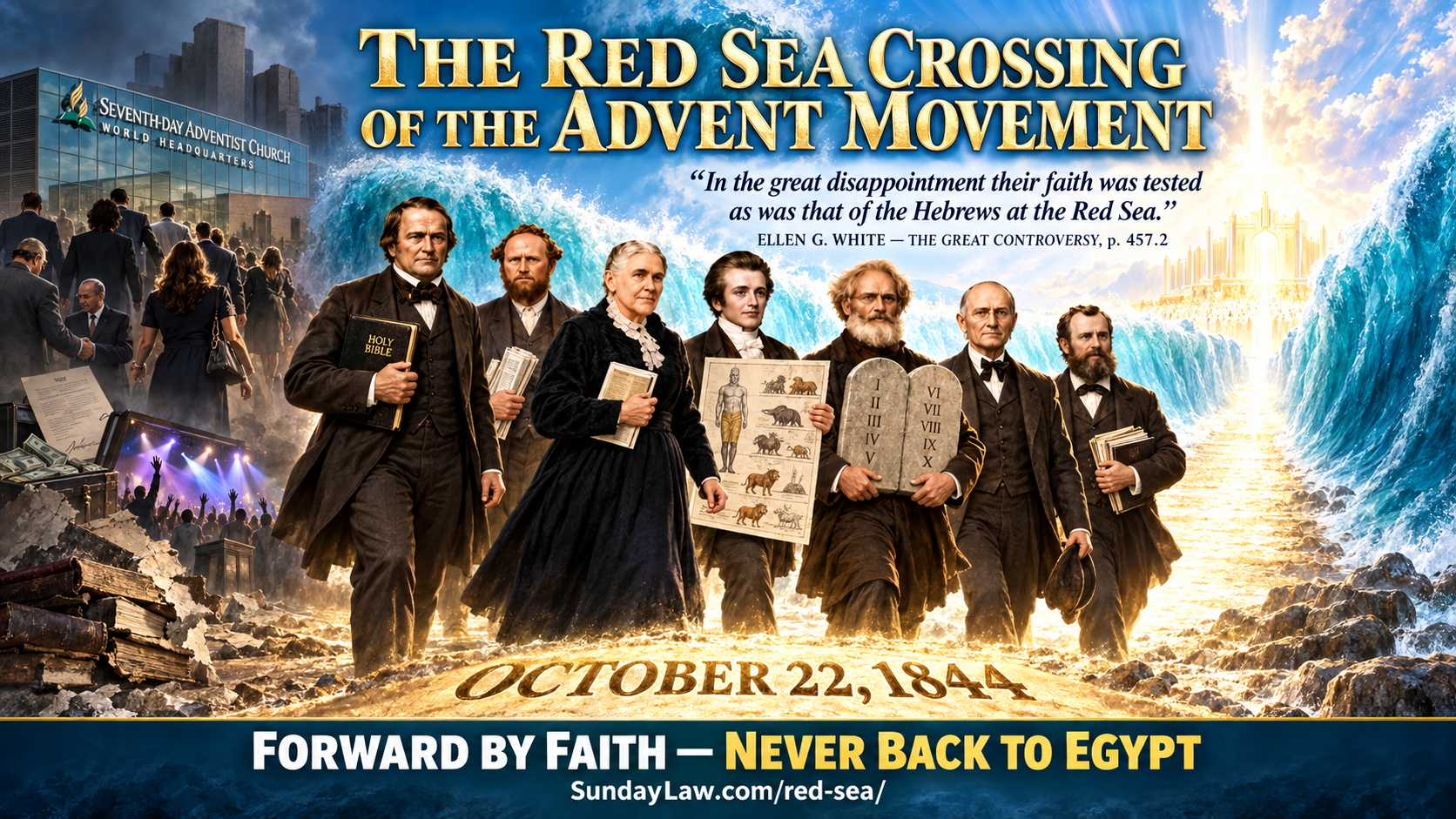
Ellen G. White placed the Advent movement inside the Exodus story. The believers came out under the power of prophecy, stood before the Red Sea on October 22, 1844, and then received the sanctuary light that opened Christ’s work in heaven. Their own journals, sermons, papers, and testimonies carry the heat of that passage.

“The history of ancient Israel is a striking illustration of the past experience of the Adventist body. God led His people in the advent movement, even as He led the children of Israel from Egypt. In the great disappointment their faith was tested as was that of the Hebrews at the Red Sea.”
— Ellen G. White, The Great Controversy, p. 457
The prophetic pattern

Egypt to the Red Sea to the heavenly sanctuary

The same pattern appears across the biblical story: God calls His people out of bondage, leads them through a crisis, and then reveals the true path beyond the apparent obstacle. The Advent movement followed this pattern in its own way.

01

Egypt

Israel was called out of slavery. The Advent people were called out from churches that rejected the light of the Second Advent message.

“Opposition was waxing stronger, and the battle was increasing.”
James White, The Present Truth account of the paper’s beginning

In the Protestant churches of 1843 and 1844, the Advent proclamation met a settled religious order. The pulpits that should have received the warning rejected the light; the people who received it came out and followed the message into the wilderness.

02

Exodus

God led the people through prophecy, the midnight cry, and the deep conviction that Christ was near.

03

Red Sea

October 22, 1844, became the moment of apparent dead end. The people faced the same question Israel faced at the sea: will we trust God’s leading?

04

Wilderness

Unbelief entered the camp, and the wilderness years followed. Ellen White described the delay as the fruit of a people who refused to enter Canaan by faith.

05

Restoration

The path forward led through faith in Christ’s heavenly ministry, the sanctuary, and the final warning.

The wilderness warning

Unbelief lengthened the wilderness journey

“It was not the will of God that Israel should wander forty years in the wilderness; He desired to lead them directly to the land of Canaan and establish them there, a holy, happy people. But ‘they could not enter in because of unbelief.’ In like manner, it was not the will of God that the coming of Christ should be so long delayed and His people should remain so many years in this world of sin and sorrow. But unbelief separated them from God.”
— Ellen G. White, The Great Controversy, pp. 457–458

The Red Sea comparison carries a living warning. God leads His people to the edge of impossible waters, then calls them to trust His word. The Advent believers faced that test in 1844. The sanctuary opened the next stage of Christ’s work and gave the scattered flock a path beneath their feet.

The key to the mystery

The sanctuary opened the Protestant path forward

“The subject of the sanctuary was the key which unlocked the mystery of the disappointment of 1844. It opened to view a complete system of truth, connected and harmonious, showing that God’s hand had directed the great advent movement and revealing present duty as it brought to light the position and work of His people.”
— Ellen G. White, The Great Controversy, p. 423

Here the Advent movement stands in the Protestant succession. Luther opened the Bible against the authority of Rome. In 1843 and 1844, the Advent pioneers opened the sanctuary against the authority of inherited error in the Protestant churches of the day. James White lifted the press, Joseph Bates lifted the Sabbath, Charles Fitch lifted the cry, and Ellen White bore witness to the living light. Their appeal was the old Protestant appeal: To the law and to the testimony.

John the Baptist stood in the wilderness crying, “Prepare ye the way of the Lord.” The Advent heralds stood in the prophetic wilderness crying, “The hour of his judgment is come.” Both calls demanded separation from dead tradition, repentance before God, and a people ready to follow the Lamb wherever He leads.

The Red Sea brought the people to a deeper understanding. The sanctuary revealed the heavenly reality: Christ ministers as High Priest, the judgment proceeds before the Ancient of Days, and the prophetic movement stands beneath the direction of God’s hand.

“The Lord shew me in vision, more than one year ago, that Brother Crosier had the true light, on the cleansing of the Sanctuary, &c. I feel fully authorized by the Lord, to recommend that Extra, to every saint.”
Ellen G. White, A Word to the Little Flock (1847), referring to O. R. L. Crosier’s Day-Star Extra
Hosea 6:2 and the 31 AD chart

After two days: living in His sight

Hosea gives the Advent people a time-bearing promise. The prophet joins healing, resurrection, knowledge of the Lord, and the third-day appearing. The 31 AD line on the pioneer chart marks the death, resurrection, and ascension of Christ. From that foundation the two days reach across two thousand prophetic years, and the third day opens the promised life in His sight.

“Come, and let us return unto the LORD: for he hath torn, and he will heal us; he hath smitten, and he will bind us up. After two days will he revive us: in the third day he will raise us up, and we shall live in his sight. Then shall we know, if we follow on to know the LORD: his going forth is prepared as the morning; and he shall come unto us as the rain, as the latter and former rain unto the earth.”
Hosea 6:1–3 (KJV)

The chart line

31 AD + 2,000 years = approximately 2031. This is the prophetic reading presented in the chart study: two days represent two thousand years, followed by the third-day promise, “we shall live in his sight.”

Read the full Hosea chart explanation, including the 31 AD crucifixion line and the 2,000-year calculation.

The inner court and the Most Holy Place

Esther entered the inner court and touched the golden sceptre. In the heavenly sanctuary, the final work of Christ is before the throne, in the Most Holy Place. Faith follows the High Priest into the presence of God, beyond the wilderness of expectation and into the living ministry of the New Jerusalem sanctuary.

The golden sceptre speaks of mercy at the throne. The sanctuary speaks of the Priest who ministers there. Together they call for a prepared people to draw near by faith.

2 Peter 3:8 (KJV) — “But, beloved, be not ignorant of this one thing, that one day is with the Lord as a thousand years, and a thousand years as one day.”

Genesis 22:4 (KJV) — “Then on the third day Abraham lifted up his eyes, and saw the place afar off.”

Genesis 42:18 (KJV) — “And Joseph said unto them the third day, This do, and live; for I fear God:”

Joshua 1:11 (KJV) — “Pass through the host, and command the people, saying, Prepare you victuals; for within three days ye shall pass over this Jordan, to go in to possess the land, which the LORD your God giveth you to possess.”

Jonah 1:17 (KJV) — “Now the LORD had prepared a great fish to swallow up Jonah. And Jonah was in the belly of the fish three days and three nights.”

Esther 5:1–2 (KJV) — “Now it came to pass on the third day, that Esther put on her royal apparel, and stood in the inner court of the king’s house, over against the king’s house: and the king sat upon his royal throne in the royal house, over against the gate of the house. And it was so, when the king saw Esther the queen standing in the court, that she obtained favour in his sight: and the king held out to Esther the golden sceptre that was in his hand. So Esther drew near, and touched the top of the sceptre.”

Exodus 19:11 (KJV) — “And be ready against the third day: for the third day the LORD will come down in the sight of all the people upon mount Sinai.”

Matthew 16:21 (KJV) — “From that time forth began Jesus to shew unto his disciples, how that he must go unto Jerusalem, and suffer many things of the elders and chief priests and scribes, and be killed, and be raised again the third day.”

Matthew 12:40 (KJV) — “For as Jonas was three days and three nights in the whale’s belly; so shall the Son of man be three days and three nights in the heart of the earth.”

John 2:19, 21 (KJV) — “Jesus answered and said unto them, Destroy this temple, and in three days I will raise it up.” “But he spake of the temple of his body.”

2 Kings 20:5 (KJV) — “Thus saith the LORD, the God of David thy father, I have heard thy prayer, I have seen thy tears: behold, I will heal thee: on the third day thou shalt go up unto the house of the LORD.”

Luke 13:32–33 (KJV) — “Behold, I cast out devils, and I do cures to day and to morrow, and the third day I shall be perfected. Nevertheless I must walk to day, and to morrow, and the day following: for it cannot be that a prophet perish out of Jerusalem.”

Luke 24:46 (KJV) — “Thus it is written, and thus it behoved Christ to suffer, and to rise from the dead the third day:”

1 Corinthians 15:4 (KJV) — “And that he was buried, and that he rose again the third day according to the scriptures:”

Luke 24:7 (KJV) — “Saying, The Son of man must be delivered into the hands of sinful men, and be crucified, and the third day rise again.”

Luke 24:21 (KJV) — “But we trusted that it had been he which should have redeemed Israel: and beside all this, to day is the third day since these things were done.”

Luke 18:33 (KJV) — “And they shall scourge him, and put him to death: and the third day he shall rise again.”

Mark 9:31 (KJV) — “For he taught his disciples, and said unto them, The Son of man is delivered into the hands of men, and they shall kill him; and after that he is killed, he shall rise the third day.”

Mark 10:34 (KJV) — “And they shall mock him, and shall scourge him, and shall spit upon him, and shall kill him: and the third day he shall rise again.”

Ezra 8:32 (KJV) — “And we came to Jerusalem, and abode there three days.”

Nehemiah 2:11 (KJV) — “So I came to Jerusalem, and was there three days.”

Matthew 17:23 (KJV) — “And they shall kill him, and the third day he shall be raised again. And they were exceeding sorry.”

Matthew 20:19 (KJV) — “And shall deliver him to the Gentiles to mock, and to scourge, and to crucify him: and the third day he shall rise again.”
Crosier and the New Jerusalem

The Most Holy Place belongs to the New Jerusalem sanctuary

“The Sanctuary of the new covenant is connected with New Jerusalem, like the Sanctuary of the first covenant was with Old Jerusalem. As that was the place where the priests of that covenant ministered, so this is in heaven, the place where the Priest of the new covenant ministers.”
O. R. L. Crosier, The Law of Moses, Day-Star Extra, February 7, 1846

Crosier’s argument gives the sanctuary a city and a throne. Old Jerusalem held the earthly sanctuary, its courts, its priests, and its appointed services. New Jerusalem holds the heavenly sanctuary of the better covenant, where Christ ministers as Priest. The Most Holy Place is therefore the inner chamber of the heavenly order, before the presence of God, where the final work of judgment and atonement proceeds.

This is the land of Canaan toward which the Advent people travel. Jordan stands before us. The chart gives the line. Hosea gives the promise. The sanctuary gives the Priest. Faith crosses over by following Christ into the Most Holy Place, toward the New Jerusalem and the kingdom that cannot be moved.

The bridegroom and the Most Holy Place

The Advent movement followed Christ into the sanctuary

The Exodus opened into a bridal procession. The sanctuary, bridal, and judgment themes belong together. The movement followed Christ into the closing phase of His ministry while the people of God prepared for the marriage supper of the Lamb.

Matthew 25:1-13 — the wise virgins and the bridegroom.

Daniel 7:9-14 — Christ approaching the Ancient of Days.

Malachi 3:1-3 — the Messenger coming to His temple.

Revelation 19:7-9 — the marriage of the Lamb.

Revelation 14:4 — “These are they which follow the Lamb whithersoever he goeth.”

The pioneers joined the call to come out of Babylon with the call to follow the Lamb. Charles Fitch preached the message from Revelation 18:4, and the early Advent people carried that cry from the churches into the sanctuary light.

“And I heard another voice from heaven, saying, Come out of her, my people, that ye be not partakers of her sins, and that ye receive not of her plagues.”
Revelation 18:4 (KJV), the text of Charles Fitch’s 1843 sermon Come Out of Her, My People
Esther and the golden sceptre

Purification, acceptance, and the King’s favour

Esther gives a vivid picture of preparation, approach, and royal acceptance. Her people stood under sentence, and Esther carried their cause before the king. The golden sceptre became the sign of life and favour extended to the one who came in faith.

Esther 4:11 (KJV) — “Whosoever, whether man or woman, shall come unto the king into the inner court, who is not called, there is one law of his to put him to death, except such to whom the king shall hold out the golden sceptre, that he may live: but I have not been called to come in unto the king these thirty days.”

Esther 5:2 (KJV) — “The king held out to Esther the golden sceptre that was in his hand. So Esther drew near, and touched the top of the sceptre.”

Esther 8:4 (KJV) — “Then the king held out the golden sceptre toward Esther. So Esther arose, and stood before the king,”

John 20:24-29 (KJV) — “But Thomas, one of the twelve, called Didymus, was not with them when Jesus came. The other disciples therefore said unto him, We have seen the Lord. But he said unto them, Except I shall see in his hands the print of the nails, and put my finger into the print of the nails, and thrust my hand into his side, I will not believe. And after eight days again his disciples were within, and Thomas with them: then came Jesus, the doors being shut, and stood in the midst, and said, Peace be unto you. Then saith he to Thomas, Reach hither thy finger, and behold my hands; and reach hither thy hand, and thrust it into my side: and be not faithless, but believing. And Thomas answered and said unto him, My Lord and my God. Jesus saith unto him, Thomas, because thou hast seen me, thou hast believed: blessed are they that have not seen, and yet have believed.”

Psalm 45:6 (KJV) — “Thy throne, O God, is for ever and ever: the sceptre of thy kingdom is a right sceptre.”

Hebrews 1:8 (KJV) — “Thy throne, O God, is for ever and ever: a sceptre of righteousness is the sceptre of thy kingdom.”

Genesis 49:10 (KJV) — “The sceptre shall not depart from Judah, nor a lawgiver from between his feet, until Shiloh come; and unto him shall the gathering of the people be.”

Numbers 24:17 (KJV) — “There shall come a Star out of Jacob, and a Sceptre shall rise out of Israel...”

God holds out the golden sceptre, His Son, for us to touch by faith and live in His sight. Thomas wanted the evidence in his hands; Christ answered him with a call to believe. “Blessed are they that have not seen, and yet have believed.” Esther touched the sceptre and lived. The Advent people come before the King through grace. Preparation, faith, reverence, obedience, and purity mark the path. The sceptre proclaims acceptance and life, while the throne rests upon righteousness.

The wilderness and backsliding

When a movement is led out by God, it can still drift into unbelief

The Advent experience moved from the first exodus into a long wilderness test. The delay in Christ’s return tested whether believers would remain faithful to the sanctuary message or drift toward inherited systems and errors. The pioneers answered the test with preaching, printing, sacrifice, and a return to the commandments of God.

James White launched The Present Truth in that season. Joseph Bates pressed the Sabbath into the center of the message. John Loughborough recorded the rise and progress of the movement. Their work gives the wilderness a human voice: weary, watchful, earnest, and determined to walk in the light.

Joseph Bates and the sealing message

Read Bates’s autobiography alongside the Sabbath and sealing writings that carried the post-1844 movement forward.

Esther, the 144,000, and the bride

Into the inner court by faith

Esther stood before the inner court in royal apparel. The king’s throne was before her, the sentence against her people was hanging over the kingdom, and the golden sceptre was extended. The scene gives the Advent people a solemn picture of the final approach: a prepared bride comes before the King, clothed for the occasion, and receives favour in His sight.

Hosea joins this approach with the promise of the third day: “After two days will he revive us: in the third day he will raise us up, and we shall live in his sight.” In the pioneer reading, the two days stretch from the 31 AD foundation of Christ’s death and resurrection across two thousand years. The third-day promise brings the people into the presence of God, into the Most Holy Place by faith, and toward the city prepared as a bride for her husband.

“And I looked, and, lo, a Lamb stood on the mount Sion, and with him an hundred forty and four thousand, having his Father’s name written in their foreheads.”
Revelation 14:1 (KJV)

Prepared before the throne

The 144,000 stand with the Lamb on Mount Sion. They follow Him wherever He goes, and their foreheads bear the Father’s name. Esther’s royal apparel and the 144,000’s Father’s name both speak of a people marked for the presence of the King.

Revelation 14:4 (KJV) — “These are they which follow the Lamb whithersoever he goeth. These were redeemed from among men, being the firstfruits unto God and to the Lamb.”

The door into the holiest

Christ’s ministry draws the believer inward. The wilderness congregation looked toward the sanctuary; Esther stood in the inner court; the Advent people follow the High Priest into the Most Holy Place. The movement is by faith, under the blood and righteousness of Christ.

Hebrews 9:8 (KJV) — “The Holy Ghost this signifying, that the way into the holiest of all was not yet made manifest, while as the first tabernacle was yet standing:”

“And to her was granted that she should be arrayed in fine linen, clean and white: for the fine linen is the righteousness of saints.”
Revelation 19:8 (KJV)

Revelation 19:7 (KJV) — “Let us be glad and rejoice, and give honour to him: for the marriage of the Lamb is come, and his wife hath made herself ready.”

Revelation 19:8 (KJV) — “And to her was granted that she should be arrayed in fine linen, clean and white: for the fine linen is the righteousness of saints.”

Revelation 21:2 (KJV) — “And I John saw the holy city, new Jerusalem, coming down from God out of heaven, prepared as a bride adorned for her husband.”

Revelation 21:9 (KJV) — “Come hither, I will shew thee the bride, the Lamb’s wife.”

Revelation 14:5 (KJV) — “And in their mouth was found no guile: for they are without fault before the throne of God.”

Isaiah 61:10 (KJV) — “I will greatly rejoice in the LORD, my soul shall be joyful in my God; for he hath clothed me with the garments of salvation, he hath covered me with the robe of righteousness, as a bridegroom decketh himself with ornaments, and as a bride adorneth herself with her jewels.”

Matthew 22:11–12 (KJV) — “And when the king came in to see the guests, he saw there a man which had not on a wedding garment: And he saith unto him, Friend, how camest thou in hither not having a wedding garment? And he was speechless.”

The white robe is the righteousness of saints, received from Christ and lived before God. The wedding garment belongs to the inner-court crisis: the King examines the guests, the bride makes herself ready, and the people who follow the Lamb stand before the throne. Faith enters the Most Holy Place because faith follows the Priest.

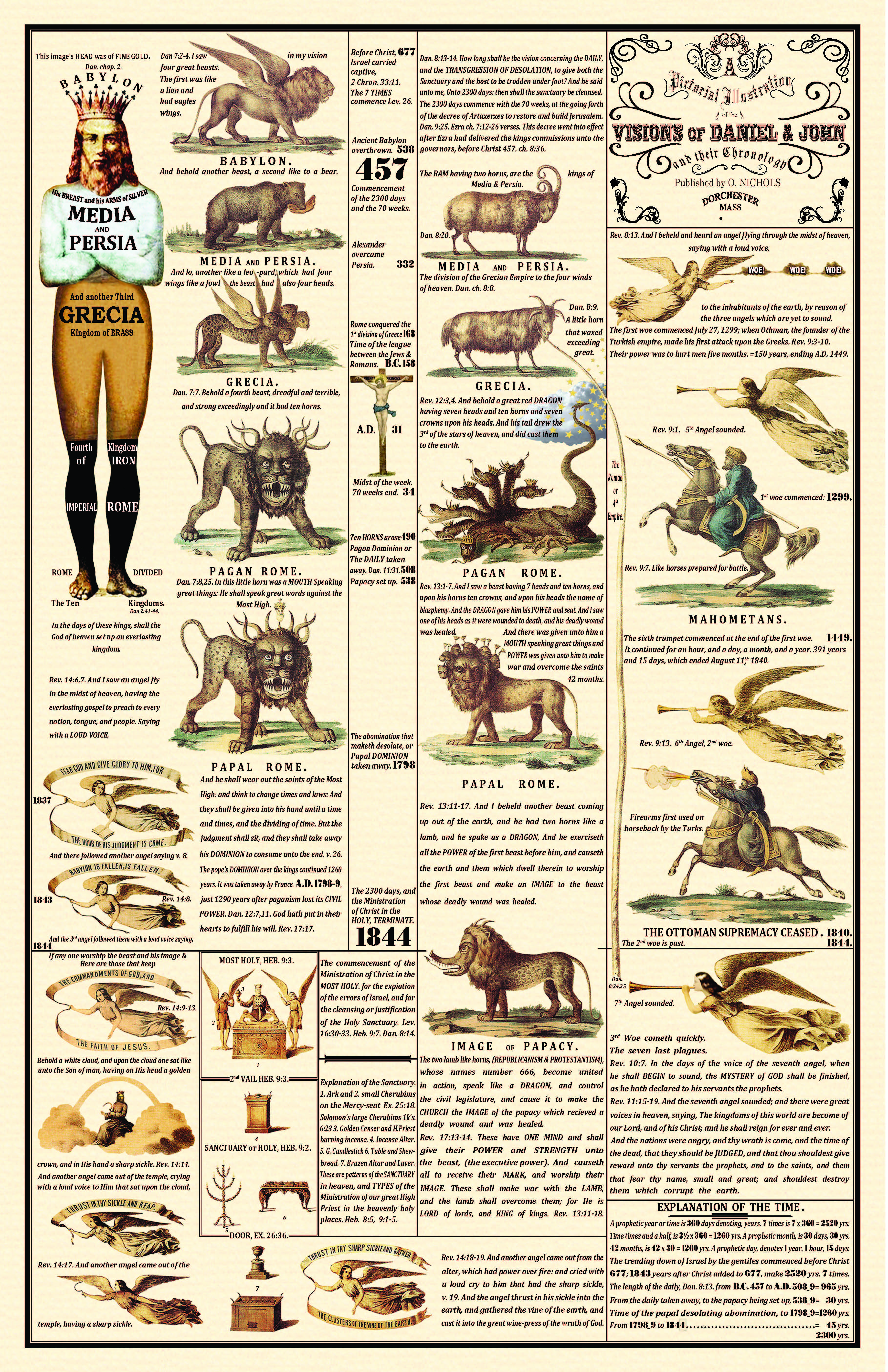
The 1843 and 1850 charts

From the chart to the city

The 1843 chart proclaimed the prophetic road from the decree to restore Jerusalem, through the cross, to the judgment-hour message. The 1850 chart carried forward the same platform after the disappointment: the commandments of God, the faith of Jesus, the sanctuary, the Sabbath, and the everlasting gospel. The charts put the road before the eyes so that the reader might run.

The 1843 proclamation

The chart carried the first angel’s cry: “Fear God, and give glory to him; for the hour of his judgment is come.” Charles Fitch and Apollos Hale gave the Advent people a visible testimony of the prophetic periods, the sanctuary, and the coming King.

Study the 1843 Prophetic Chart and read the chart history.

The 1850 platform

The 1850 chart gathered the jewels after the Red Sea. It directed the eye to the sanctuary above, the law of God, the Sabbath seal, and the people who would stand with the Lamb. Its line points beyond the wilderness toward the New Jerusalem.

Study the 1850 Prophetic Chart and follow the 31 AD and Hosea study.

“Write the vision, and make it plain upon tables, that he may run that readeth it.”
Habakkuk 2:2 (KJV)

The chart is the road map; the sanctuary is the living ministry; the New Jerusalem is the destination. The city comes down from heaven as a bride adorned for her husband. The people who cross Jordan by faith have followed Christ through the sanctuary and stand ready for the city whose builder and maker is God.

Restoration of the foundations

Restore the foundations and keep the path clear

The present call is restoration of the original foundations: gathering the jewels, recovering the true doctrine, returning to the old paths, and clearing away the rubbish that buried the platform. Nehemiah examined the ruins, rebuilt the walls, and set every man at his work.

Nehemiah — rebuild after examining the ruins.

Isaiah 58:12 — “Thou shalt raise up the foundations of many generations...”

Daniel 2:34-35, 44-45 — the stone cut out without hands destroys the image.

Revelation 21:1-4 — the earth made new.

The pioneers handed the work forward through the press, the chart, the testimony, and the open Bible. The people of God receive the truth, walk in it, and look for the kingdom that Christ establishes when the stone cut without hands fills the whole earth.

The 1850 chart in full

Follow the chart from 31 AD to the heavenly city

The 1850 chart gives the prophetic road in one field of vision. Study it here at full size, enlarge it as much as ten times, and move through the details of the sanctuary, the law, the judgment, and the Advent hope.

Download JPG Open PDF Download PDF
The 1850 Adventist prophecy chart showing the sanctuary-centered prophetic platform and the road toward the New Jerusalem

The chart opens at 1x. Use the controls or slider to reach 10x, then scroll the enlarged image horizontally and vertically.

Questions answered

Helpful summary for study and search

Why did Ellen White compare the Advent movement to Israel at the Red Sea?

She wrote that God led His people in the Advent movement as He led Israel from Egypt, and that their faith was tested in the great disappointment the same way the Hebrews were tested at the Red Sea.

What happened on October 22, 1844?

The Advent believers expected Christ to appear visibly on that date. After the disappointment, they searched the sanctuary teaching and understood that Christ was entering the Most Holy Place in the heavenly sanctuary.

What does the sanctuary have to do with the Red Sea?

The sanctuary was the key that unlocked the disappointment. It explained the prophetic period and directed the believers to Christ’s continuing ministry in heaven.

Why is Esther’s golden sceptre relevant?

Esther’s story illustrates the royal crisis, purification, and the Lord’s gracious acceptance of a prepared people. It gives a biblical picture of approaching the King in reverence and faith alongside the broader Advent sanctuary symbolism.

Share This Page - Spread the Final Warning

The Three Angels’ Messages are meant for every nation, kindred, tongue, and people. Share this resource with someone who needs to hear it.