Daniel 8:14 — the sanctuary
“And he said unto me, Unto two thousand and three hundred days; then shall the sanctuary be cleansed.”
Daniel 8:14, KJV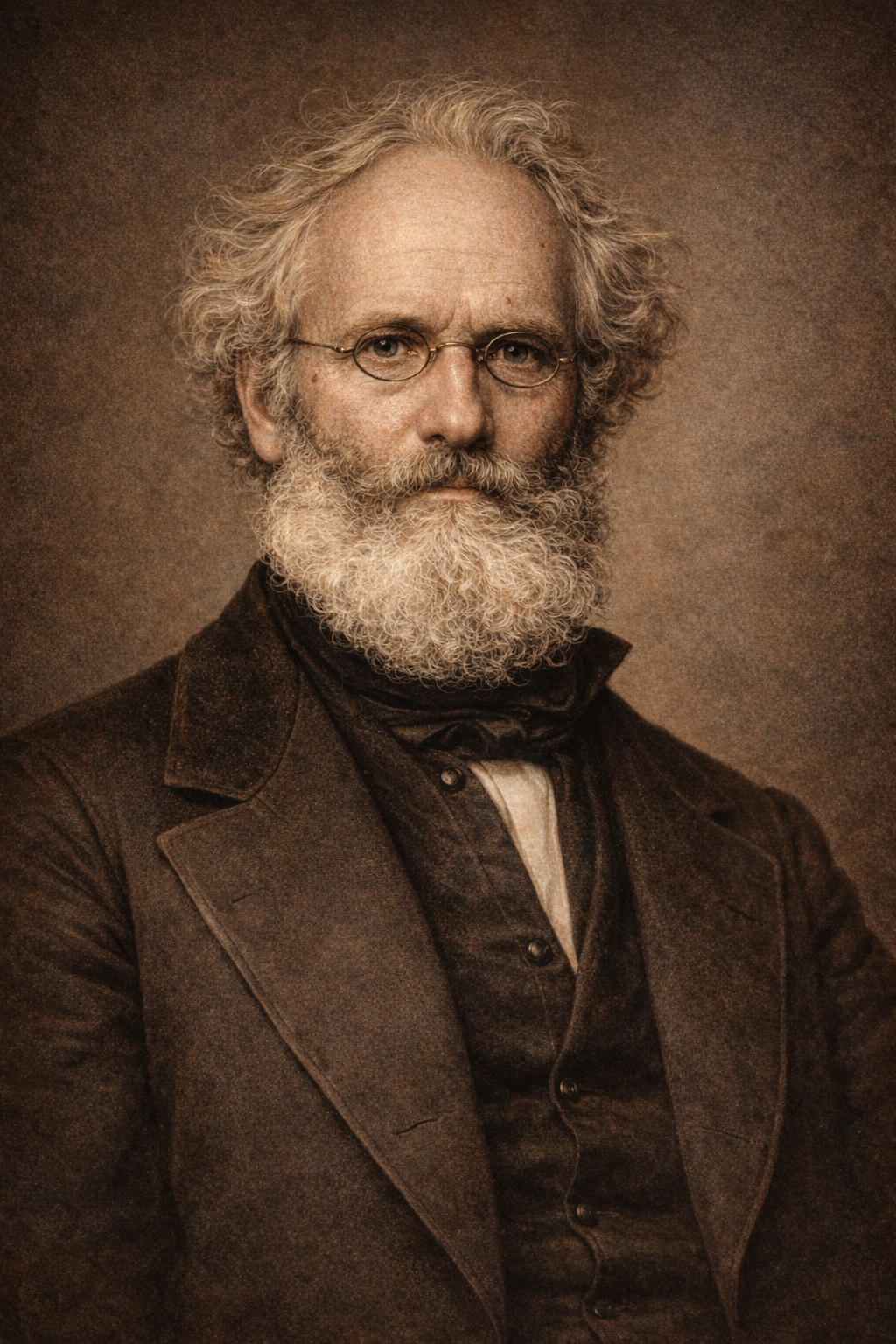
“As John the Baptist heralded the first advent of Jesus, and prepared the way for his coming, so also, Wm. Miller and those who joined him, proclaimed the second advent of the Son of God.”Read the 1858 Great Controversy source
Apollos Hale belongs to the public-facing edge of the Advent awakening: a lecturer, editor, writer, and visual teacher. His name appears beside Charles Fitch in the story of the 1843 prophetic chart, one of the great teaching tools of the Millerite movement. The chart gave audiences a single visual field for Daniel, Revelation, the prophetic periods, and the approaching Advent hope.
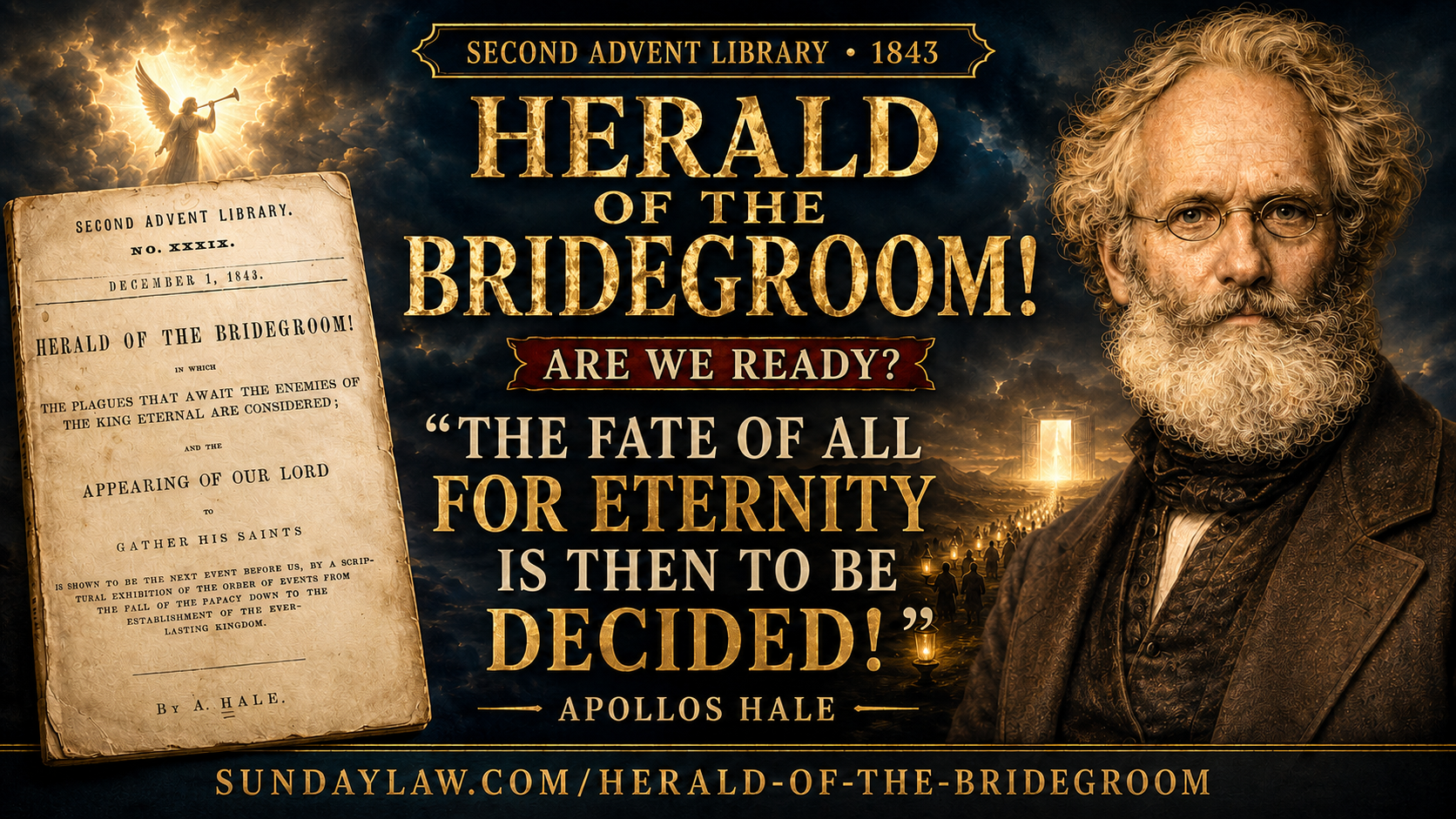
Hale's surviving work shows a man drawn to making an urgent message understandable. Herald of the Bridegroom appears in Second Advent Library, volume 6, published by J. V. Himes in 1844 and digitized from Harvard University's copy. Its title catches the mood of the movement: an announcement meant to wake readers, turn them toward Scripture, and press the question of readiness.
Read the accompanying Satan, Fallen Angels, Counterfeit Sunday Worship, and Sabbath PDF for the complete source file.
With Charles Fitch, Hale helped design the 1843 Prophetic Chart. This was practical ministry: a large visual aid for explaining prophetic chronology in public meetings. The chart captures Hale's instinct for communication - taking a sweeping prophetic argument and giving people something they could see, follow, and discuss.
That work placed Hale within a larger circle of preachers, editors, and organizers including William Miller, Joshua V. Himes, Josiah Litch, and Fitch. Their message moved by lectures, periodicals, correspondence, camp meetings, and charts. Hale's contribution was to help the message travel in forms that could be carried beyond a single sermon.
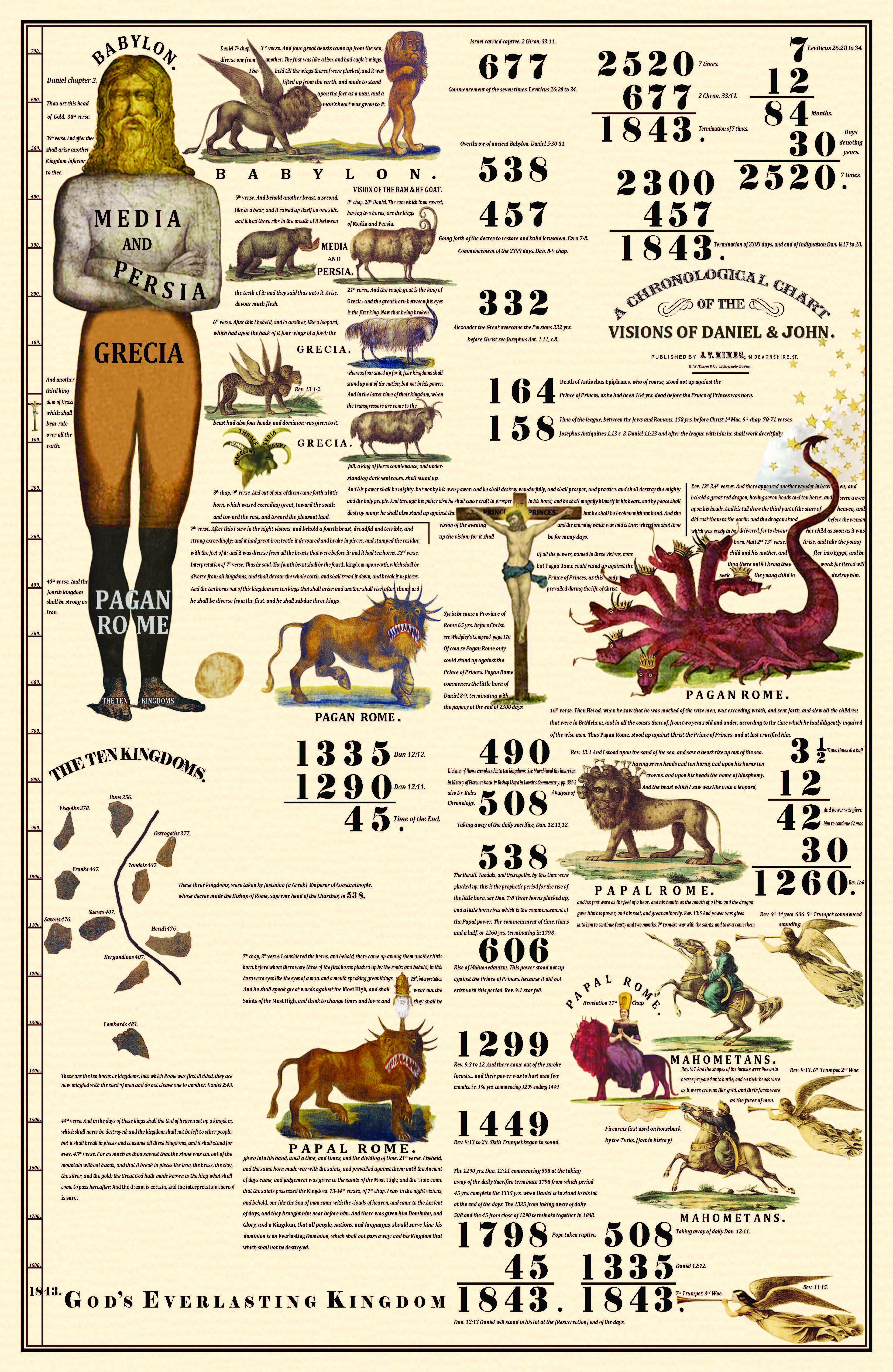
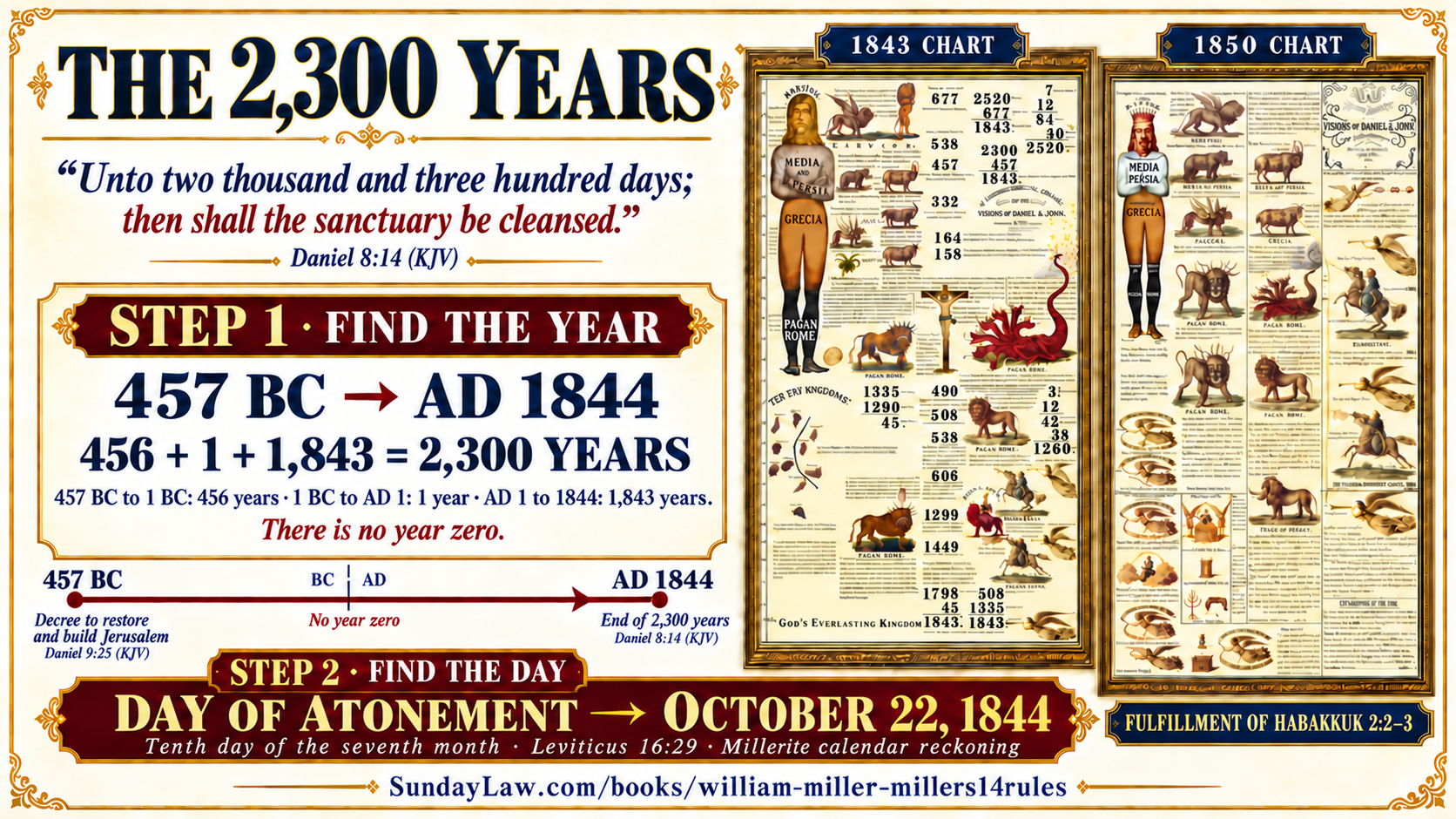
The 1843 Prophetic Chart: a visual Bible study made for a waiting people.
“And the Lord answered me, and said, Write the vision, and make it plain upon tables, that he may run that readeth it. For the vision is yet for an appointed time, but at the end it shall speak, and not lie: though it tarry, wait for it; because it will surely come, it will not tarry.”
— Habakkuk 2:2-3 (KJV)
For Hale and Fitch, a “table” became a teaching chart. It let a reader follow the numbers with the Bible open: Daniel's kingdoms, the seventy weeks, the 2,300 days, the cleansing of the sanctuary, and Revelation's messages. The charts continue to reward slow reading. The time from October 22, 1844 to today now reaches beyond 180 years; Habakkuk's words invite readers to keep the vision before them and live with watchful hope.
The two tables of stone written by the finger of God carried the Ten Commandments - the covenant law given at Sinai (Exodus 31:18; Deuteronomy 9:10-11). In this study, the two great prophetic charts of 1843 and 1850 stand as a second pair of “tables”: visual covenant witnesses that make the prophetic vision plain for readers of the last-day message. The stone tables set forth the law of God; the prophetic tables gather Daniel and Revelation around the sanctuary, the judgment hour, the Sabbath, the three angels' messages, and the hope of Christ's coming.
Together they form a powerful marriage-covenant picture: the law written on the tables of stone, and the Bridegroom's prophetic call written plainly upon the 1843 and 1850 tables. The 1843 chart points to the prophetic foundation; the 1850 chart carries forward the sanctuary and sealing light. Study the two chart keys beside Exodus 20, Daniel 8:14, Habakkuk 2:2-3, and Revelation 14 to follow this covenant thread from Sinai to the New Jerusalem.
Ellen G. White wrote: “I was shown that the 1843 chart was directed by the hand of the Lord, and that it should not be altered; that the figures were as He wanted them; that His hand was over and hid a mistake in some of the figures, and that it would not be seen until His hand was removed. Then I was shown that the 1850 chart was directed by His hand, and that the figures were correct.” — Early Writings, p. 74. Explore the companion 1850 Prophetic Chart and its key of explanation.
The chart key is the best companion for first-time readers. It identifies the chart's visual symbols and directs attention back to the passages from which the chart's claims were drawn. Read it alongside Daniel 2, 7, 8, and 9 and Revelation 12-14.
At the 1980 General Conference Session in Dallas, the denomination adopted a statement of Fundamental Beliefs whose No. 2 is titled “The Trinity.” Its official wording begins, “There is one God: Father, Son, and Holy Spirit, a unity of three co-eternal Persons.” That 1980 statement is a dated denominational record; readers can compare it directly with the pioneer-era 1872 Fundamental Principles and the 1843 chart.
The site’s historical-study reading of these later developments connects the April 15, 1904 incorporation record with Ellen White’s warning against a “new organization” and her statement: “Our religion would be changed. The Protestant form would be retained, but the spirit and power would be gone. It would be a Protestant in name only.” Read the April 15, 1904 Incorporation Record, the History of the Seventh-day Adventist Name, the Loud Cry study, and the 501(c)(3) church-state study to examine the quotations and documents in full.
The KJV describes Israel's call to covenant loyalty in these words: “They provoked him to jealousy with strange gods, with abominations provoked they him to anger.” — Deuteronomy 32:16 (KJV). In the Matthew 25 study application, the wise virgins represent those who keep the oil of Scripture, test every teaching, and follow the light they have received; the foolish virgins represent an unprepared Laodicean condition. The enduring invitation is to test every teaching by Scripture, hold fast to what is true, and keep the hope of Christ's appearing before the heart. Follow that thread into New Jerusalem, The 144,000, The Sanctuary, and The Loud Cry.
“Those who have betrayed sacred trusts will be unmasked before the world, whatever may be their position, height, or reputation.”
— Ellen G. White, Testimonies for the Church, vol. 5, p. 81.
Hale's charts and printed witness invite readers to keep the pioneer sources in view and to examine the later historical record with candor. Continue with the History of the Seventh-day Adventist Name and the April 15, 1904 Incorporation Record.
The 1872 Fundamental Principles provide a concise historical statement from the pioneer era. Read them alongside the 1843 and 1850 charts, then compare the language with the denomination's 1980 Fundamental Beliefs statement. This is a rewarding way to trace how Adventist teaching was expressed across generations.
James White's 1850 presentation of Brother Miller's Dream gives this chart study a memorable picture. In the dream, Captain William Miller opened a casket filled with “jewels, diamonds, precious stones, and gold and silver coins.” The casket had “a cross of light” within it. James White identified the casket as “the great truths of the Bible, relative to the second advent of our Lord Jesus Christ, which were given Bro. Miller to publish to the world.”
The dream then pictures genuine jewels and coins covered by “dirt and rubbish,” alongside “spurious coins and counterfeit jewels.” After the dirt-brush man clears the room, the false articles depart with the rubbish, while the genuine jewels remain. A larger casket receives them, and they shine “with ten times their former glory.” Read the complete dream and James White's notes for the full narrative and the original interpretive framework.
The image offers a lively study pattern: place primary documents side by side, open the Bible passages they use, and let clear scriptural evidence illuminate the message. The 1872 principles, the 1843 and 1850 charts, and Miller's dream each invite that kind of careful, hopeful reading.
Hale was associated with Millerite publishing, including Signs of the Times and the Advent Herald, and contributed to early material connected with Sylvester Bliss and Memoirs of William Miller. His source trail invites readers directly into the printed world of the Advent awakening.
James White's July 21, 1850 letter preserves an important retrospective reference to Hale. Describing the testimonies he was gathering for the Advent Review, White wrote: “In looking over these testimonies from Miller, Brown, Fassett, Shipman, Porter, Hale, Cook, etc., I am astonished to see how they preached a shut door.” The Ellen G. White Estate's Shut Door Documents identifies this as a July 21, 1850 letter from White at East Hampton, New York. It places Hale among the remembered voices of the 1844 movement, even as the post-disappointment Advent landscape divided and developed.
Apollos Hale was born in Massachusetts in 1807 and died in Washington, D.C., on February 13, 1898. The family record connected with his Rock Creek Cemetery memorial preserves five children: Martha Rogers Hale Hampson (1837-1923), Mary E. Hale Pinder (1839-1895), Joseph W. Hale (1841-1851), Rebecca A. W. Hale Baker (1844-1920), and Charles Sumner Hale (1853-1911). Biographical references also connect his household with Rebecca Wait.
Hale rests at Rock Creek Cemetery in Washington, D.C., Section G, Lot 083. His memorial provides an accessible place to honor his life and follow the linked family record across generations.
Ellen G. White gave the movement-wide frame for Hale's generation: “As John the Baptist heralded the first advent of Jesus, and prepared the way for his coming, so also, Wm. Miller and those who joined him, proclaimed the second advent of the Son of God.” Read it in the 1858 Great Controversy book page, chapter “William Miller,” p. 129.
Hale's writing, lectures, editorial work, and chart design show how he joined in carrying the Advent message into public view. The passage gives readers a vivid lens for seeing the generation in which Hale labored: a company gathered around the Second Advent proclamation.
In January 1845, Hale and Joseph Turner appeared as editors of The Advent Mirror, volume 1, number 1. Their four-page tract, Has Not the Savior Come as the Bridegroom?, is preserved online in a digitized copy. The title page reads: “BOSTON, JANUARY, 1845, A. HALE & J. TURNER, EDS.”
The tract reads Matthew 25 through the themes of the Bridegroom, the marriage, the New Jerusalem, the wise and foolish virgins, and the coming kingdom. Its closing appeal is direct: “Let us hold fast, and be ready for the call to the marriage supper of the Lamb!” Read the digitized original to meet Hale's own voice on the page.
The Find a Grave memorial for Rev. Apollos Hale records his burial at Rock Creek Cemetery, Washington, D.C., and identifies the plot as Section G, Lot 083. It is a meaningful destination for visitors tracing the enduring story of a man whose printed words and chart work helped carry the Advent message across the country.
Apollos Hale made prophecy public. His legacy shines through a body of communication work: the 1843 Herald, the chart shared with Fitch, and his place in the publishing world of the Advent awakening. He makes the history feel immediate: ideas became pages, pages became lectures, and lectures became a movement.
Before William Miller, most Christian teachers relied on church tradition, denominational commentary, and the interpretations of educated clergy. Miller did something radical: he went directly to Scripture and applied systematic, logical principles to understand what it plainly said.
The Impact: Using these fourteen rules, William Miller followed the KJV text from Daniel 8:14 to the sanctuary message and the 1844 waymark. The 1843 chart made the sequence visible: prophecy, judgment, the sanctuary, the commandments, the Sabbath, and the soon return of Christ.
“And he said unto me, Unto two thousand and three hundred days; then shall the sanctuary be cleansed.”
Daniel 8:14, KJV“The seventh day is the sabbath of the LORD thy God: in it thou shalt not do any work.”
Exodus 20:10, KJV“This same Jesus, which is taken up from you into heaven, shall so come in like manner as ye have seen him go into heaven.”
Acts 1:11, KJV“Fear God, and give glory to him; for the hour of his judgment is come.”
Revelation 14:7, KJV Daniel gives the period: 2300 days. Miller’s rules apply the Bible’s day-for-a-year principle (Numbers 14:34; Ezekiel 4:6) and connect the starting point with Daniel 9:25, the command to restore Jerusalem.
457 BC + 2300 years - 1 year for crossing from BC into AD = 1844 AD
“The intellect should be cultivated, the memory taxed. All intellectual laziness is sin, and spiritual lethargy is death.”
— Ellen G. White, Testimonies for the Church, vol. 4, p. 399.1
“I have been shown that many who profess to have a knowledge of present truth know not what they believe. They do not understand the evidences of their faith. They have no just appreciation of the work for the present time. When the time of trial shall come, there are men now preaching to others who will find, upon examining the positions they hold, that there are many things for which they can give no satisfactory reason. Until thus tested they knew not their great ignorance. And there are many in the church who take it for granted that they understand what they believe; but, until controversy arises, they do not know their own weakness. When separated from those of like faith and compelled to stand singly and alone to explain their belief, they will be surprised to see how confused are their ideas of what they had accepted as truth. Certain it is that there has been among us a departure from the living God and a turning to men, putting human in place of divine wisdom.”
— Ellen G. White, Testimonies for the Church, vol. 5, p. 707.2
The Millerite chart then placed the expected cleansing of the sanctuary at the tenth day of the seventh month, corresponding to October 22, 1844. The date is the chart’s historical result; Daniel 8:14 supplies the prophecy and the KJV gives the anchor text.
Miller’s method was a disciplined chain: read the words, compare the passages, follow the symbols through Scripture, and test the historical fulfillment against every prophetic detail. The 1843 chart gave ordinary believers a visual map of that chain. Read the full 1843 chart study and the William Miller biography for the story of the doctor who called Miller a “monomaniac” before discovering how completely his method rested on Scripture.
These rules keep Bible study anchored in the written Word. They lead the reader back to the sanctuary, the law, the Sabbath, the judgment-hour message, and the literal return of Jesus Christ.
Published writings and theological contributions
Press Esc to close · / or Ctrl+K to open