“I believe the Sanctuary, to be cleansed at the end of the 2300 days, is the New Jerusalem Temple, of which Christ is a minister.”E. G. White, A Word to the “Little Flock” (1847), p. 12.
Home / Sanctuary / O. R. L. Crosier
Day-Star Extra · February 7, 1846
The Sanctuary
O. R. L. Crosier’s sanctuary article, published as The Law of Moses, helped answer the Great Disappointment by showing that the sanctuary to be cleansed was not the earth, but the heavenly sanctuary where Christ ministers as High Priest.
“See, saith he, that thou make all things according to the pattern shewed to thee in the mount.”Hebrews 8:5, KJV
Ellen White’s Endorsement
“The true light, on the cleansing of the Sanctuary.”
The strongest reason this article belongs in the center of the pioneer library is the way Ellen White referred to Crosier’s Day-Star Extra in 1847.
“The Lord shew me in vision, more than one year ago, that Brother Crosier had the true light, on the cleansing of the Sanctuary, &c.”E. G. White, A Word to the “Little Flock” (1847), p. 12.
“I feel fully authorized by the Lord, to recommend that Extra, to every saint.”E. G. White, referring to the Day-Star, Extra, February 7, 1846.
1846 Sanctuary Study
The article Ellen White recommended.
“I feel fully authorized by the Lord, to recommend that Extra, to every saint.”Ellen G. White, A Word to the “Little Flock” (1847), p. 12.
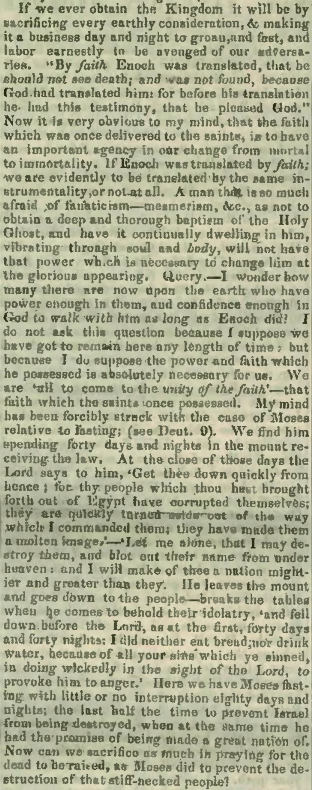
A Kingdom Worth Seeking
If we are ever going to obtain the kingdom...
This image preserves one of the most gripping portions of Crosier's sanctuary argument: the question is not a remote theological curiosity, but whether God's people will understand the ministry of Christ deeply enough to follow Him by faith into the heavenly reality.
The sanctuary message pulls the eyes upward: from earth to heaven, from disappointment to priestly ministry, from scattered expectation to the New Jerusalem and the kingdom that cannot be moved.
How the article came about
After the disappointment, Hiram Edson, O. R. L. Crosier, and Franklin B. Hahn searched the Scriptures for the meaning of Daniel 8:14. ESDA records that Hahn and Edson believed the sanctuary study was “just what the scattered remnant needed” and agreed to share the publication expense if Crosier would “write out the subject of the sanctuary.”
Crosier’s most mature exposition was published as “The Law of Moses” in the Day-Star Extra of February 7, 1846. The pioneers treated this as more than a historical curiosity: it connected the law, the priesthood, the heavenly sanctuary, the 2300 days, the Day of Atonement, and Christ’s final ministry before His return.
Original Publication History
The surviving article and the earlier lost Day-Dawn notice.
The February 7, 1846 article is the earliest surviving complete sanctuary exposition. It was not merely a reprint of the earlier Day-Dawn material; it was a greatly enlarged presentation of the sanctuary study.
The Day-Star Extra
Crosier's The Law of Moses appeared in a special issue of The Day-Star on February 7, 1846. In the complete volume scan, look for the Extra beginning on printed page 37 and continuing through about page 44.
Open Day-Star Volume at Page 37Internet Archive
The full periodical volume is preserved online as The Day-Star, Volume 9. Use it as primary-source evidence for the complete context around the Extra.
Internet Archive Book PageFull-text transcription
Search the OCR text for Law of Moses, Sanctuary, Hebrews 8:5, and the New Jerusalem statement.
Searchable Full TextContinue Reading
Begin with the full Day Star, then follow the message into print.
Read the complete 1846 volume one page at a time. When you reach the Day-Star Extra, continue into Crosier’s sanctuary article, then follow the later publishing trail in James White’s The Present Truth.
What Crosier Taught
The sanctuary article gathers the types into one line of light.
The article argued from Scripture that the sanctuary service was a prophetic model of Christ's ministry and that the 1844 event was heavenly, not earthly.
The Mosaic sanctuary was a prophetic model
The earthly service was not arbitrary ritual; it was a shadow designed to teach the gospel work of Christ.
The pattern was heavenly
Hebrews 8:5 anchors the earthly sanctuary to the heavenly pattern shown in the mount.
Christ serves as High Priest
The cleansing belongs to Christ's priestly ministry in the true tabernacle, which the Lord pitched, and not man.
The sanctuary was not the earth
The article corrected the expectation that Daniel 8:14 pointed to the burning of the world in 1844.
The Day of Atonement points forward
The autumn types, especially Leviticus 16, point to the closing phase of Christ's heavenly ministry.
New Jerusalem is connected
Crosier wrote that the sanctuary of the new covenant is connected with New Jerusalem as the first-covenant sanctuary was with Old Jerusalem.
Study Notes
What this page is tracing
The sanctuary doctrine did not stand alone. It joined Daniel 8:14, Hebrews 8-9, Leviticus 16, the Sabbath, the sealing message, and the New Jerusalem temple into one connected framework.
Hebrews 8:5
The earthly sanctuary was made according to a heavenly pattern. Crosier’s article insists that the shadow teaches the gospel reality.
October 22, 1844
The error was not the prophetic period, but the event expected. The cleansing pointed to Christ’s heavenly work, not the burning of the earth.
The Most Holy Place
The sanctuary light explains the Advent movement’s present position: Christ ministers in the true tabernacle which the Lord pitched, and not man.
Embedded Source
Read Crosier’s article here.
This PDF is the SundayLaw-hosted Crosier sanctuary article: The Law of Moses, Day-Star Extra, February 7, 1846.
Complete Periodical Evidence
The full Day-Star volume, opened at the Extra.
The clean article PDF is easiest to read, but the complete periodical scan preserves the original surviving publication context. The embedded reader below opens the full volume at page 37, where the February 7, 1846 Extra begins.
Important Historical Distinction
The truth does not rest on Crosier's later course.
Crosier briefly accepted the seventh-day Sabbath, later opposed it, and eventually abandoned or substantially repudiated portions of the sanctuary interpretation he had helped formulate. The doctrine's truth rests upon Scripture and the confirming testimony God gave at a decisive moment, not upon Crosier's later faithfulness.
The Day-Dawn, 1845
Crosier's group had earlier published sanctuary conclusions in the Day-Dawn around March 1845. No copy of that particular issue is presently known to survive.
The Day-Star Extra, 1846
The February 7, 1846 Extra is the earliest surviving complete exposition and a greatly enlarged presentation.
Truth above personality
God used Crosier's early Bible study and writing at a decisive moment, even though Crosier afterward departed from portions of the light.
Research Notes
Primary and secondary paths for deeper study
These notes preserve the research trail around Crosier, the Day-Star Extra, the Day-Dawn, the sanctuary, and the Sabbath.
- J. N. Andrews, A Review of the Remarks of O. R. L. Crosier on the Institution, Design and Abolition of the Sabbath [1852].
- Merlin D. Burt, “The Day-Dawn of Canandaigua, New York,” Andrews University Seminary Studies 44, no. 2 (Autumn 2006): 317-330.
- Merlin D. Burt, “The Extended Atonement View in the Day-Dawn and the Emergence of Sabbatarian Adventism,” AUSS 44, no. 2 (Autumn 2006): 331-339.
- Merlin D. Burt, “The Historical Background, Interconnected Development, and Integration of the Doctrines of the Sanctuary and the Sabbath,” Ph.D. diss., Andrews University, 2002.
- Michael W. Campbell, “Day-Dawn,” Encyclopedia of Seventh-day Adventists.
- O. R. L. Crosier, “The Law of Moses,” The Day-Star, February 7, 1846. SundayLaw PDF.
- O. R. L. Crosier, “The Sanctuary,” Advent Review and Herald, September 1850, 42-47; “The Priesthood,” October 1850.
- O. R. L. Crosier, “Dear Bro. Jacobs,” The Day-Star, November 15, 1845.
- O. R. L. Crosier, “Letter from Bro. Crosier,” The Advent Herald, and Signs of the Times Reporter, October 2, 1844.
- O. R. L. Crosier, “Prophetic Day and Hour,” Voice of Truth, April 9, 1845.
- W. A. Spicer, “A Meeting With O. R. L. Crosier,” Advent Review and Herald, March 29, 1945.
- Francis D. Nichol, The Midnight Cry: A Defense of William Miller and the Millerites, Review and Herald, 1944.
- George R. Knight, A Search for Identity: The Development of Seventh-day Adventist Beliefs, Review and Herald, 2000.
- ESDA: Crosier (Crozier), Owen Russell Loomis (1820-1912).
- Find a Grave memorial: Owen Russell Loomis Crozier.