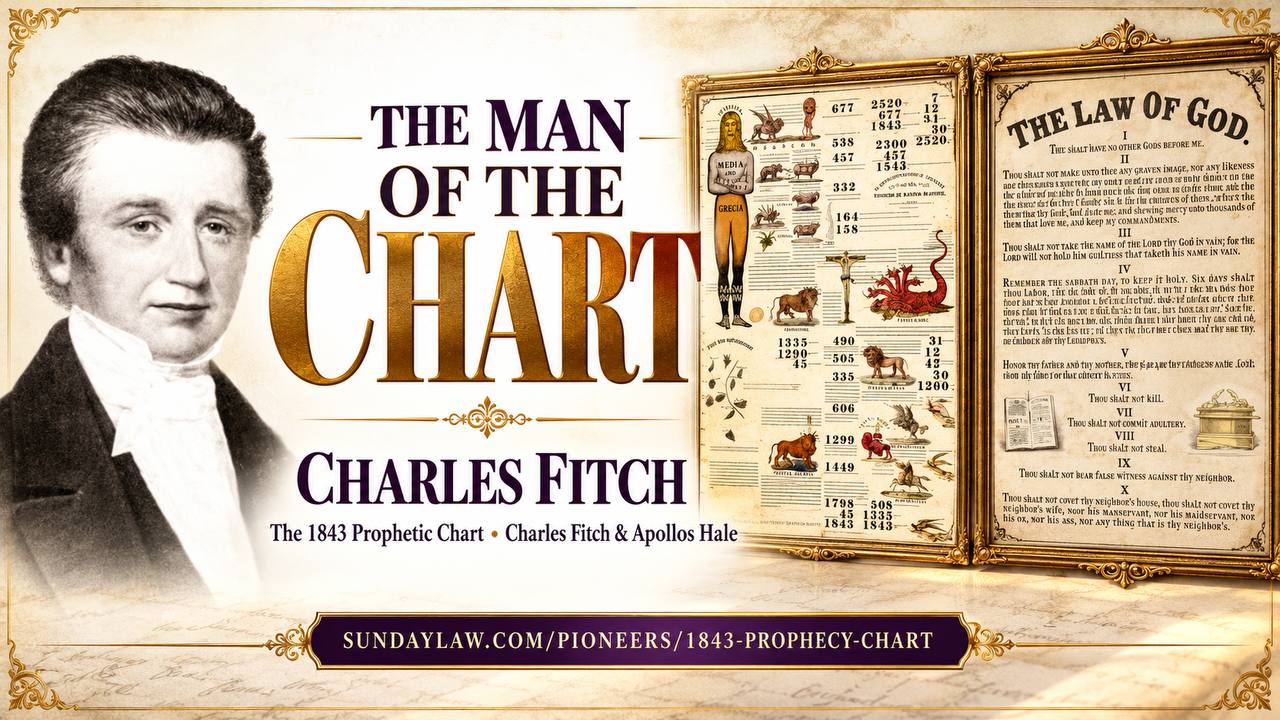
Key to the 1843 Prophetic Chart
the inspired description being followed as closely as delineation of the pen can be illustrated with the pencil. Hence those who endeavor to throw ridicule upon these things, we care not if they are arrayed in priestly robes, and have names cumbered with pompous titles, betray both ignorance and depravity, and the God who inspired his prophets to write out these descriptions, will hold all who thus treat them to a strict account for their doings.
The reader will understand at once that it is not the province of this work to give a dull exposition of all that is illustrated upon the Chart. What is here presented is designed to be but little more than a brief synopsis of the great historical facts shadowed forth by these symbols, reference being had for a full exposition to the works upon the Four Kingdoms of Daniel's Prophecies, The Three Angels of Rev. xiv (14), The Sanctuary, and The Seven Trumpets. Now let the student place the Chart before him, just as he would his atlas in learning a lesson in geography, and, opening his Bible to a description of these symbols, proceed to consider the wonderful nature of some of the revelation of God to man.
THE GREAT IMAGE OF DANIEL II (2)
In the upper left-hand corner of the Chart stands a great image. Concerning this symbol, the time when, and the person by whom, it was seen, and the lessons of wisdom couched in its massive and majestic form, we read in full in Daniel, chapter ii. It was seen in a dream by Nebuchadnezzar, king of Babylon, B.C. 603. But though the dream was given to a heathen king, the interpretation could come only through a servant of God; hence Daniel was called in to interpret the matter, the principal design of which is declared to be, to make known "what shall be in the latter days." Verse 28.
THE HEAD OF GOLD
This image symbolizes four universal kingdoms which should bear rule over the earth, commencing with the then reigning kingdom of Babylon, and extending, in common phraseology, to the end of time. These kingdom's are denoted by the different metals of which the image was composed, namely, gold, silver, brass, and iron. In his interpretation, the prophet addressing the king of Babylon, as a representative of his kingdom, said, "Thou art this head of gold."
Verse 38. The head of gold, then, represents the kingdom of Babylon. Babylon was but a continuation of the old Assyrian empire which had governed Asia for more than thirteen hundred years, having been founded by Nimrod, the mighty hunter, and a great grandson of Noah. Gen. x, 10. The Kingdom of Babylon, proper, or as we read of it in scripture, dates from B.C. 747; but yet it dates in prophecy from B.C. 677. The reason of this is, because kingdoms are not recognized in the prophetic record, as existing, until they become connected with the people of God. Hence in prophecy, kingdoms must date from that point of time at which they began to act a part in the prophetic drama. Babylon first became connected with the people of God by taking Manasseh, king of Judah,