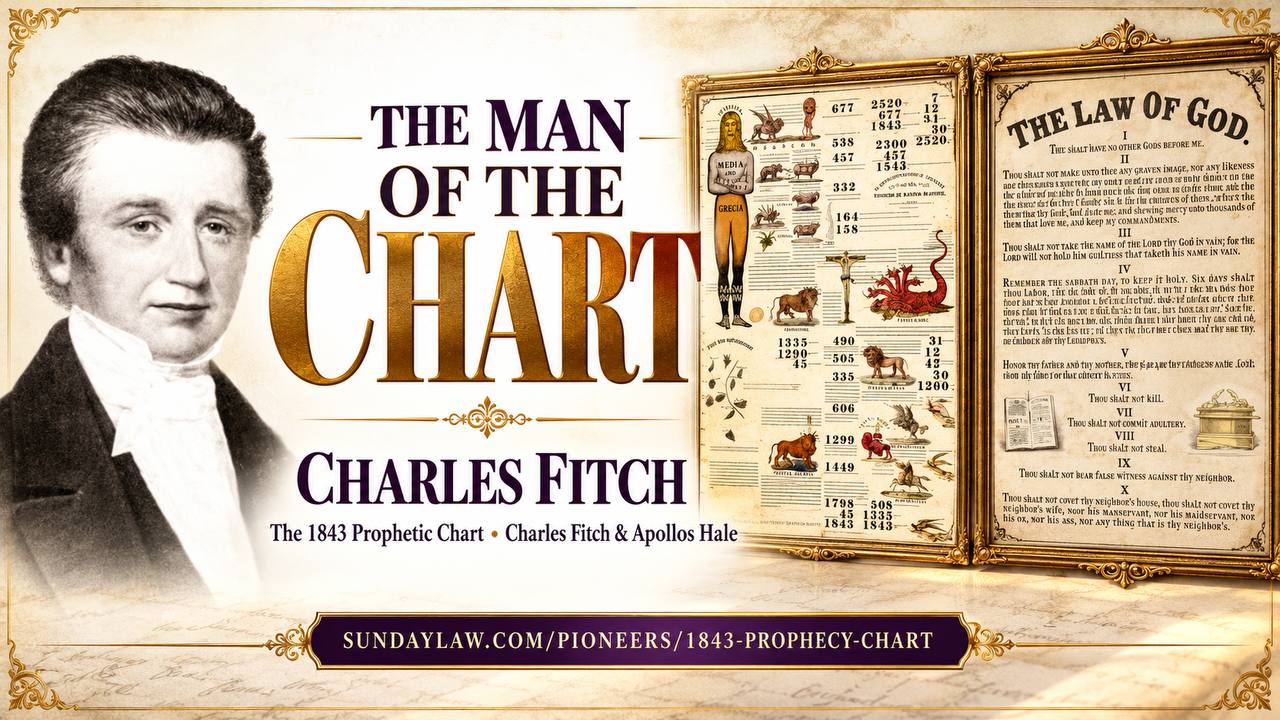
Key to the 1843 Prophetic Chart
captive, B.C. 677. 2 Chron. xxxii (32). The date of Babylon, therefore, as represented by the head of gold, is B.C. 677.
THE BREAST AND ARMS OF SILVER
"And after thee," continued the prophet, "shall arise another kingdom inferior to thee." This kingdom must be symbolized by the breast and arms of the image, which were of silver; for that kingdom represented by the gold must cease where the gold of the image ceases; and the division of brass which follows the silver, is expressly declared to be a third kingdom. It is the same therefore, as if it had said, After thee shall arise another kingdom which is symbolized by the breast and arms of this great image. What kingdom was this?
That which next succeeded Babylon, which was Medo-Persia. Cyrus, king of the Persians, took Babylon, slew Belshazzar the Babylonian king, ended the Babylonian, and commenced the universal Persian, empire, B.C. 538. The scenes of the eventful night in which this transpired are graphically described in Dan. v (5).
THE BELLY AND SIDES OF BRASS
"Another third kingdom of brass," says Daniel. As the brazen portion of the image is plainly called a kingdom, we look for its development in the kingdom that succeeded Persia, which, as the least acquaintance with history will show, was the kingdom of Grecia. Alexander, the first king of Grecia, conquered Darius, overthrew the Persian kingdom, and assumed the reins of universal dominion, at the battle of Arbela, B.C. 331. But the brass was succeeded by another portion of the image, which brings us to
THE LEGS OF IRON
In interpreting this portion of the image, the prophet said, "And the fourth kingdom shall be strong as iron." This leaves no room for mistake. We look for a kingdom to succeed Grecia, and behold Rome coming forth grasping a wider extent of territory than any of its predecessors, leaving no kingdom unsubdued, and ruling with an iron hand over all the then known world. Rome then is without controversy the kingdom symbolized by the legs of iron. Rome virtually succeeded Grecia, on its conquest of Macedonia, B.C. 168. It was not, however, till seven years thereafter, that is, in B.C. 161, that it entered into the famous league with the Jews, and thus became connected with the people of God.
Hence the Roman kingdom, the iron of the image, dates from B.C. 161. Passing down to the feet and toes, we find them part of iron and part of clay, The signification of this was that the kingdom in that stage of its existence should be partly strong and partly broken, and finally be divided. Rome first grew strong