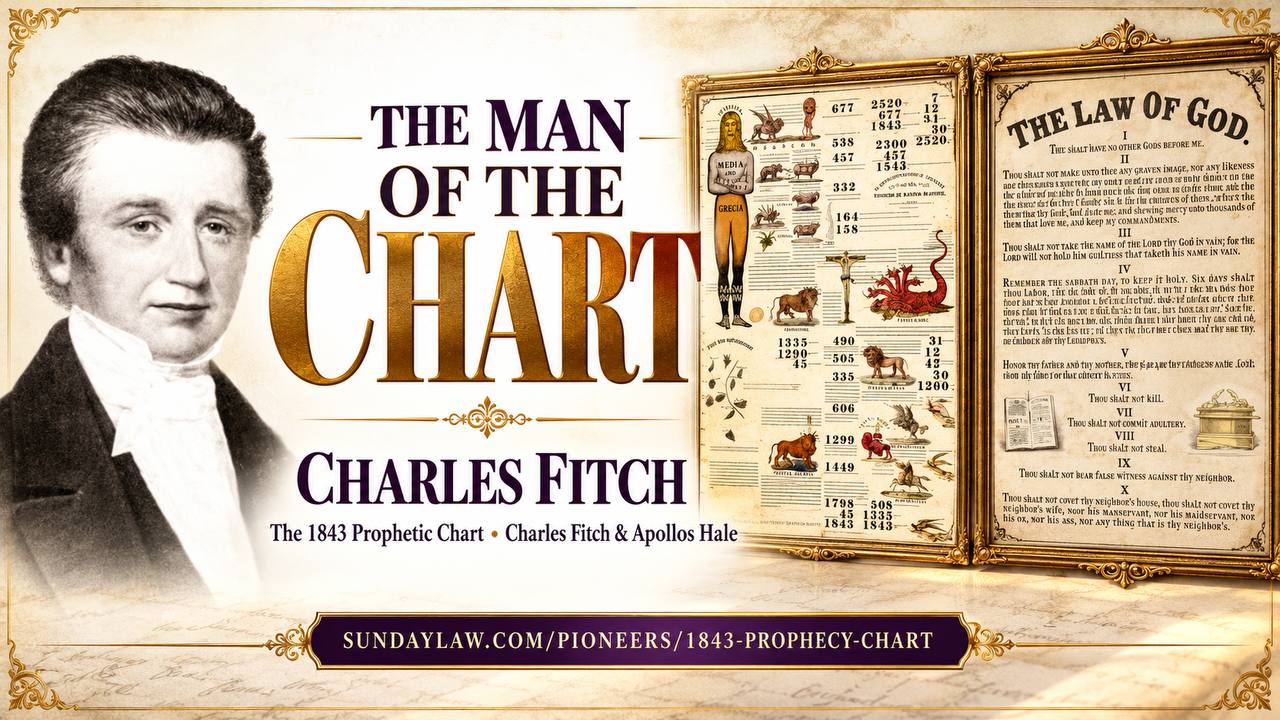
Key to the 1843 Prophetic Chart
The ground covered by this vision is the same in its main features as that covered by the great image of chapter ii. The question may be asked; then, why this vision was given. Why repeat what had once been so forcibly expressed?
We answer, Prophecies are repeated because all the instruction that God wishes to convey, and all the particulars concerning nations and kingdoms, cannot well be embodied in one series of symbols. Thus the head of gold represents the grandeur and glory of the Babylonian kingdom; but it could not represent the fact that that kingdom bore the same relation to other kingdoms that the lion does to other beasts; or, in other words, it could not show its warlike character, its ability to conquer, its bravery and daring, and the rapidity of its conquests; all which plainly appear in the symbol of the lion with eagle's wings. But while the lion shows these qualities, it does not represent the grandeur and glory shadowed forth by the head of gold. Hence both lines of prophecy are necessary to bring out the whole truth. So with Medo-Persia. The bear raising himself up on one side, does not so well represent the two lines of kings in that empire, as the two arms of the image. But on the other hand, the breast and arms of the image cannot represent the cruel and oppressive nature of that power, shown by the bear with three ribs in his mouth. Likewise Grecia, while it continued a unit, is well represented by the belly and sides of brass; but this portion of the image could not represent its division into four kingdoms, and the rapidity of its aggressive marches, as brought out by the four heads and four wings of the leopard.
And so, too, of the different features of the Roman kingdom. The ten kingdoms that arose out of that empire, are represented by the ten toes of the image. But the change that afterward took place in those kingdoms, the rise of the little horn, and the plucking up of three to make way for him, could not be represented on the image, hence the fourth beast, in his second form, is brought upon the stage.
A query here arises: As this beast in his last form has only seven horns besides the papal horn, and these horns denote kingdoms, shall we now look for any more than seven kingdoms in the place of the original ten? We answer that the little horn in plucking up the three horns did not absorb them into itself. It simply removed them out of its ambitious path to universal dominion. They were not destroyed, but only compelled to change their territory and location. So the symbol of the image, which retains all its ten toes till the consummation, will remain true, as the ten kingdoms will in reality exist; and the symbol of the beast with its seven horns will also remain true, as showing that three kingdoms were removed to make way for the papacy.
Before leaving this prophecy we desire to call the attention of the skeptic to one remarkable feature. The prophet's stand-point is away back in the kingdom of Babylon about five and a half centuries before Christ. And the farther he comes down from his own time, the more minute he becomes in his predictions and descriptions of events, until, coming down to the rise of the little horn, or Papacy, he even gives the exact time of its supremacy, predicting for it an unparalleled period of triumph for 1260 years, reaching to a