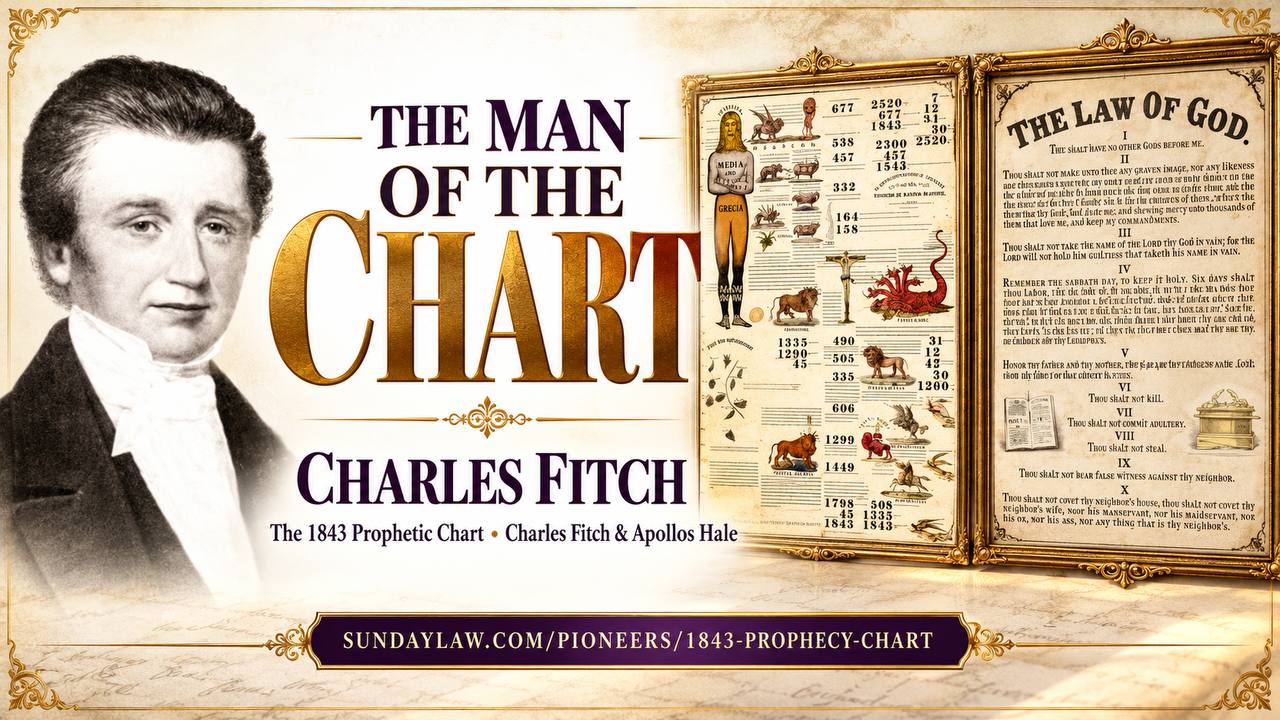
Key to the 1843 Prophetic Chart
point of time more than two thousand years distant from his own day, Human foresight speaks with most minuteness of events that are nearest at hand, and grows more and more indefinite as it goes off into the dim and distant future. And had Daniel dwelt minutely upon the kingdom of Babylon, giving the length of its continuance, but giving no such particulars in the following kingdom, and growing less and less definite and distinct with each succeeding kingdom, there would have been more ground to account for these predictions independent of any divine agency; but the prophecy does just the reverse of this, speaking with most minuteness of the most distant events, as if to shame skepticism out of its shallow claim that these prophecies are but the shrewd conjectures of human foresight and discernment. None but the mind of God could or would have predicted events in this concise and wonderful manner.
THE RAM, GOAT, AND LITTLE HORN OF DAN. VIII (8)
Standing at the right of the series of beasts last described will be seen another line of prophecy, consisting of a Ram, Goat and Little Horn. This vision is found in Daniel viii (8), and in it we are again conducted over a portion of the world's great highway, with additional particulars concerning the mighty kingdoms that we pass along our journey. Thus we have line upon line till the subject is made so plain that no man, however poor or wayfaring he may be, need err therein. On the symbols of this chapter, the ram, he-goat, and little horn which waxed exceeding great, the prophet received the following instruction: The ram which thou sawest having two horns, are the kings of Media and Persia. The higher of the two horns came up last.
Verse 3. This represented the Persian division of the empire, which rose last, and became the leading influence in the nation. The ram with the two horns was the well-known emblem of the Medes and Persians. This symbol is placed on the Chart, on a line with the breast and arms and the bear, as it denotes the same power.
The goat which came against the ram had at his first appearance, not represented on the Chart, a notable horn between his eyes. This goat and horn are explained by the angel, in verse 21, thus: "And the rough goat is the king of Grecia; and the great horn that is between his eyes is the first king." This king was Alexander the Great, a man of unbridled appetite and lust, and who eight years after he overthrew the Persian empire at the battle of Arbela, B.C.331, died at Babylon in a drunken fit, at the age of 33, B.C.323. This horn was thus broken, and four came up in its stead, as represented on the Chart. In explanation of this change, the angel said, "And whereas, the great horn being broken, four came up in its stead;" "four kingdoms shall stand up out of the nation." Verse 22.
These kingdoms were Macedonia, Thrace, Syria and Egypt, into which the empire was divided shortly after Alexander's death, governed respectively by Cassander, Lysimachus, Seleucus and Ptolemy.