How the story enters the church
“The Infiltration” presents Rivera’s account of hidden influence moving through religious institutions. Use the narrative as a prompt to investigate the documents and historical actors it names.
Press Esc to close · / or Ctrl+K to open
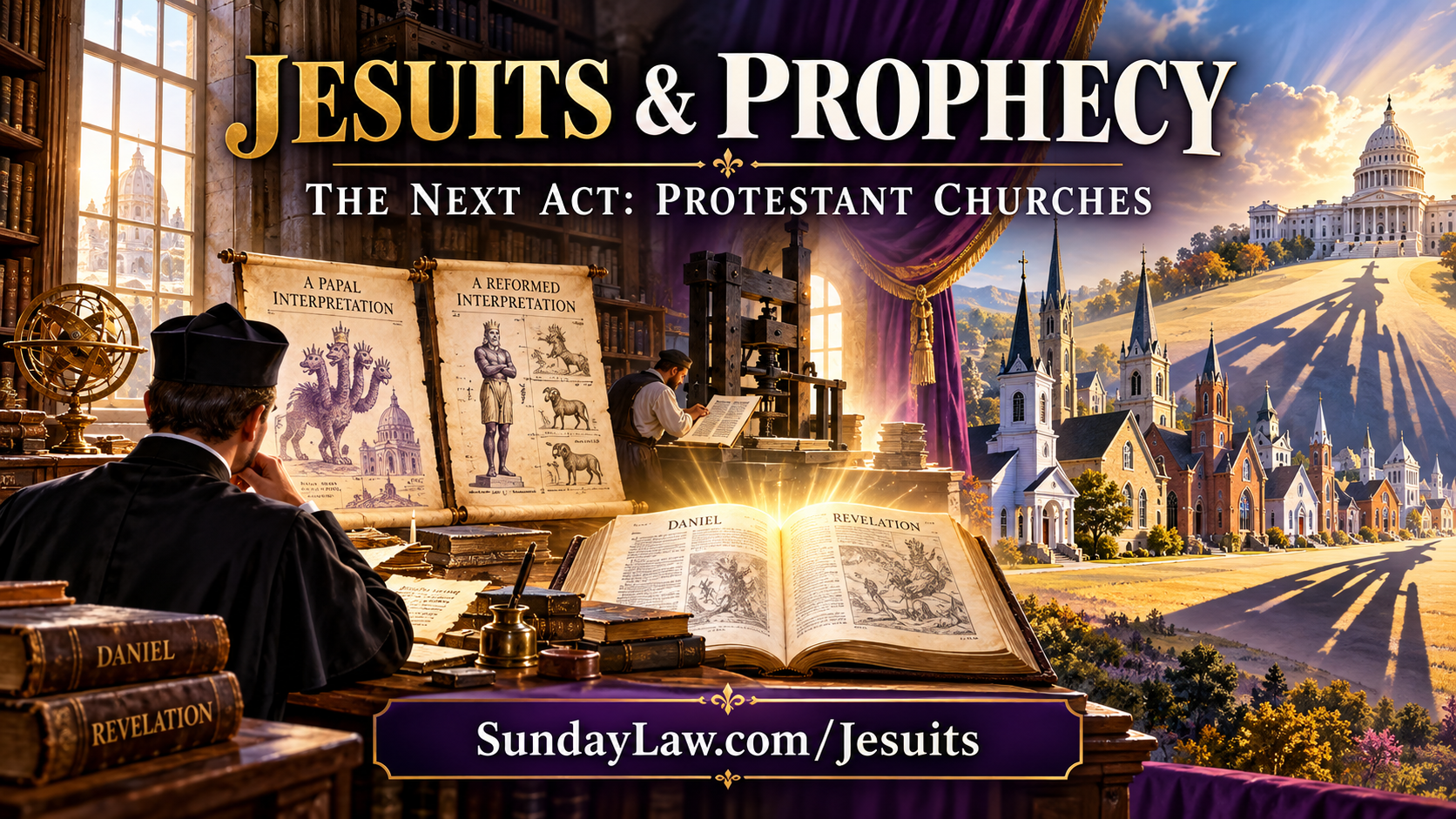
The Society of Jesus became a principal instrument of the Catholic Counter-Reformation. This page separates documented Jesuit history from popular legends, then lets visitors examine the Alberto Rivera video testimony and decide what the evidence demands of a Protestant conscience.
“The professed are all priests, who make, besides the three usual solemn vows of religion, a fourth, of special obedience to the pope in the matter of missions, undertaking to go wherever they are sent...”The Catholic Encyclopedia, “The Society of Jesus” (1912), New Advent. Read the complete historical entry.
This is the complete source passage used on this page. It identifies the fourth vow and its missionary scope. The long sensational “secret Jesuit oath” circulated online carries a disputed provenance; the page begins with the wording that can be checked in a published historical reference.
This image exhibit preserves the supplied oath scan for close inspection. Use the controls to move from 1× through 10×, scroll across the enlarged page, or download the original JPEG for independent study.
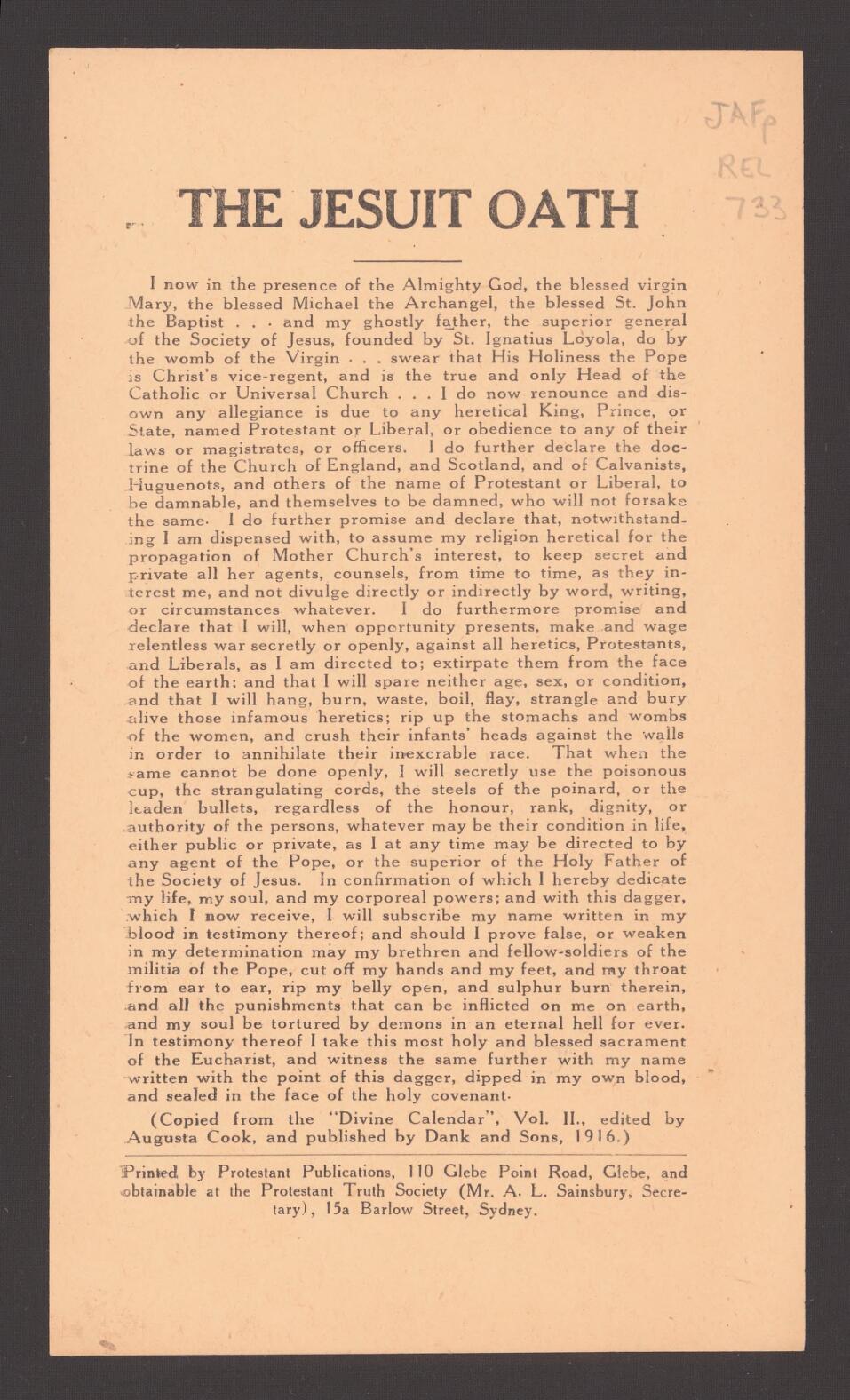
A reliable historical source describes the fourth vow of professed Jesuits as special obedience to the pope concerning missions. That documented formulation is stronger evidence than the sensational “secret Jesuit oath” texts widely copied online.
“The professed are all priests, who make, besides the three usual solemn vows of religion, a fourth, of special obedience to the pope in the matter of missions, undertaking to go wherever they are sent...”The Catholic Encyclopedia, “The Society of Jesus” (1912), New Advent. Read the historical entry.
This page brings the documented fourth vow, the October 4, 1923 Trove article, and the supplied oath scan into one place for Protestant examination. Read the wording, inspect the provenance, and trace every larger claim back to primary evidence so the exposure rests on documents rather than rumor.
The exact “storm troopers” or “shock troops” wording belongs to later polemical descriptions and has not been verified here as a quotation from Martin Luther. Luther died in 1546; the Society of Jesus received papal approval in 1540 and became a major Counter-Reformation force after his lifetime. The historical point remains powerful: the Jesuits organized around disciplined obedience and became central agents in the Catholic recovery of territory and influence from Protestant reform movements.
These four videos present Alberto Rivera’s former-Jesuit testimony and the documentary case built around it. Watch them as testimony exhibits: note the dates, names, documents, and claims, then compare each claim with independent historical evidence.
“The Infiltration” presents Rivera’s account of hidden influence moving through religious institutions. Use the narrative as a prompt to investigate the documents and historical actors it names.
This interview presentation gives the testimony in a form visitors can pause, compare, and investigate rather than receive as a slogan.
Rivera describes a journey from Roman Catholic priesthood to Protestant conviction. The page preserves the testimony while inviting source-by-source verification.
This testimony exhibit continues Rivera’s account of Jesuit formation and the influence he believed he encountered. Compare every historical claim with independent records.
This enhanced-audio interview preserves another presentation of Rivera’s allegations. Hear the claims in context, then test each historical assertion against independent records.
Rivera’s videos place Jesuit infiltration, intelligence work, Vatican influence, and religious deception directly before the Protestant conscience. The allegations demand investigation: identify the name, locate the document, establish the date, and compare the claimed operation with the historical record of Jesuit obedience, Counter-Reformation strategy, and Catholic authority.
Accounts of Rivera’s death and alleged retaliation belong in the same examination. Preserve the testimony, trace its sources, and mark the evidence clearly. Exposure becomes strongest when the documented Jesuit structure, the witness’s claims, and the independent record stand together in full view.
For SundayLaw.com, the Jesuit question connects to the older Protestant call to test every church authority by Scripture. The counter-Reformation history, the documented Jesuit obedience to the pope in mission assignments, the pioneer warnings about Rome’s doctrines, and Rivera’s testimony belong in one research trail leading back to the Bible and the testimony of Jesus.
Study the 1840–1850 Advent platform and the three angels’ messages.
Trace the Dallas adoption of Fundamental Belief No. 2 and the authority question.
Follow the broader Protestant evidence archive.
Compare pioneer testimony with later denominational language.
A Protestant warning for this generation
“As the people go to their former teachers with the eager inquiry, Are these things so? the ministers present fables, prophesy smooth things, to soothe their fears and quiet the awakened conscience. But since many refuse to be satisfied with the mere authority of men and demand a plain ‘Thus saith the Lord,’ the popular ministry, like the Pharisees of old, filled with anger as their authority is questioned, will denounce the message as of Satan and stir up the sin-loving multitudes to revile and persecute those who proclaim it.”
Ellen G. White, The Great Controversy (1911), p. 606.2; originally The Spirit of Prophecy, vol. 4, p. 425.1
The challenge
Take these two questions to your pastor, theologian, or conference leader. Ask for a direct answer, then compare the answer with the primary documents:
Then watch what happens. Does the answer rest on Scripture and the original record, or on institutional authority, tradition, and the fear of questioning accepted teachers?
The original Advent band came out of the fallen churches, passed through the Midnight Cry and October 22, 1844, and stood upon the pioneer platform.
The pioneers organized an association of believers and churches for gospel cooperation, unity, and efficiency in labor. This was not itself a civil church-state corporation.
This was not a harmless paperwork update. The General Conference Corporation of Seventh-day Adventists was incorporated in Washington, D.C. on April 15, 1904, creating a civil legal structure with the power to hold property, govern institutions, and speak for the denomination under civil law. That incorporated body must be examined as the new organization Ellen White warned about—not casually treated as identical to the original Advent movement built on the pioneer platform.
“As a people, we are to stand firm on the platform of eternal truth that has withstood test and trial. We are to hold to the sure pillars of our faith. The principles of truth that God has revealed to us are our only true foundation. They have made us what we are. The lapse of time has not lessened their value. It is the constant effort of the enemy to remove these truths from their setting, and to put in their place spurious theories.”
Ellen G. White, Selected Messages, book 1, p. 201.2
“The enemy of souls has sought to bring in the supposition that a great reformation was to take place among Seventh-day Adventists, and that this reformation would consist in giving up the doctrines which stand as the pillars of our faith, and engaging in a process of reorganization. Were this reformation to take place, what would result? … A new organization would be established. Books of a new order would be written. A system of intellectual philosophy would be introduced.”
Ellen G. White, Selected Messages, book 1, p. 204.2
“Those who would tear down the foundation that God has laid are not to be accepted as the teachers and leaders of His people.”
Ellen G. White, Selected Messages, book 1, p. 205.3
“The waymarks which have made us what we are, are to be preserved, and they will be preserved, as God has signified through His Word and the testimony of His Spirit. He calls upon us to hold firmly, with the grip of faith, to the fundamental principles that are based upon unquestionable authority.”
Ellen G. White, Selected Messages, book 1, p. 208.2
“In amazement they hear the testimony that Babylon is the church, fallen because of her errors and sins, because of her rejection of the truth sent to her from heaven.”
Ellen G. White, The Great Controversy, Chapter 38, “The Final Warning,” pp. 606–607
The federal tax-exempt entity is listed under the legal name GENERAL CONFERENCE OF SEVENTH DAY ADVENTISTS, EIN 52-0643036. Official denominational materials separately identify The General Conference Corporation of Seventh-day Adventists. Related names must not be treated as interchangeable; examine each charter, tax record, governing instrument, incorporation date, officer list, property power, and legal succession individually.
“There is another universal and truly catholic organization, the Seventh-day Adventist Church.”
— Neal C. Wilson, “From the President,” Adventist Review, March 5, 1981, p. 3.
“Although it is true that there was a period in the life of the Seventh-day Adventist Church when the denomination took a distinctly anti-Roman Catholic viewpoint, and the term ‘hierarchy’ was used in a pejorative sense to refer to the papal form of church governance, that attitude on the church’s part was nothing more than a manifestation of widespread anti-popery attitude among conservative Protestant denominations in the early part of this century and the latter part of the last, and which has now been consigned to the historical trash heap so far as the Seventh-day Adventist Church is concerned.”
— Reply Brief for Defendants, Equal Employment Opportunity Commission v. Pacific Press Publishing Association and General Conference of Seventh-day Adventists, Civil Case No. 74-2025 CBR, March 30, 1975, p. 4.
Continue the investigation
Follow the trail from Babylon’s claims, through the Exodus call, into the pioneer biographies and Charles Fitch’s original “Come Out of Her, My People” appeal.
Meet the witnesses