The original Advent witness · Scripture and the printed record
The Pillars of Our Faith
The Old Landmarks · Ancient Paths · Prophetic Waymarks · 1872 Fundamental Principles · The Jewels of William Miller’s Dream
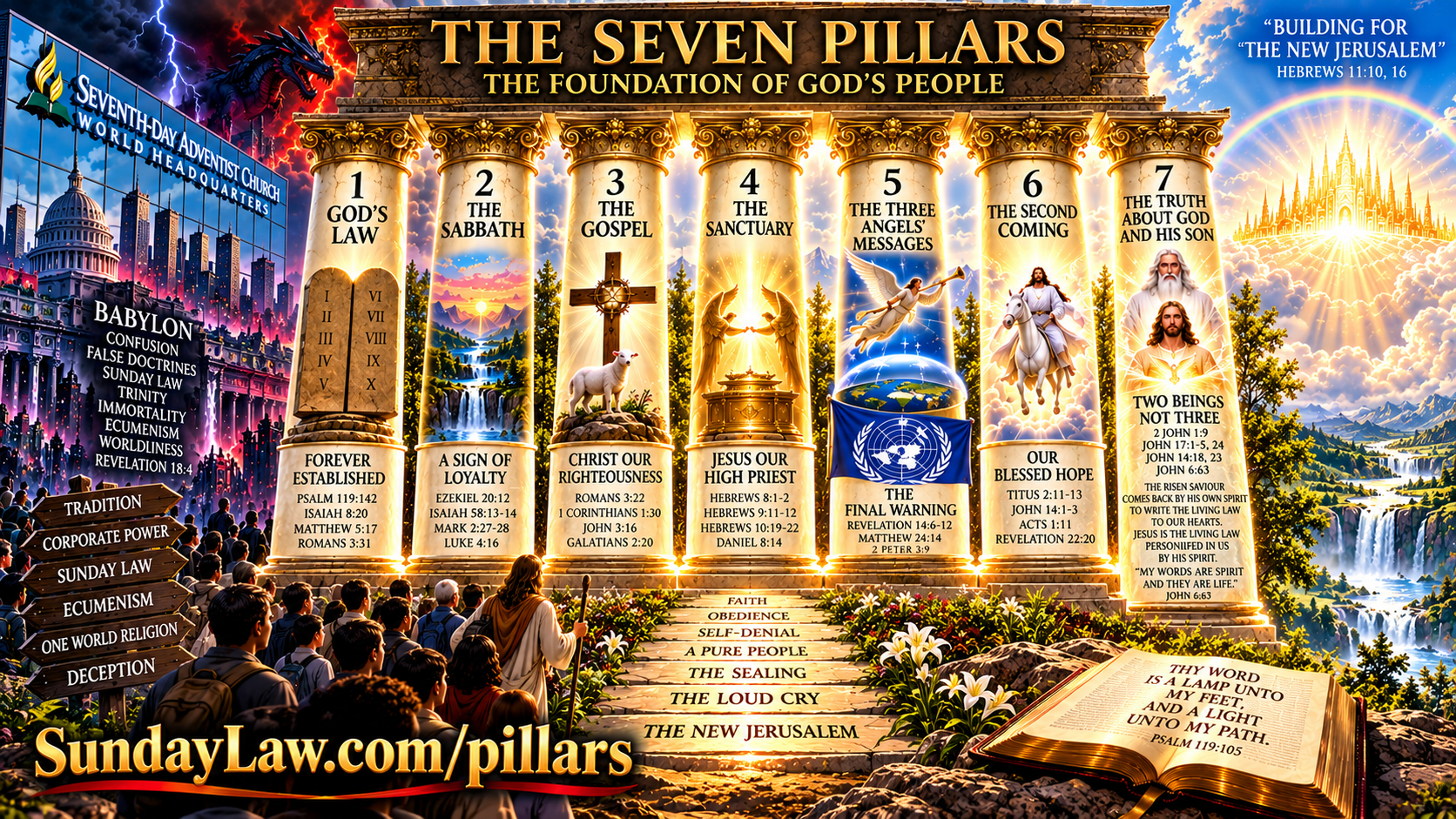
The pillars of the Advent faith lead us to the Father and His Son, Christ’s heavenly ministry, the commandments of God, the faith of Jesus, and the hope of His return. Read the complete 1872 Declaration alongside Ellen White’s old landmarks, Joseph Bates’s waymarks, and James White’s explanation of Miller’s dream.
01 · The temple vision
What did Ellen White see in the temple?
This temple was supported by seven pillars, all of transparent gold, set with pearls most glorious.
Ellen G. White, Early Writings, p. 19.1. Read the complete vision · Open the historical editions and PDFs.
Jesus leads the redeemed to Mount Zion and the glorious temple. The seven pillars belong to this vision of the better world. Turn next to her 1889 testimony for the named landmarks of the Advent experience.
02 · Manuscript 13, 1889 · Counsels to Writers and Editors, pp. 30–31
Which old landmarks did Ellen White recall?
The following seven study themes follow the connected truths in her paragraph. Read her testimony in full, then compare each theme with Scripture and the 1872 propositions.
The passing of the time in 1844 was a period of great events, opening to our astonished eyes the cleansing of the sanctuary transpiring in heaven, and having decided relation to God’s people upon the earth, [also] the first and second angels’ messages and the third, unfurling the banner on which was inscribed, “The commandments of God and the faith of Jesus.” One of the landmarks under this message was the temple of God, seen by His truth-loving people in heaven, and the ark containing the law of God. The light of the Sabbath of the fourth commandment flashed its strong rays in the pathway of the transgressors of God’s law. The nonimmortality of the wicked is an old landmark. I can call to mind nothing more that can come under the head of the old landmarks. All this cry about changing the old landmarks is all imaginary.
Read the original landmark paragraph · Read the chapter and Minneapolis context · Continue the full Old Landmarks study and original PDF library.
In the surrounding discussion she defended established truth while welcoming genuine light from Scripture. Her call is to stand on the foundation God has given and keep learning from His Word.
2. Cleansing of the heavenly sanctuary
3. The three angels’ messages
1872 concordance: XVII
4. Commandments of God and faith of Jesus
5. The heavenly temple and ark of the testament
1872 concordance: XI
6. The seventh-day Sabbath
7. Nonimmortality of the wicked
03 · Joseph Bates · 1847
What were Bates’s waymarks and high heaps?
Captain Joseph Bates published Second Advent Way Marks and High Heaps as a connected view of prophecy from 1840 to 1847. His opening landmark is the proclamation of the everlasting gospel in Revelation 14:6–7.
Open the original 1847 PDF · Download Bates’s book · Read the first landmark.
First Land Mark and High Heap
A proclamation of the everlasting gospel: fear God and give Him glory, for the hour of His judgment is come. Read this section in Bates.
Second Waymark. Tarrying of the Bridegroom
Matthew 25:5 and the tarrying experience. Read this section in Bates.
Third Way Mark. The Fall of Babylon
The second angel’s announcement and separation from fallen churches. Read this section in Bates.
Fourth Way Mark. Come Out of Her, My People
The call of Revelation 18:4. Read this section in Bates.
Fifth Way Mark. A Cry at Midnight
The Bridegroom announcement and the Advent experience of 1844. Read this section in Bates.
Sixth Way Mark. Philadelphia Church
The faithful company and Christ’s promise in Revelation 3. Read this section in Bates.
Seventh Way Mark. Seventh Angel Sounding Under the Third Wo
The seventh trumpet and the prophetic sequence. Read this section in Bates.
Eighth Way Mark. The Bridegroom Come, Marriage of the Lamb, and Door Shut
The marriage, the Bridegroom, and the shut-door experience. Read this section in Bates.
Ninth Way Mark. The Patience of the Saints Keeping the Commandments of God and the Faith or Testimony of Jesus
Revelation 14:12 and the patient, commandment-keeping saints. Read this section in Bates.
Tenth Way Mark, and High Heaps. Perilous Times Have Come in the Last Days
The little flock pressing up to the eleventh and last mark in their pathway. Read this section in Bates.
The eleventh and last mark—still ahead in 1847
THE LITTLE FLOCK PRESSING UP TO THE ELEVENTH AND LAST MARK IN THEIR PATHWAY.
That expectation appears in the heading of the tenth section. Bates closes:
Let us be watching then for the voice of God to shake the heavens and earth, for that is the next sign. Amen.
Bates, Tenth Way Mark. Read the complete closing section · Original PDF.
The pathway points toward deliverance, the voice of God, the shaking of heaven and earth, and the hope of Christ’s return. Follow the closing section into these Bible passages:
Daniel 12:1 KJV · Hebrews 12:26 KJV · Joel 3:16 KJV · Luke 21:28 KJV · Revelation 14:12 KJV
04 · The Present Truth · May 1850
Who are the jewels in William Miller’s dream?
James White’s notes distinguish the message from the people who received it. The casket holds the precious truths of the second advent; the jewels represent God’s children gathered by that message.
The casket: Bible truth
The great truths of the Bible concerning the second advent of our Lord Jesus Christ, given to William Miller to publish.
The key: Scripture interpreting Scripture
White identifies Miller’s manner of interpreting the prophetic Word: comparing scripture with scripture, with the Bible its own interpreter.
The jewels: God’s children
People from the churches and many stations of life received the Advent faith and stood in the cause of truth. White connects them with Malachi 3:17.
Counterfeits and rubbish
His notes distinguish false converts from the errors represented by dirt, shavings, and rubbish. He specifically names repeated time-setting after 1844 among the errors.
In Miller’s account, the man with the dirt-brush clears the rubbish and restores the jewels to a larger casket. The recovered treasures shine more gloriously: a call to gather, restore, and cherish what God has given.
Read the dream with James White’s notes (PDF)Original Present Truth collection (PDF)Parallel dream in Early Writings, pp. 81–83Repeat their words—restore the jewels
Read the institutional edition of Brother Miller’s Dream, with James White’s notes.
05 · Battle Creek, Michigan · 1872
What did the original 25 Fundamental Principles say?
A Declaration of the Fundamental Principles Taught and Practiced by the Seventh-day Adventists was printed by the Seventh-day Adventist Publishing Association. Its title page names Jesus Christ as the chief corner stone through Ephesians 2:20.
Download the original 1872 PDFOpen the 1872 document pageRead the original scans hereSearch and share these passages
The complete introduction and all twenty-five propositions follow in their original Roman-numeral order. The topic labels beside the numerals are a study guide; the quoted paragraphs preserve the declaration’s text.
The original introduction: the Bible and the synopsis
In presenting to the public this synopsis of our faith, we wish to have it distinctly understood that we have no articles of faith, creed, or discipline, aside from the Bible. We do not put forth this as having any authority with our people, nor is it designed to secure uniformity among them, as a system of faith, but is a brief statement of what is, and has been, with great unanimity, held by them. We often find it necessary to meet inquiries on this subject, and sometimes to correct false statements circulated against us, and to remove erroneous impressions which have obtained with those who have not had an opportunity to become acquainted with our faith and practice. Our only object is to meet this necessity.
As Seventh-day Adventists we desire simply that our position shall be understood; and we are the more solicitous for this because there are many who call themselves Adventists who hold views with which we can have no sympathy, some of which, we think, are subversive of the plainest and most important principles set forth in the word of God.
As compared with other Adventists, Seventh-day Adventists differ from one class in believing in the unconscious state of the dead, and the final destruction of the unrepentant wicked; from another, in believing in the perpetuity of the law of God as summarily contained in the ten commandments, in the operation of the Holy Spirit in the church, and in setting no times for the advent to occur; from all, in the observance of the seventh day of the week as the Sabbath of the Lord, and in many applications of the prophetic scriptures.
With these remarks, we ask the attention of the reader to the following propositions, which aim to be a concise statement of the more prominent features of our faith.
1872 Declaration, pp. 3–4; PDF scans 2–3. See the printed introduction · Compare the institutional transcription.
I One God
That there is one God, a personal, spiritual being, the creator of all things, omnipotent, omniscient, and eternal, infinite in wisdom, holiness, justice, goodness, truth, and mercy; unchangeable, and everywhere present by his representative, the Holy Spirit. Ps. 139:7.
Fundamental Principles (1872), I, printed p. 4. Original PDF, scan 3 · Institutional text.
II Jesus Christ, the Son of the Eternal Father
That there is one Lord Jesus Christ, the Son of the Eternal Father, the one by whom God created all things, and by whom they do consist; that he took on him the nature of the seed of Abraham for the redemption of our fallen race; that he dwelt among men full of grace and truth, lived our example, died our sacrifice, was raised for our justification, ascended on high to be our only mediator in the sanctuary in Heaven, where, with his own blood he makes atonement for our sins; which atonement so far from being made on the cross, which was but the offering of the sacrifice, is the very last portion of his work as priest, according to the example of the Levitical priesthood, which foreshadowed and prefigured the ministry of our Lord in Heaven. See Lev. 16; Heb. 8:4, 5; 9:6, 7; &c.
Fundamental Principles (1872), II, printed p. 4. Original PDF, scan 3 · Institutional text.
III The Holy Scriptures
That the Holy Scriptures, of the Old and New Testaments, were given by inspiration of God, contain a full revelation of his will to man, and are the only infallible rule of faith and practice.
Fundamental Principles (1872), III, printed p. 5. Original PDF, scan 3 · Institutional text.
IV Baptism by immersion
That Baptism is an ordinance of the Christian church, to follow faith and repentance, an ordinance by which we commemorate the resurrection of Christ, as by this act we show our faith in his burial and resurrection, and through that, of the resurrection of all the saints at the last day; and that no other mode fitly represents these facts than that which the Scriptures prescribe, namely, immersion. Rom. 6:3-5; Col. 2:12.
Fundamental Principles (1872), IV, printed p. 5. Original PDF, scan 3 · Institutional text.
V The new birth
That the new birth comprises the entire change necessary to fit us for the kingdom of God, and consists of two parts: first, a moral change, wrought by conversion and a Christian life; second, a physical change at the second coming of Christ, whereby, if dead, we are raised incorruptible, and if living, are changed to immortality in a moment, in the twinkling of an eye. John 3:3, 5; Luke 20:36.
Fundamental Principles (1872), V, printed p. 6. Original PDF, scan 4 · Institutional text.
VI Understanding prophecy
We believe that prophecy is a part of God’s revelation to man; that it is included in that scripture which is profitable for instruction, 2 Tim. 3:16; that it is designed for us and our children: Deut. 29:29; that so far from being enshrouded in impenetrable mystery, it is that which especially constitutes the word of God a lamp to our feet and a light to our path, Ps. 119:105, 2 Pet. 2:19; that a blessing is pronounced upon those who study it, Rev. 1:1-3; and that, consequently, it is to be understood by the people of God sufficiently to show them their position in the world’s history, and the special duties required at their hands.
Fundamental Principles (1872), VI, printed p. 6. Original PDF, scan 4 · Institutional text.
VII History outlined in prophecy
That the world’s history from specified dates in the past, the rise and fall of empires, and chronological succession of events down to the setting up of God’s everlasting kingdom, are outlined in numerous great chains of prophecy; and that these prophecies are now all fulfilled except the closing scenes.
Fundamental Principles (1872), VII, printed p. 7. Original PDF, scan 4 · Institutional text.
VIII Christ comes before the millennium
That the doctrine of the world’s conversion and temporal millennium is a fable of these last days, calculated to lull men into a state of carnal security, and cause them to be overtaken by the great day of the Lord as by a thief in the night; that the second coming of Christ is to precede, not follow, the millennium; for until the Lord appears the papal power, with all its abominations, is to continue, the wheat and tares grow together, and evil men and seducers wax worse and worse, as the word of God declares.
Fundamental Principles (1872), VIII, printed p. 7. Original PDF, scan 4 · Institutional text.
IX 1844 and the 2300 days
That the mistake of Adventists in 1844 pertained to the nature of the event then to transpire, not to the time; that no prophetic period is given to reach to the second advent, but that the longest one, the two thousand and three hundred days of Dan. 8:14, terminated in that year, and brought us to an event called the cleansing of the sanctuary.
Fundamental Principles (1872), IX, printed p. 7. Original PDF, scan 4 · Institutional text.
X The heavenly sanctuary
That the sanctuary of the new covenant is the tabernacle of God in Heaven, of which Paul speaks in Hebrews 8, and onward, of which our Lord, as great High Priest, is minister; that this sanctuary is the antitype of the Mosaic tabernacle, and that the priestly work of our Lord, connected therewith, is the antitype of the work of the Jewish priests of the former dispensation. Heb. 8:1-5, &c.; that this is the sanctuary to be cleansed at the end of the 2300 days, what is termed its cleansing being in this case, as in the type, simply the entrance of the high priest into the most holy place, to finish the round of service connected therewith, by blotting out and removing from the sanctuary the sins which had been transferred to it by means of the ministration in the first apartment. Heb. 9:22, 23; and that this work in the antitype, commencing in 1844, occupies a brief but indefinite space, at the conclusion of which the work of mercy for the world is finished.
Fundamental Principles (1872), X, printed p. 8. Original PDF, scan 5 · Institutional text.
XI The law and the ark
That God’s moral requirements are the same upon all men in all dispensations; that these are summarily contained in the commandments spoken by Jehovah from Sinai, engraven on the tables of stone, and deposited in the ark, which was in consequence called the “ark of the covenant,” or testament. Num. 10:33, Heb. 9:4, &c.; that this law is immutable and perpetual, being a transcript of the tables deposited in the ark in the true sanctuary on high, which is also, for the same reason, called the ark of God’s testament; for under the sounding of the seventh trumpet we are told that “the temple of God was opened in Heaven, and there was seen in his temple the ark of his testament.” Rev. 11:19.
Fundamental Principles (1872), XI, printed p. 8. Original PDF, scan 5 · Institutional text.
XII The seventh-day Sabbath
That the fourth commandment of this law requires that we devote the seventh day of each week, commonly called Saturday, to abstinence from our own labor, and to the performance of sacred and religious duties; that this is the only weekly Sabbath known to the Bible, being the day that was set apart before paradise was lost, Gen. 2:2, 3, and which will be observed in paradise restored, Isa. 66:22, 23; that the facts upon which the Sabbath institution is based confine it to the seventh day, as they are not true of any other day; and that the terms, Jewish Sabbath and Christian Sabbath, as applied to the weekly rest-day, are names of human invention, unscriptural in fact, and false in meaning.
Fundamental Principles (1872), XII, printed p. 9. Original PDF, scan 5 · Institutional text.
XIII Sabbath reform
That as the man of sin, the papacy, has thought to change times and laws (the laws of God), Dan. 7:25, and has misled almost all Christendom in regard to the fourth commandment, we find a prophecy of a reform in this respect to be wrought among believers just before the coming of Christ. Isa. 56:1, 2, 1 Pet. 1:5, Rev. 14:12, &c.
Fundamental Principles (1872), XIII, printed p. 10. Original PDF, scan 6 · Institutional text.
XIV Conversion and the Holy Spirit
That as the natural or carnal heart is at enmity with God and his law, this enmity can be subdued only by a radical transformation of the affections, the exchange of unholy for holy principles; that this transformation follows repentance and faith, is the special work of the Holy Spirit, and constitutes regeneration or conversion.
Fundamental Principles (1872), XIV, printed p. 10. Original PDF, scan 6 · Institutional text.
XV Justification and grace through Christ
That as all have violated the law of God, and cannot of themselves render obedience to his just requirements, we are dependent on Christ, first, for justification from our past offences, and, secondly, for grace whereby to render acceptable obedience to his holy law in time to come.
Fundamental Principles (1872), XV, printed p. 10. Original PDF, scan 6 · Institutional text.
XVI Spiritual gifts and Scripture
That the Spirit of God was promised to manifest itself in the church through certain gifts, enumerated especially in 1 Cor. 12 and Eph. 4; that these gifts are not designed to supersede, or take the place of, the Bible, which is sufficient to make us wise unto salvation, any more than the Bible can take the place of the Holy Spirit; that in specifying the various channels of its operation, that Spirit has simply made provision for its own existence and presence with the people of God to the end of time, to lead to an understanding of that word which it had inspired, to convince of sin, and work a transformation in the heart and life; and that those who deny to the Spirit its place and operation, do plainly deny that part of the Bible which assigns to it this work and position.
Fundamental Principles (1872), XVI, printed p. 11. Original PDF, scan 6 · Institutional text.
XVII The three messages of Revelation 14
That God, in accordance with his uniform dealings with the race, sends forth a proclamation of the approach of the second advent of Christ; that this work is symbolized by the three messages of Rev. 14, the last one bringing to view the work of reform on the law of God, that his people may acquire a complete readiness for that event.
Fundamental Principles (1872), XVII, printed p. 11. Original PDF, scan 6 · Institutional text.
XVIII Investigative judgment
That the time of the cleansing of the sanctuary (see proposition X), synchronizing with the time of the proclamation of the third message, is a time of investigative judgment, first with reference to the dead, and at the close of probation with reference to the living, to determine who of the myriads now sleeping in the dust of the earth are worthy of a part in the first resurrection, and who of its living multitudes are worthy of translation—points which must be determined before the Lord appears.
Fundamental Principles (1872), XVIII, printed p. 12. Original PDF, scan 7 · Institutional text.
XIX The grave
That the grave, whither we all tend, expressed by the Hebrew sheol, and the Greek hades, is a place of darkness in which there is no work, device, wisdom, or knowledge. Eccl. 9:10.
Fundamental Principles (1872), XIX, printed p. 12. Original PDF, scan 7 · Institutional text.
XX The unconscious state of the dead
That the state to which we are reduced by death is one of silence, inactivity, and entire unconsciousness. Ps. 146:4; Eccl. 9:5, 6; Dan. 12:2, &c.
Fundamental Principles (1872), XX, printed p. 12. Original PDF, scan 7 · Institutional text.
XXI Two bodily resurrections
That out of this prison house of the grave mankind are to be brought by a bodily resurrection; the righteous having part in the first resurrection, which takes place at the second advent of Christ, the wicked in the second resurrection, which takes place a thousand years thereafter. Rev. 20:4-6.
Fundamental Principles (1872), XXI, printed p. 12. Original PDF, scan 7 · Institutional text.
XXII The living righteous changed
That at the last trump, the living righteous are to be changed in a moment, in the twinkling of an eye, and with the resurrected righteous are to be caught up to meet the Lord in the air, so forever to be with the Lord.
Fundamental Principles (1872), XXII, printed p. 13. Original PDF, scan 7 · Institutional text.
XXIII The thousand years
That these immortalized ones are then taken to Heaven, to the New Jerusalem, the Father’s house in which there are many mansions, John 14:1-3, where they reign with Christ a thousand years, judging the world and fallen angels, that is, apportioning the punishment to be executed upon them at the close of the one thousand years; Rev. 20:4; 1 Cor. 6:2, 3; that during this time the earth lies in a desolate and chaotic condition, Jer. 4:20-27, described, as in the beginning by the Greek term abussos (ἄβυσσος) bottomless pit (Septuagint of Gen. 1:2); and that here Satan is confined during the thousand years, Rev. 20:1, 2, and here finally destroyed, Rev. 20:10; Mal. 4:1; the theater of the ruin he has wrought in the universe, being appropriately made for a time his gloomy prison house, and then the place of his final execution.
Fundamental Principles (1872), XXIII, printed p. 13. Original PDF, scan 7 · Institutional text.
XXIV Final destruction of the wicked
That at the end of the thousand years, the Lord descends with his people and the New Jerusalem, Rev. 21:2, the wicked dead are raised and come up upon the surface of the yet unrenewed earth, and gather about the city, the camp of the saints, Rev. 20:9, and fire comes down from God out of heaven and devours them. They are then consumed root and branch, Mal. 4:1, becoming as though they had not been. Obad. 15, 16. In this everlasting destruction from the presence of the Lord, 2 Thess. 1:9, the wicked meet the everlasting punishment threatened against them, Matt. 25:46. This is the perdition of ungodly men, the fire which consumes them being the fire for which “the heavens and the earth which are now” are kept in store, which shall melt even the elements with its intensity, and purge the earth from the deepest stains of the curse of sin. 2 Pet. 3:7-12.
Fundamental Principles (1872), XXIV, printed p. 14. Original PDF, scan 8 · Institutional text.
XXV The new heavens and earth
That a new heavens and earth shall spring by the power of God from the ashes of the old, to be, with the New Jerusalem for its metropolis and capital, the eternal inheritance of the saints, the place where the righteous shall evermore dwell. 2 Pet. 3:13; Ps. 37:11, 29; Matt. 5:5.
Fundamental Principles (1872), XXV, printed p. 14. Original PDF, scan 8 · Institutional text.
Read the original 1872 printing
Page numbers count the PDF scans, including covers and preliminary leaves. Scroll to read and turn pages at the edge; drag to pan; use Ctrl+scroll to zoom. Recenter restores the fitted width.
The doctrine of Christ · 2 John 1:9 · KJV
What does it mean to have both the Father and the Son?
Whosoever transgresseth, and abideth not in the doctrine of Christ, hath not God. He that abideth in the doctrine of Christ, he hath both the Father and the Son.
Abiding in the doctrine of Christ means having BOTH THE FATHER AND THE SON.
John explicitly identifies the Father and the Son. Abide in Christ’s doctrine, receive the Father, and believe in His Son. The first two 1872 principles name one God and one Lord Jesus Christ, the Son of the Eternal Father.
Study the Father and His Son in Scripture and the pioneer writings · Read Principle I · Read Principle II.
06 · Expanded pioneer studies · Themes 8–25
How do the wider pioneer teachings connect with Scripture?
Continue beyond the seven themes of the 1889 landmark paragraph. These eighteen related studies connect KJV passages, pioneer sources, and the 1872 declaration where it addresses the subject.
07 · Adventist pioneer library · Twenty reading paths
Where can I read the pioneer books?
Open the books, sermons, periodicals, and charts behind the study. The edition or destination type appears beside each title.
William Miller
Evidence from Scripture and History (1842 edition)
William Miller
Views of the Prophecies and Prophetic Chronology (1842 edition)
James White, Ellen White, Joseph Bates
A Word to the Little Flock (1847)
James White
The Present Truth (1849–1850)
William Miller; notes by James White
Brother Miller’s Dream (May 1850)
James White
Life Incidents (1868)
Joseph Bates
The Seventh Day Sabbath, a Perpetual Sign (1846)
Joseph Bates
Second Advent Way Marks and High Heaps (1847)
Joseph Bates
A Vindication of the Seventh-day Sabbath (1848)
Joseph Bates
A Seal of the Living God (1849)
Joseph Bates
An Explanation of the Typical and Anti-typical Sanctuary (1850)
J. N. Andrews
The Three Angels of Revelation 14:6–12 (1855 edition)
J. N. Andrews
History of the Sabbath and First Day of the Week
J. N. Loughborough
Rise and Progress of Seventh-day Adventists (1892)
J. N. Loughborough
The Great Second Advent Movement (1905)
J. N. Loughborough
Questions on the Sealing Message (1916)
Charles Fitch
Come Out of Her, My People (1843)
O. R. L. Crosier
The Law of Moses (Day-Star Extra, February 7, 1846)
Ellen G. White
Early Writings: historical printed editions
Charles Fitch, Apollos Hale, Otis Nichols
The 1843 and 1850 prophetic charts
08 · Historical timeline
How do these witnesses fit into Advent history?
- 1841–1844: Millerite proclamation, prophetic calculations, the 1843 chart, and the midnight cry. Explore the charts.
- 1845–1847: Sanctuary study, Bates’s Sabbath writings, Way Marks, and A Word to the Little Flock. Read Little Flock.
- 1848–1850: Sabbath conferences, sealing publications, The Present Truth, White’s notes on Miller’s dream, and the 1850 chart. Read The Present Truth.
- 1851–1872: Continued pioneer exposition and the published summary of twenty-five principles. Read the declaration.
- 1889–1916: Ellen White’s explicit landmark recollection and Loughborough’s historical and sealing testimony. Follow the historical sources.
Search the text and share a passage
Type a word or several nearby keywords. Select passages to copy or share with their source, direct reading link, preview artwork, and invitation to revive the Advent pioneer books.
Share selected by email or social network
Enter keywords to find and share passages.
Questions about the pillars, waymarks, and principles
What were the 1872 Fundamental Principles?
The 1872 Declaration published at Battle Creek presented 25 propositions describing widely held Seventh-day Adventist beliefs. Its introduction affirmed the Bible as the rule of faith and did not give the synopsis authority over believers.
What are Ellen White’s old landmarks?
Her 1889 statement recalls 1844, the heavenly sanctuary, the three angels’ messages, the commandments and faith of Jesus, the heavenly temple and ark, the seventh-day Sabbath, and the nonimmortality of the wicked.
How many waymarks did Joseph Bates describe in 1847?
His book contains ten waymark sections. In the tenth he describes the little flock pressing toward an eleventh and last mark, and closes by looking for the voice of God to shake the heavens and earth.
Who are the jewels in William Miller’s dream?
James White’s May 1850 notes identify the jewels with God’s children who received the Advent faith. The casket represents the great Bible truths concerning Christ’s second advent; the key represents Scripture interpreting Scripture.
Will you walk in the ancient paths?
“Earnestly contend for the faith which was once delivered unto the saints.” Jude 1:3, KJV.
“The repairer of the breach, The restorer of paths to dwell in.” Isaiah 58:12, KJV.
Open the Word. Read the witnesses. Follow Jesus into His heavenly ministry, keep the commandments of God and the faith of Jesus, and proclaim the three angels’ messages. Revive the old landmarks and restore the jewels.