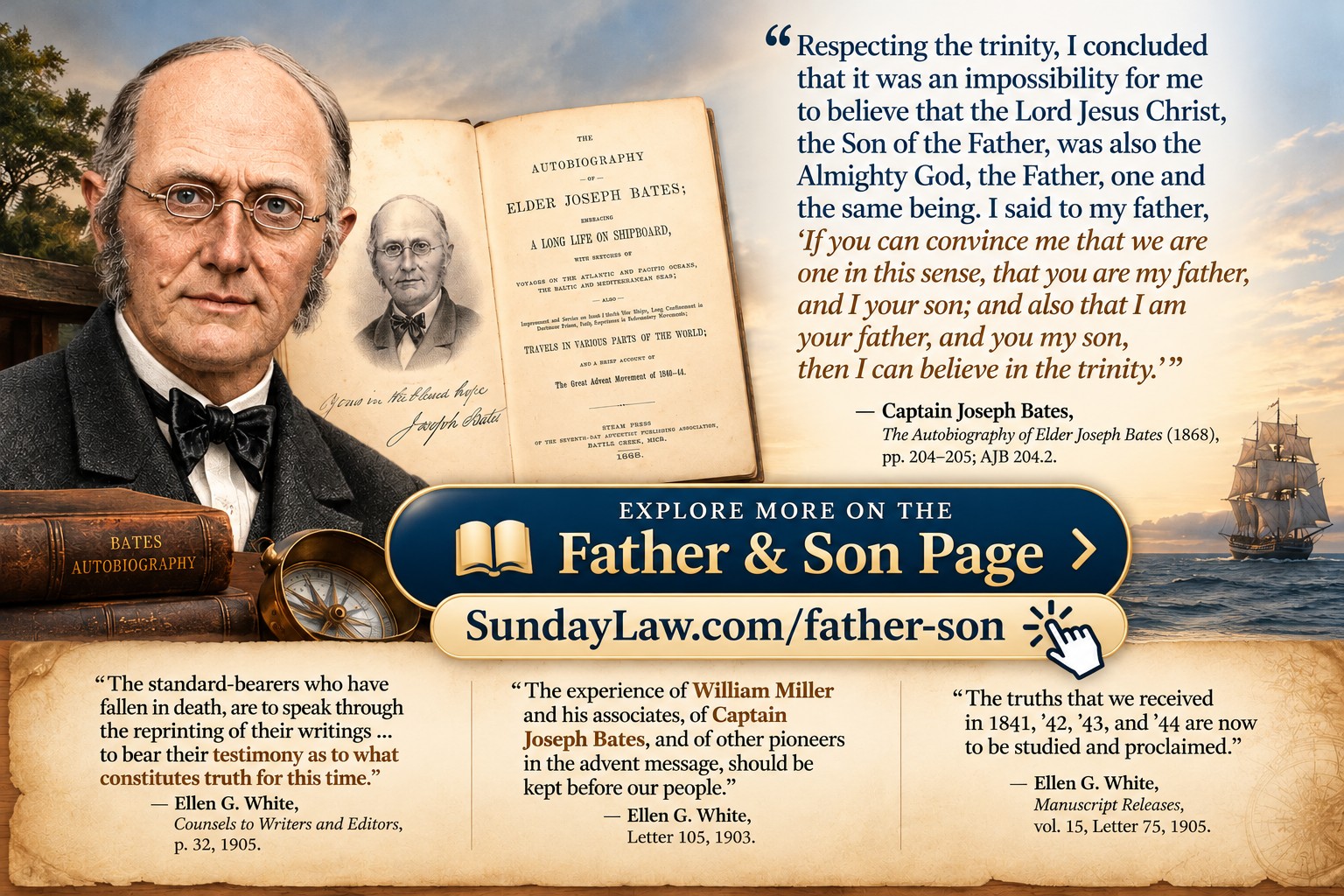
Jesus calls the Father “my Father, and your Father” and “my God, and your God” (John 20:17, KJV). The Father is God, and His Son is Himself called God in Hebrews 1:8. Read the distinct testimony of the Father and His Son, the authority the Son receives, and the honor the Father commands us to give Him.
What did Joseph Bates say about the Father and the Son?
Respecting the trinity, I concluded that it was an impossibility for me to believe that the Lord Jesus Christ, the Son of the Father, was also the Almighty God, the Father, one and the same being. I said to my father, “If you can convince me that we are one in this sense, that you are my father, and I your son; and also that I am your father, and you my son, then I can believe in the trinity.”
Captain Joseph Bates, The Autobiography of Elder Joseph Bates (1868), pp. 204–205; AJB 204.2.
Bates’s argument preserves the reality of the relationship: the Son is the Son of the Father, and the Father is not His own Son. His 1868 autobiography recounts his earlier convictions; the date of publication and the earlier experience are distinct.
R. F. Cottrell answers by joining John 5:23 to Hebrews 1: worship of the Son honors the Father who commands it. The Son’s divine name and honor stand together with His Father’s authority.
It may be objected, If the Father and the Son are two distinct beings, do you not, in worshiping the Son and calling him God, break the first commandment of the Decalogue?
No; it is the Father's will “That all men should honor the Son, even as they honor the Father.” We cannot break the commandment and dishonor God by obeying him. The Father says of the Son, “Let all the angels of God worship him.” Should angels refuse to worship the Son, they would rebel against the Father. Children inherit the name of their father. The Son of God “hath by inheritance obtained a more excellent name than” the angels. That name is the name of his Father. The Father says to the Son, “Thy throne, O God, is forever and ever.” Heb. i. The Son is called “The mighty God.” Isa. ix, 6. And when he comes again to earth his waiting people will exclaim, “This is our God.” Isa. xxv, 9. It is the will of the Father that we should thus honor the Son. In doing so we render supreme honor to the Father. If we dishonor the Son we dishonor the Father; for he requires us to honor his Son.
But though the Son is called God yet there is a “God and Father of our Lord Jesus Christ.” 1 Pet. i, 3. Though the Father says to the Son, “Thy throne, O God, is forever and ever,” yet, that throne is given him of his Father; and because he loved righteousness and hated iniquity, he further says, “Therefore God, even thy God, hath anointed thee.” Heb. i, 9. “God hath made that same Jesus both Lord and Christ.” Acts. ii, 36. The Son is “the everlasting Father,” not of himself, nor of his Father, but of his children. His language is, “I and the children which God hath given me.” Heb. ii, 13.
R. F. Cottrell, Advent Review and Sabbath Herald, June 1, 1869, p. 181; local PDF scan 5.
Page numbers count the PDF scans, including covers and preliminary leaves. Scroll to read and turn pages at the edge; drag to pan; use Ctrl+scroll to zoom. Recenter restores the fitted width.
Why number the faithful Sabbath pioneers with the 144,000?
Cottrell is presented here among the Sabbath pioneers numbered with the 144,000 according to the pioneer sealing teaching: death does not remove those who died in the faith of the third angel’s message, keeping the Sabbath, from the sealed company. They rise before Christ’s appearing and stand among the living saints.
If they were then sealed, they will be among those resurrected to eternal life at the voice of God.
J. N. Loughborough, Questions on the Sealing Message (1916), pp. 24–25; PDF scans 26–27.
Loughborough’s argument concerns faithful Sabbathkeepers who received the sealing message—not merely a name on a church membership list. This is the pioneer teaching applied to Cottrell here.
Page numbers count the PDF scans, including covers and preliminary leaves. Scroll to read and turn pages at the edge; drag to pan; use Ctrl+scroll to zoom. Recenter restores the fitted width.
What does Scripture say about the Father, His Son, and received authority?
Jesus has a Father and a God—the same Father and God He identifies to His brethren. The Father gives life, authority, and a kingdom to His Son; the Son reveals, honors, and ultimately subjects Himself to the Father. This is the scriptural foundation of SundayLaw.com’s Father-and-Son confession: a real Father and His divine Son, rather than a Son who is His own Father.
John 20:17 (KJV)
Jesus saith unto her, Touch me not; for I am not yet ascended to my Father: but go to my brethren, and say unto them, I ascend unto my Father, and your Father; and to my God, and your God.
John 5:26 (KJV)
For as the Father hath life in himself; so hath he given to the Son to have life in himself;
1 Corinthians 8:5–6 (KJV)
5 For though there be that are called gods, whether in heaven or in earth, (as there be gods many, and lords many,)
6 But to us there is but one God, the Father, of whom are all things, and we in him; and one Lord Jesus Christ, by whom are all things, and we by him.
1 Corinthians 15:24–28 (KJV)
24 Then cometh the end, when he shall have delivered up the kingdom to God, even the Father; when he shall have put down all rule and all authority and power.
25 For he must reign, till he hath put all enemies under his feet.
26 The last enemy that shall be destroyed is death.
27 For he hath put all things under his feet. But when he saith all things are put under him, it is manifest that he is excepted, which did put all things under him.
28 And when all things shall be subdued unto him, then shall the Son also himself be subject unto him that put all things under him, that God may be all in all.
1 Corinthians 11:3 (KJV)
But I would have you know, that the head of every man is Christ; and the head of the woman is the man; and the head of Christ is God.
John 14:28 (KJV)
Ye have heard how I said unto you, I go away, and come again unto you. If ye loved me, ye would rejoice, because I said, I go unto the Father: for my Father is greater than I.
John 17:3 (KJV)
And this is life eternal, that they might know thee the only true God, and Jesus Christ, whom thou hast sent.
John 5:19 (KJV)
Then answered Jesus and said unto them, Verily, verily, I say unto you, The Son can do nothing of himself, but what he seeth the Father do: for what things soever he doeth, these also doeth the Son likewise.
John 5:30 (KJV)
I can of mine own self do nothing: as I hear, I judge: and my judgment is just; because I seek not mine own will, but the will of the Father which hath sent me.
John 6:38 (KJV)
For I came down from heaven, not to do mine own will, but the will of him that sent me.
Ephesians 4:5–6 (KJV)
5 One Lord, one faith, one baptism,
6 One God and Father of all, who is above all, and through all, and in you all.
Philippians 2:9–11 (KJV)
9 Wherefore God also hath highly exalted him, and given him a name which is above every name:
10 That at the name of Jesus every knee should bow, of things in heaven, and things in earth, and things under the earth;
11 And that every tongue should confess that Jesus Christ is Lord, to the glory of God the Father.
1 Timothy 2:5 (KJV)
For there is one God, and one mediator between God and men, the man Christ Jesus;
Malachi 2:10 (KJV)
Have we not all one father? hath not one God created us? why do we deal treacherously every man against his brother, by profaning the covenant of our fathers?
1 Thessalonians 1:9–10 (KJV)
9 For they themselves shew of us what manner of entering in we had unto you, and how ye turned to God from idols to serve the living and true God;
10 And to wait for his Son from heaven, whom he raised from the dead, even Jesus, which delivered us from the wrath to come.
2 Corinthians 1:3 (KJV)
Blessed be God, even the Father of our Lord Jesus Christ, the Father of mercies, and the God of all comfort;
John 6:27 (KJV)
Labour not for the meat which perisheth, but for that meat which endureth unto everlasting life, which the Son of man shall give unto you: for him hath God the Father sealed.
1 John 4:9 (KJV)
In this was manifested the love of God toward us, because that God sent his only begotten Son into the world, that we might live through him.
2 John 1:3 (KJV)
Grace be with you, mercy, and peace, from God the Father, and from the Lord Jesus Christ, the Son of the Father, in truth and love.
Hebrews 1:8–9 (KJV)
8 But unto the Son he saith, Thy throne, O God, is for ever and ever: a sceptre of righteousness is the sceptre of thy kingdom.
9 Thou hast loved righteousness, and hated iniquity; therefore God, even thy God, hath anointed thee with the oil of gladness above thy fellows.
Honor the Son even as the Father. The Father’s supremacy and the Son’s divinity belong in the same confession. Hebrews calls the Son “O God” and then speaks of “God, even thy God.” Read both statements together.
Two praying companies: whom were they following?
The March 14, 1846 Day-Star account distinguishes those following Jesus into the Holiest from those who remain before the throne and receive Satan’s unholy influence. Read the complete passage; its test reaches beyond displays of light and power to the love, joy, and peace that accompany the Holy Ghost.
Those who rose up when Jesus did, kept their eyes fixed on him as he left the throne, and led them out a little way, then he raised his right arm and we heard his lovely voice saying, wait ye, I am going to my Father to receive the Kingdom. Keep your garments spotless and in a little while I will return from the wedding, and receive you to myself. And I saw a cloudy chariot with wheels like flaming fire. Angels were all about the chariot as it came where Jesus was; he stepped into it and was borne to the Holiest where the Father sat. Then I beheld Jesus as he was before the Father a great High Priest. On the hem of his garment was a bell and a pomegranate, a bell and a pomegranate. Then Jesus shewed me the difference between faith and feeling. And I saw those who rose up with Jesus send up their faith to Jesus in the Holiest, and praying, Father give us thy spirit. Then Jesus would breathe on them the Holy Ghost. In the breath was light, power and much love, joy and peace. Then I turned to look at the company who were still bowed before the throne. They did not know that Jesus had left it. Satan appeared to be by the throne trying to carry on the work of God. I saw them look up to the throne and pray, My Father give us thy spirit. Then Satan would breathe on them an unholy influence. In it there was light and much power, but no sweet love, joy and peace. Satan's object was to keep them deceived and to draw back and deceive God's children. I saw one after another leave the company who were praying to Jesus in the Holiest, go and join those before the throne and they at once received the unholy influence of Satan.
Ellen G. Harmon, The Day-Star, March 14, 1846, paragraph 1; local PDF scan 5, internal text p. 9, par. 1.
A warning against false worship: SundayLaw.com’s application
Follow the real Son to His real Father. This study applies the vision’s warning to Trinitarian teaching that displaces the Father-and-Son relationship proclaimed by these pioneers. The call is to examine whom we worship and whom we follow—not to mistake spiritual power for the presence of God. The vision’s wording stands above; this application is the site’s doctrinal comparison.
In the sanctuary study, the October 22, 1844 transition directs faith to Christ’s ministry in the Most Holy Place. Explore the wedding and preparation of the people of God in the studies of the heavenly sanctuary, the 144,000, and the New Jerusalem.
Page numbers count the PDF scans, including covers and preliminary leaves. Scroll to read and turn pages at the edge; drag to pan; use Ctrl+scroll to zoom. Recenter restores the fitted width.
Why let the pioneers speak again?
And the standard-bearers who have fallen in death, are to speak through the reprinting of their writings. I am instructed that thus their voices are to be heard. They are to bear their testimony as to what constitutes the truth for this time.
The experience of William Miller and his associates, of Captain Joseph Bates, and of other pioneers in the Advent message should be kept before our people.
The truths that we received in 1841, ’42, ’43, and ’44 are now to be studied and proclaimed.
Ellen G. White · Ellen G. White, Letter 75, February 20, 1905; The Three Angels’ Messages, p. 126.2. Read the source
Keep the experience of William Miller, Captain Joseph Bates, and their fellow pioneers before the people. Return to Scripture, read their testimony, and carry their words to another reader.
Type a word or several nearby keywords. Select passages to copy or share with their source, direct reading link, preview artwork, and invitation to revive the Advent pioneer books.