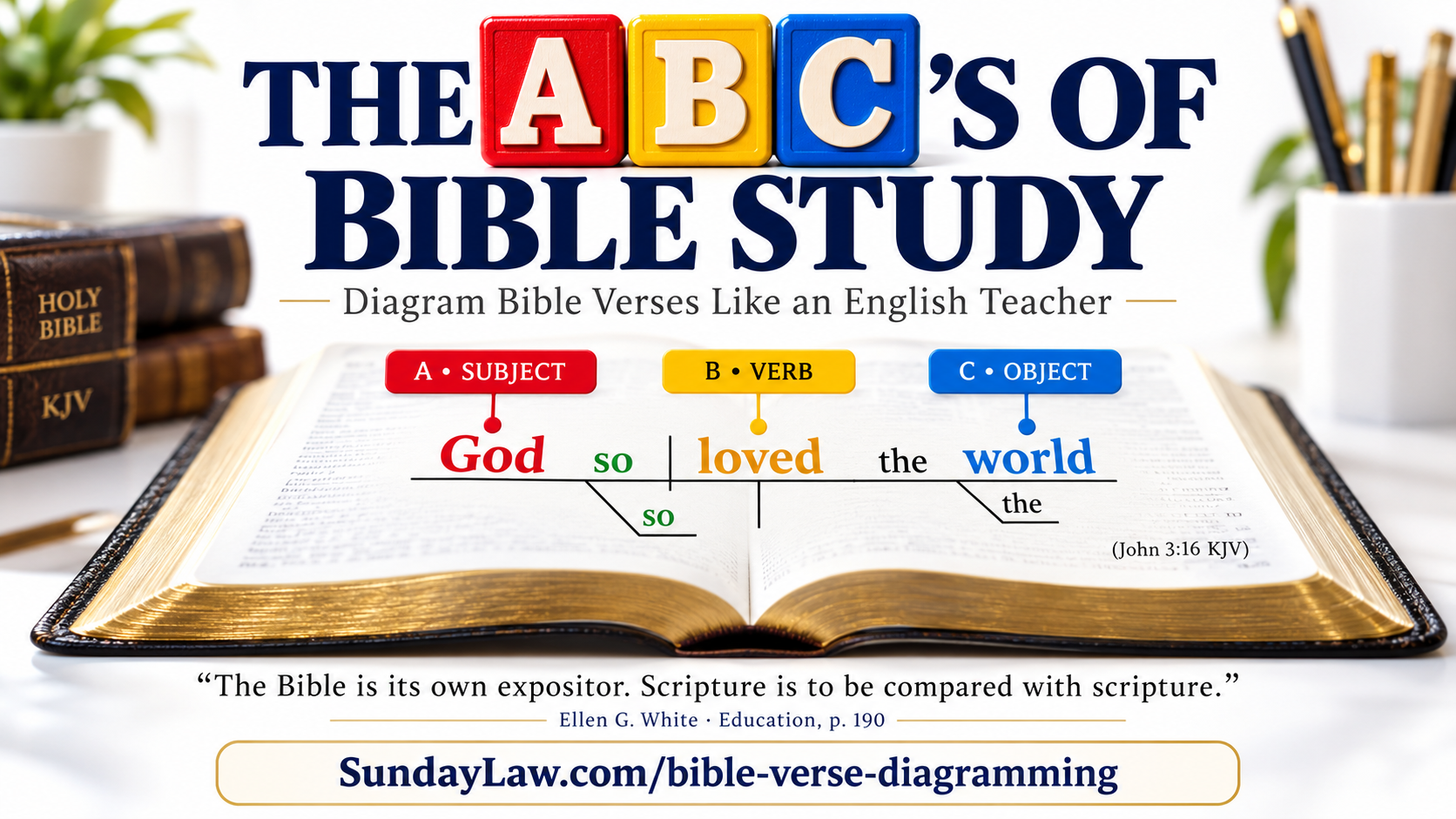
ABC’S OF BIBLE VERSE DIAGRAMMING · LESSON 1
Matthew 28:17–20
Context comes first. Matthew 28:17–20 gives the complete closing scene of the chapter: worship, doubt, Christ’s authority, the command, ongoing instruction, and the promise of His presence.
R.F. Cottrell on Worshiping the Son
— R.F. Cottrell, Review & Herald, June 1, 1869“It may be objected, If the Father and the Son are two distinct beings, do you not, in worshipping the Son and calling him God, break the first commandment of the decalogue?
No; it is the Father’s will ‘That all men should honor the Son, even as they honor the Father.’ We cannot break the commandment and dishonor God by obeying him. The Father says of the Son, ‘Let all the angels of God worship him.’ Should angels refuse to worship the Son, they would rebel against the Father.
Children inherit the name of their Father. The Son of God ‘hath by inheritance obtained a more excellent name than’ the angels. That name is the name of his Father. The Father says to the Son, ‘Thy throne, O God, is forever and ever.’ Heb.1. The Son is called ‘The mighty God.’ Isa. 9:6. And when he comes again to earth his waiting people will exclaim, ‘This is our God.’ Isa. 25:9. It is the will of the Father that we should thus honor the Son. In doing so we render supreme honor to the Father. If we dishonor the Son, we dishonor the Father; for he requires us to honor his son.
But though the Son is called God, yet there is a ‘God and Father of our Lord Jesus Christ’ 1 Pet. 1:3. Though the Father says to the Son, ‘Thy throne, O God, is forever and ever,’ yet, that throne is given him of his Father; and because he loved righteousness and hated iniquity, he further says, ‘Therefore God, even thy God, hath anointed thee.’ Heb. 1:9. ‘God hath made that same Jesus both Lord and Christ.’ Acts 2:36. The Son is ‘the everlasting Father,’ not of himself, nor of his Father, but of his children. His language is, ‘I and the children which God hath given me.’ Heb. 2:13.”
Jesus Is Divine by Inheritance
This shows the Son is truly divine, but He is not the same being as the Father. Jesus is truly the only formed God (Isaiah 43:10), and Micah 5:2 speaks of His goings forth as from old, from everlasting. John 20:17 preserves His own words: “my Father, and your Father; and to my God, and your God.”
God commanded the angels to worship His Son. The shepherds at Bethlehem heard heaven’s witness, and the wise men worshiped Him. We are to worship the Son too. Both the Father and Son are alone to be exalted and worshiped, while Scripture still says, “to us there is but one God, the Father” (1 Corinthians 8:6), the God and Father of Jesus Christ.
After the plan of redemption is completed, 1 Corinthians 15:28 says: “When all things shall be subdued unto him, then shall the Son also himself be subject unto him that put all things under him, that God may be all in all.”
The Bible Inheritance
“Children inherit the name of their Father… The Son of God hath by inheritance obtained a more excellent name…” — R.F. Cottrell, Review & Herald, June 1, 1869.
Just as only a human can beget a human, only God could beget a God. Isaiah 43:10 says, “Before me there was no God formed, neither shall there be after me.” There is no other God created; but the Son is not a created being. He is begotten, and that is why the Son of God is divine as His Father is divine, just as a human son is human as his father is human. We were made in the image of God, so a son is not the same age as his father, and the Son is not a metaphor. He is the true and literal Son of God, begotten.
Who was Eve’s mother? She had none. Eve was truly human because she came from Adam; she did not need a separate human mother in order to possess Adam’s nature. Ellen White wrote, “Eve was created from a rib taken from the side of Adam,” and explained that she was “bone of his bone, and flesh of his flesh,” his “second self.” — Patriarchs and Prophets, p. 46.
The comparison is narrow but powerful: Eve was not another order of being because she came out of Adam, and Christ is not a created being because He came forth from the Father. Eve’s source showed her humanity; Christ’s inheritance shows His divinity. This is why the Son can be honored and worshiped without dishonoring the Father who gave Him the name, throne, authority, and inheritance.
The complete context, KJV
17 And when they saw him, they worshipped him: but some doubted.
18 And Jesus came and spake unto them, saying, All power is given unto me in heaven and in earth.
19 Go ye therefore, and teach all nations, baptizing them in the name of the Father, and of the Son, and of the Holy Ghost:
20 Teaching them to observe all things whatsoever I have commanded you: and, lo, I am with you alway, even unto the end of the world. Amen.
Diagram the thought
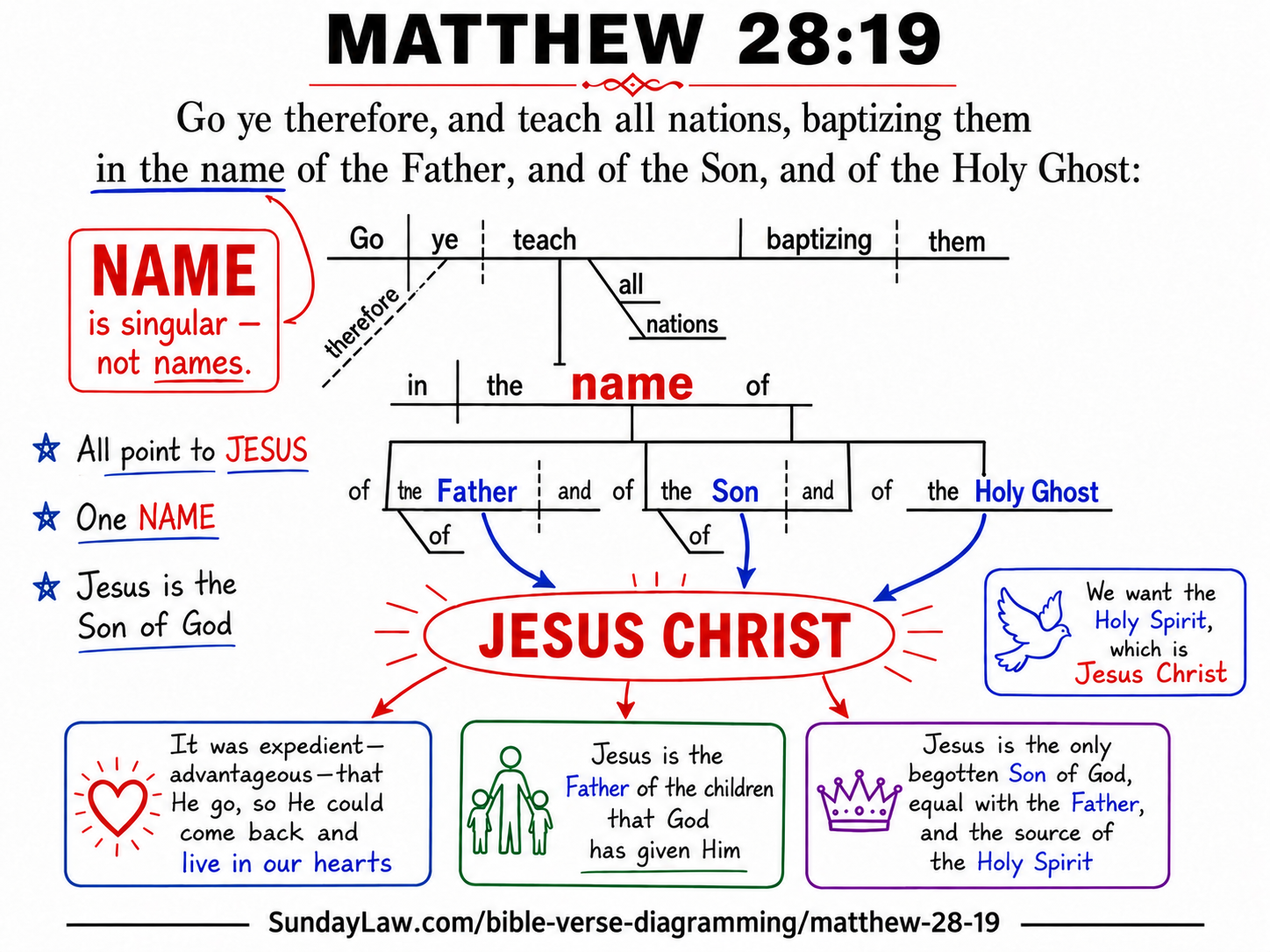
“In the name” — the singular noun matters
Matthew 28:19 says “in the name,” singular—not “in the names.” The sentence places the Father, Son, and Holy Ghost after one shared noun. Grammar establishes the singular wording; Scripture must supply the meaning of that shared name and the authority behind the command.
Understanding the “Year 0” Correction
The Julian calendar has no year zero. The calendar goes directly from 1 BC to AD 1. This is not an error; it is how historians have always counted. However, when calculating across the BC/AD boundary, we must account for this.
From 1 BC to AD 1 counts as 1 year, not 2 years. Therefore, when calculating 2,300 years from 457 BC, the clean count is: 457 + 1843 = 2,300, landing precisely in autumn of 1844 AD.
Some have said the charts were wrong because “457 BC + 2300 = 1843.” But when you correctly account for the missing year zero, the math lands exactly in autumn 1844 — specifically on the Day of Atonement (Yom Kippur), October 22, 1844.
“As thou hast given him power over all flesh, that he should give eternal life to as many as thou hast given him.” — John 17:2, KJV
“Behold I and the children which God hath given me.” — Hebrews 2:13, KJV
“For both he that sanctifieth and they who are sanctified are all of one: for which cause he is not ashamed to call them brethren.” — Hebrews 2:11, KJV
The surrounding KJV witness presents the Father as the giver and the Son as the One who receives authority and a people. The diagram therefore keeps Matthew 28:17–20 beside John 17:2 and Hebrews 2:11–13, allowing readers to test whether “one name” identifies a shared authority and mission rather than silently supplying a later co-equal-person formula.
Apply William Miller’s 14 Rules: whose are we?
William Miller’s method begins with the whole passage, lets Scripture explain Scripture, compares repeated words, and tests figurative claims against plain biblical usage. Read the complete 14 Rules of Bible Interpretation, then watch the ownership language repeat across the KJV.
“And ye are Christ’s; and Christ is God’s.” — 1 Corinthians 3:23
“Ye are not your own. For ye are bought with a price: therefore glorify God in your body, and in your spirit, which are God’s.” — 1 Corinthians 6:19–20
“Now if any man have not the Spirit of Christ, he is none of his.” — Romans 8:9
“But every man in his own order: Christ the firstfruits; afterward they that are Christ’s at his coming.” — 1 Corinthians 15:23
“And if ye be Christ’s, then are ye Abraham’s seed, and heirs according to the promise.” — Galatians 3:29
The Second Adam: Why It Was Better for Jesus to Return to Heaven
The booklet The Breath of the Second Adam follows the Bible chain from Eden’s first breath to Pentecost’s fire. Jesus said, “It is expedient for you that I go away” (John 16:7). Expedient means advantageous, profitable, better. Why? Because He would return to the Father, receive again the glory He had before the world was, and send the Comforter to His people.
“Nevertheless I tell you the truth; It is expedient for you that I go away: for if I go not away, the Comforter will not come unto you; but if I depart, I will send him unto you.” — John 16:7, KJV
“And now, O Father, glorify thou me with thine own self with the glory which I had with thee before the world was.” — John 17:5, KJV
“Wherefore when he cometh into the world, he saith, Sacrifice and offering thou wouldest not, but a body hast thou prepared me.” — Hebrews 10:5, KJV
Before He ascended, the risen Christ gave a pledge of this life-giving gift. “He breathed on them, and saith unto them, Receive ye the Holy Ghost” (John 20:22). Then, after His ascension, the disciples waited in Jerusalem until Pentecost. The rushing mighty wind filled the house, and cloven tongues like as of fire sat upon them.
“And when he had said this, he breathed on them, and saith unto them, Receive ye the Holy Ghost.” — John 20:22, KJV
“And when the day of Pentecost was fully come, they were all with one accord in one place. And suddenly there came a sound from heaven as of a rushing mighty wind... And there appeared unto them cloven tongues like as of fire, and it sat upon each of them.” — Acts 2:1-3, KJV
Ellen White wrote that “The Holy Spirit, assuming the form of tongues of fire, rested upon those assembled,” and that “The appearance of fire signified the fervent zeal with which the apostles would labor and the power that would attend their work.” — The Acts of the Apostles, p. 39.2.
Now Jesus is seated beside His Father, sharing His throne and ministering His own life to His people. Hebrews says He “sat down on the right hand of the Majesty on high” (Hebrews 1:3), and Jesus says, “I also overcame, and am set down with my Father in his throne” (Revelation 3:21). From there He sends His words and Spirit: “the words that I speak unto you, they are spirit, and they are life” (John 6:63). That living Spirit of Christ quickens mortal bodies, filling surrendered believers with His risen life, His righteousness, and the soul of His living presence.
“It is the spirit that quickeneth; the flesh profiteth nothing: the words that I speak unto you, they are spirit, and they are life.” — John 6:63, KJV
“But if the Spirit of him that raised up Jesus from the dead dwell in you... he that raised up Christ from the dead shall also quicken your mortal bodies by his Spirit that dwelleth in you.” — Romans 8:11, KJV
Compare the witnesses
- Matthew 28:17–20 supplies the complete scene and commission.
- Acts 2:38 records Peter’s response when the gospel is preached at Pentecost.
- Acts 8:16 and Acts 10:48 show how the apostles described baptism in practice.
- John 17:3 identifies “thee the only true God, and Jesus Christ, whom thou hast sent.”
This is the diagramming method: preserve the context, identify the grammar, compare the witnesses, and then state what the text establishes. Continue with the ABC’s of Bible Verse Diagramming, then study the Trinity and Sonship evidence.