Daniel 8:14 — the sanctuary
“And he said unto me, Unto two thousand and three hundred days; then shall the sanctuary be cleansed.”
Daniel 8:14, KJVPress Esc to close · / or Ctrl+K to open
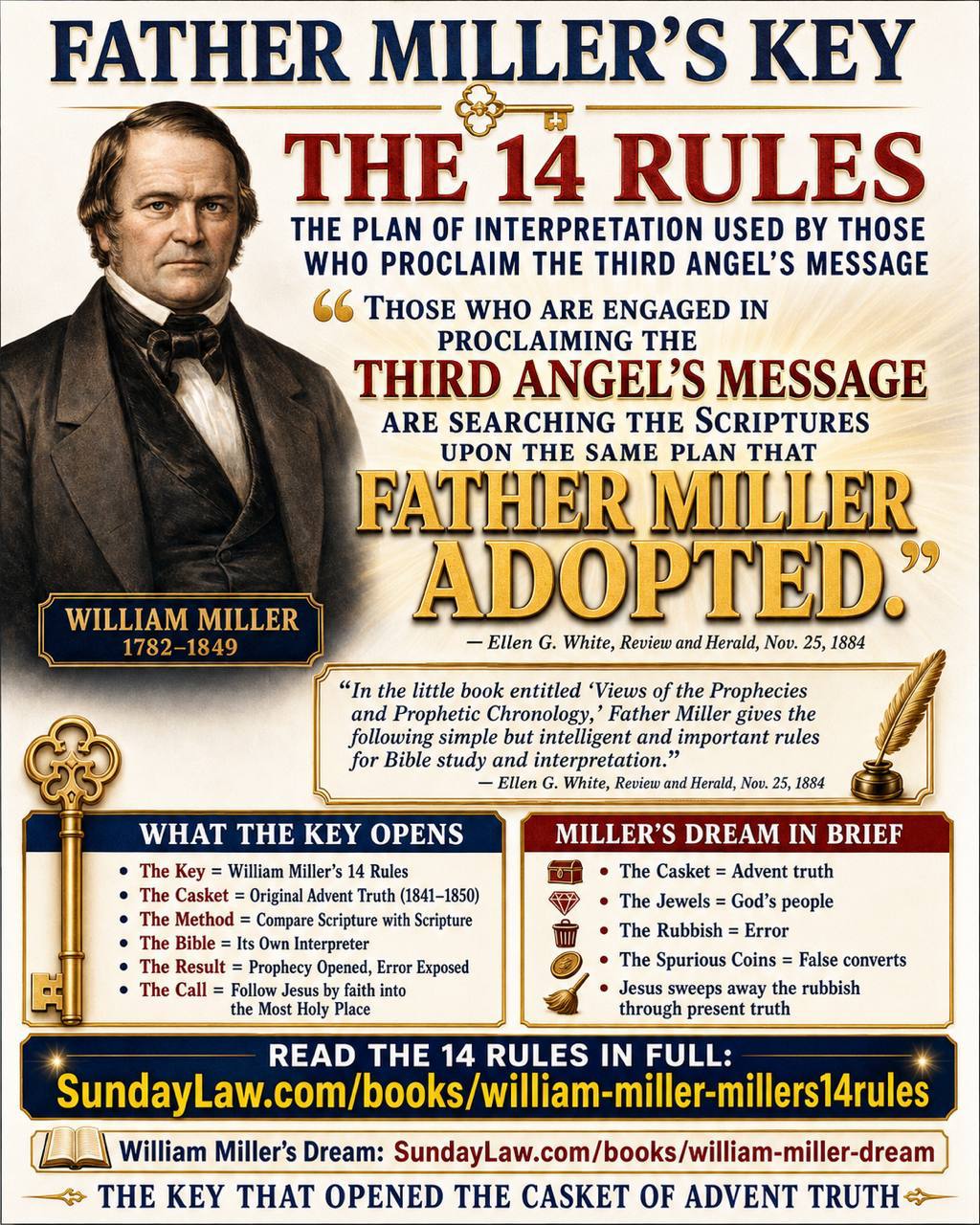
The biblical method that unlocked prophecy and awakened America to the reality of Christ's soon return. Scripture interpreting Scripture — the key to understanding the prophetic Word.
In James White's account of Brother Miller's Dream, the "key attached" to the casket represented the method by which William Miller opened the treasures of prophecy. These fourteen rules form a systematic, biblical approach to understanding Scripture — not subjective interpretation, but disciplined comparison of Scripture with Scripture, allowing the Bible to be its own interpreter.
Miller's Method: Rather than reading theological commentaries or denominational tradition into Scripture, Miller proposed a radical idea for his time — let the Bible speak for itself. Compare difficult passages with clear ones. Let plain language mean what it says. Test every interpretation against the whole of Scripture.
This approach was revolutionary in 1818. It remains powerful today. It is the foundation of the Advent message and the reason the Seventh-day Adventist Church was born.
Rules of Interpretation by William Miller: In studying the Bible, I have found the following rules to be of great service to myself, and now give them to the public by special request. Every rule should be well studied, in connection with the Scripture references, if the Bible student would be at all benefited by them.
Every word must have its proper bearing on the subject presented in the Bible.
PROOF: Matthew 5:18.
All Scripture is necessary and may be understood by a diligent application and study.
PROOF: 2 Timothy 3:15-17.
Nothing revealed in the Scripture can or will be hid from those who ask in faith, not wavering.
PROOF: Deuteronomy 29:29; Matthew 10:26, 27; 1 Corinthians 2:10; Philippians 3:15; Isaiah 14:11; Matthew 21:22; John 14:13, 14; 15:7; James 1:5, 6; 1 John 5:13-15.
To understand doctrine, bring all the scriptures together on the subject you wish to know, then let every word have its proper influence, and if you can form your theory without a contradiction, you cannot be in an error.
PROOF: Isaiah 28:7-29; 35:8; Proverbs 19:27; Luke 24:27, 44-45; Romans 16:26; James 5:19; 2 Peter 1:19, 20.
Scripture must be its own expositor, since it is a rule of itself. If I depend on a teacher to expound it to me and he should, guess at its meaning, or desire to have it so on account of his sectarian creed or to be thought wise, then his guessing, desire, creed or wisdom is my rule, not the Bible.
PROOF: Psalm 19:7-11; 119:97-105; Matthew 23:8-10; 1 Corinthians 2:12-16; Ezekiel 34:18-19; Luke 11:52; Malachi 2:7-8.
God has revealed things to come, by visions, in figures and parables, and in this way the same things are often time revealed again and again, by different visions, or in different figures, and parables. If you wish to understand them, you must combine them all in one.
PROOF: Psalm 89:19; Hosea 12:10; Habakkuk 2:2; Acts 2:17; 1 Corinthians 10:6; Hebrews 9:9, 24; Psalm 78:2; Matthew 8:13, 34; Genesis 41:1-32; Daniel 2, 7, 8; Acts 10:9-16.
Visions are always mentioned as such.
PROOF: 2 Corinthians 12:1.
Figures always have a figurative meaning, and are used much in prophecy, to represent future things, times and events; such as mountains, meaning governments; beasts meaning kingdoms. Waters, meaning people. Lamp, meaning Word of God. Day, meaning year.
PROOF: Daniel 2:35,44; 7:8,17; Revelation 17:1,15; Psalm 119:105; Ezekiel 4:6.
Parables are used as companions to illustrate subjects, and must be explained in the same way as figures by the subject and Bible.
PROOF: Mark 4:13. See also; the explanation of the ten virgins: Miller's Lectures, Number 16.
Figures sometimes have two or more different significations, as day is used in a figurative sense to represent three different periods of time.
1. Indefinite.
2. Definite, a day for a year.
3. Day for a thousand years.
If you put on the right construction it will harmonize with the Bible and make good sense, otherwise it will not.
PROOF: Ecclesiastes 7:14, Ezekiel 4:6; 2 Peter 3:8.
How to know when a word is used figuratively. If it makes good sense as it stands, and does no violence to the simple laws of nature, then it must be understood literally, if not, figuratively.
PROOF: Revelation 12:1-2; 17:3-7.
To learn the true meaning of figures, trace your figurative word through your Bible, and where you find it explained, put it on your figure, and if it makes good sense you need look no further, if not, look again.
To know whether we have the true historical event for the fulfillment of a prophecy. If you find every word of the prophecy (after the figures are understood) is literally fulfilled, then you may know that your history is the true event. But if one word lacks a fulfillment, then you must look for another event, or wait its future development. For God takes care that history and prophecy doth agree, so that the true believing children of God may never be ashamed.
PROOF: Psalm 21:5; Isaiah 14:17-19; 1 Peter 2:6; Revelation 17:17; Acts 3:18.
The most important rule of all is, that you must have faith. It must be a faith that requires a sacrifice, and, if tried, would give up the dearest object on earth, the world and all its desires, character, living, occupation, friends, home, comforts, and worldly honors. If any of these should hinder our believing any part of God's word, it would show our faith to be vain. Nor can we ever believe so long as one of these motives lies lurking in our hearts. We must believe that God will never forfeit his word. And we can have confidence that he that takes notice of the sparrow, and numbers the hairs of our head, will guard the translation of his own word, and throw a barrier around it, and prevent those who sincerely trust in God, and put implicit confidence in his word, from erring far from the truth, though they may not understand Hebrew or Greek.
Before William Miller, most Christian teachers relied on church tradition, denominational commentary, and the interpretations of educated clergy. Miller did something radical: he went directly to Scripture and applied systematic, logical principles to understand what it plainly said.
The Impact: Using these fourteen rules, William Miller followed the KJV text from Daniel 8:14 to the sanctuary message and the 1844 waymark. The 1843 chart made the sequence visible: prophecy, judgment, the sanctuary, the commandments, the Sabbath, and the soon return of Christ.
“And he said unto me, Unto two thousand and three hundred days; then shall the sanctuary be cleansed.”
Daniel 8:14, KJV“The seventh day is the sabbath of the LORD thy God: in it thou shalt not do any work.”
Exodus 20:10, KJV“This same Jesus, which is taken up from you into heaven, shall so come in like manner as ye have seen him go into heaven.”
Acts 1:11, KJV“Fear God, and give glory to him; for the hour of his judgment is come.”
Revelation 14:7, KJV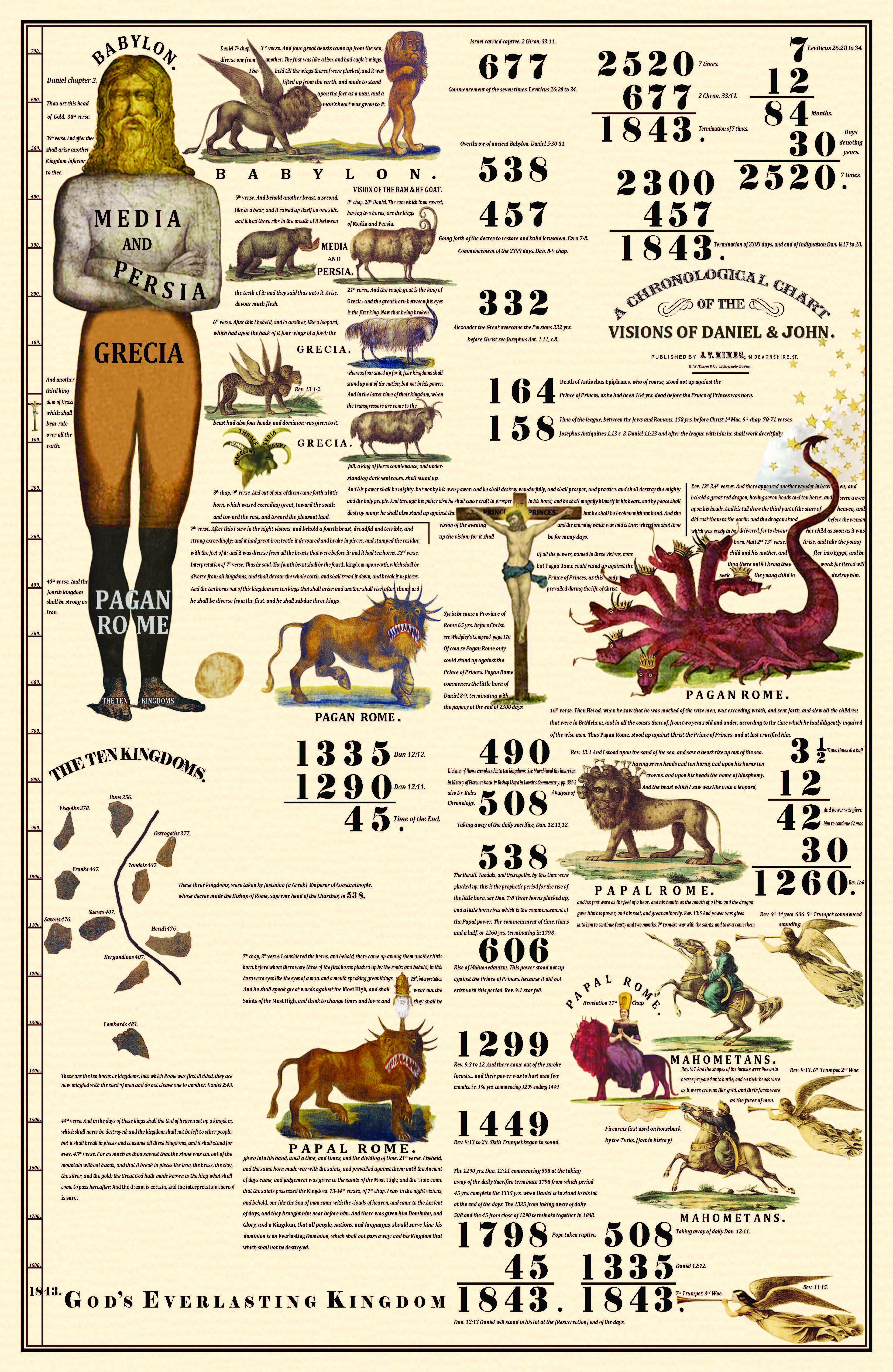
Daniel gives the period: 2300 days. Miller’s rules apply the Bible’s day-for-a-year principle (Numbers 14:34; Ezekiel 4:6) and connect the starting point with Daniel 9:25, the command to restore Jerusalem.
457 BC + 2300 years - 1 year for crossing from BC into AD = 1844 AD
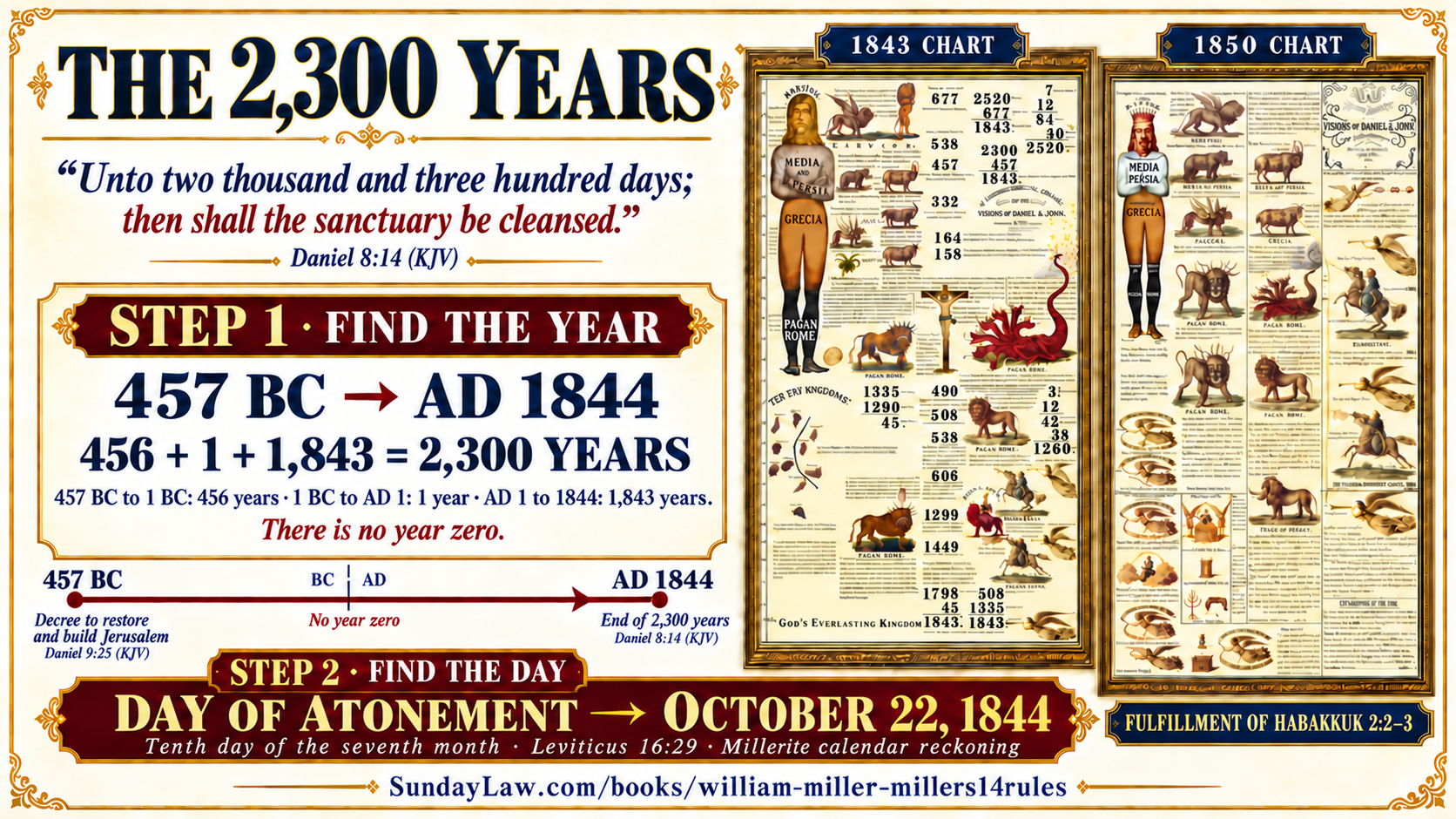
The Millerite chart then placed the expected cleansing of the sanctuary at the tenth day of the seventh month, corresponding to October 22, 1844. The date is the chart’s historical result; Daniel 8:14 supplies the prophecy and the KJV gives the anchor text.
Miller’s method was a disciplined chain: read the words, compare the passages, follow the symbols through Scripture, and test the historical fulfillment against every prophetic detail. The 1843 chart gave ordinary believers a visual map of that chain. Read the full 1843 chart study and the William Miller biography for the story of the doctor who called Miller a “monomaniac” before discovering how completely his method rested on Scripture.
These rules keep Bible study anchored in the written Word. They lead the reader back to the sanctuary, the law, the Sabbath, the judgment-hour message, and the literal return of Jesus Christ.
Download William Miller's original 14 Rules document. Print it. Study it alongside Scripture. Use it to test interpretations you encounter. Let Scripture be your authority—not traditions, not commentaries, but the Word of God itself.