From Presbyterian Merchant to the Man Who Named an Advent Movement
David Hewitt was a Presbyterian merchant living in Battle Creek, Michigan, when
Captain Joseph Bates knocked on his door in 1852. Bates had come to Battle Creek specifically
to share the Sabbath message, and after a day-long study, David and his wife Olive became
the first Sabbatarian Adventist converts in Battle Creek — without any prior
connection to the Millerite movement. Their conversion was a signal moment: it demonstrated
the message could reach people entirely outside the Millerite circle.
Hewitt was not a passive member. He hosted meetings in his home, served on early
church committees, and wrote articles for the Review and Herald.
His standing in the Battle Creek community was particular: he was known, according to
contemporary accounts, as "the most honest man in Battle Creek."
That reputation gave his words weight — and on October 1, 1860, those words changed history.
“The name Seventh-day Adventist was suggested by a man named David Hewitt, known to be the ‘most honest man’ in Battle Creek. A lengthy discussion ensued, but the name was favorably voted 24-1.”
— General Conference Historical Account — October 1, 1860, Battle Creek, Michigan
The name Hewitt proposed was not arbitrary. "Seventh-day" anchored the movement's
identity in the fourth commandment — the Sabbath of creation, observed by Jesus, never repealed
in Scripture. "Adventist" proclaimed the imminent Second Coming — the core hope
that had driven the Millerite movement. Together, the two words formed a complete doctrinal statement
in three syllables.
Twenty-five delegates had gathered at Battle Creek because the movement faced two practical
question: what denomination do you belong to? Hewitt's proposed name answered it.
The 24-1 vote made it official.
The name was formally adopted in use by 1861, when Ellen White dedicated Parkville Church,
Michigan under the name "Seventh-day Adventist." By 1863 the General Conference was formally
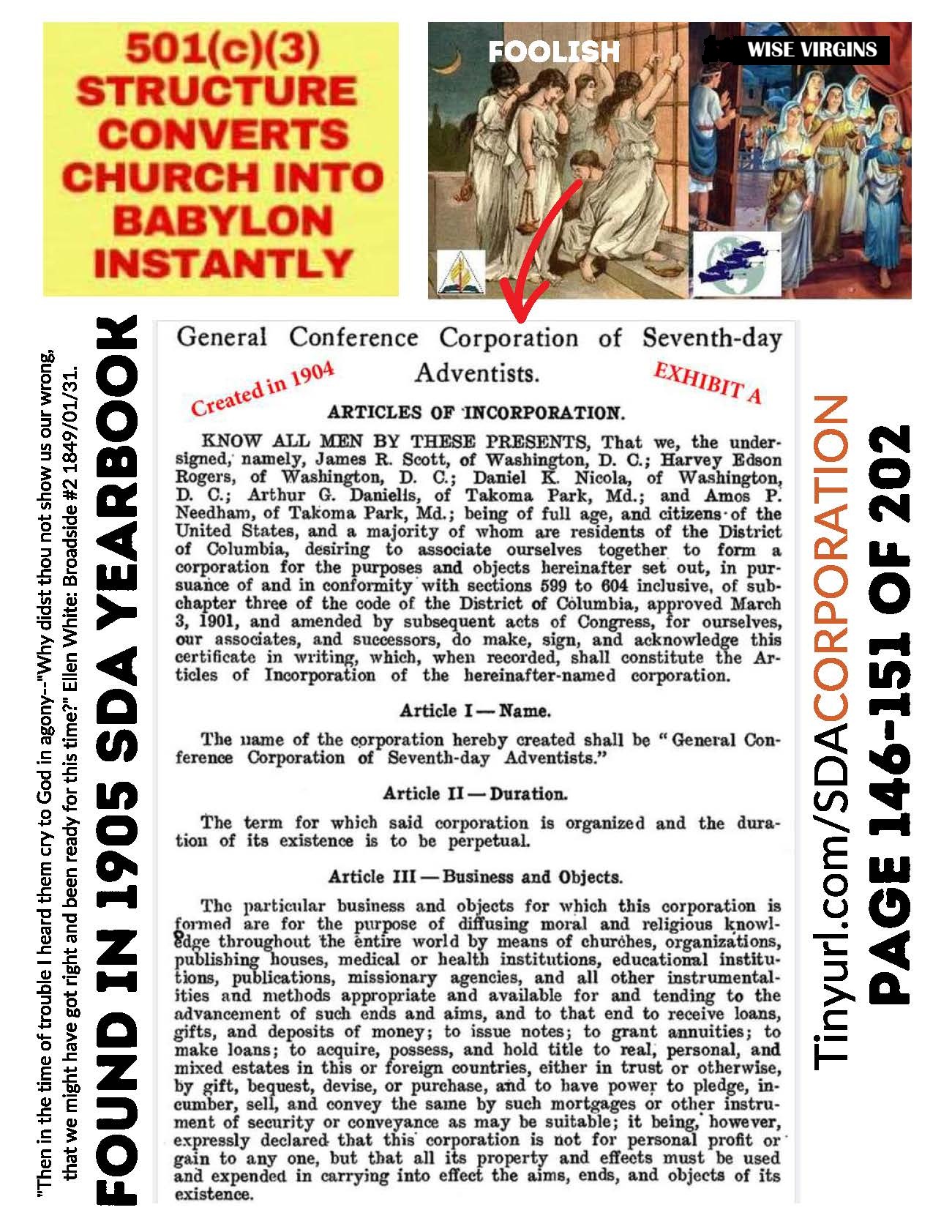
organized. And by 1904, that same name — born from an honest merchant's suggestion in Battle Creek —
had become the registered corporate property of a D.C. civil corporation.