
How Did James White Die?
His Final Illness
By the summer of 1881, James White had spent more than three decades in constant labor: preaching, editing, organizing, and traveling on behalf of the Advent cause. In late July and early August, both he and Ellen White fell ill within a day of each other and were taken to the Battle Creek Sanitarium for treatment.
Ellen White's own published account, written in the years following, describes the onset plainly: he was struck with "a severe chill," and she was "attacked" with a related illness the following day. Later Adventist historians — writing decades afterward — have identified the fever that took his life as malarial fever, a common and frequently fatal illness in nineteenth-century Michigan. Ellen White's own account does not use that clinical term; it describes the chill, the decline, and the final hours in devotional rather than medical language. Readers should hold these two threads distinctly: what she recorded as an eyewitness, and what later writers have inferred about the underlying disease.
Ellen White's Description of His Last Hours
"On the following Monday he had a severe chill, and the next day I too was attacked. Together we were taken to the Sanitarium for treatment. On Friday my symptoms became more favorable. The doctor then informed me that my husband was inclined to sleep, and that danger was apprehended. I was immediately taken to his room, and as soon as I looked upon his countenance I knew that he was dying. I tried to arouse him. He understood all that was said to him, and responded to all questions that could be answered by yes or no, but seemed unable to say more."Ellen G. White, Life Sketches of Ellen G. White (1915), p. 203
James White died later that day, Sabbath, August 6, 1881. Ellen White wrote that when she saw her husband "breathe his last," she felt that "Jesus was more precious" to her "than He ever had been in any previous hour" of her life — a testimony of grief carried by faith rather than despair.
His Earlier Stroke and Years of Strenuous Labor
James White's final illness did not strike a man in ordinary health. In 1865 he suffered a paralytic stroke that would have ended the public usefulness of many men. He partially recovered and resumed his labors, but never without cost — recurring weakness followed him through his final sixteen years, even as he continued preaching, editing the Advent Review and Sabbath Herald, and serving multiple terms as president of the original Seventh-day Adventist General Conference Association, organized in 1863.
That original Association was not the church-and-state joined corporation later formed on April 15, 1904 (see the record of that new organization). James White helped organize a voluntary association of believers, gathered around a platform of truth, not a civil corporation entangled with the state.
Read the fuller account of that strenuous life, his marriage to Ellen White, and his work building the publishing and organizational structure of the Seventh-day Adventist Church on his complete biography page.
The Vision That Set His Course
To understand why James White's death mattered to the movement he left behind, it helps to return to where his life's work began. In November 1848, at the command of God, a vision was given to his wife at the home of Otis Nichols and Mary Bird Nichols in Dorchester, Massachusetts. Ellen White was shown that her husband was to begin publishing: he was "to begin to print a little paper and send it out to the people. Let it be small at first," she recalled, but she was shown "that it was to be like streams of light that went clear round the world."
"You must begin to print a little paper and send it out to the people. Let it be small at first; but as the people read, they will send you means with which to print, and it will be a success from the first. From this small beginning it was shown to me to be like streams of light that went clear round the world."Ellen G. White, on the Dorchester vision, Life Sketches account
James White himself drew a comparison to Moses that his wife later confirmed in vision (see below): just as Moses sat Israel down and rehearsed their escape from Egypt so the next generation would not forget it, James White gathered the scattered Advent believers around the record of their own escape — the exodus of God's people out of the fallen Protestant churches, "Babylon," in the Midnight Cry of 1843–1844 (Revelation 18:4). The Present Truth was how that record of escape was kept, printed, and carried forward.
That same call to come out and return to the original platform of truth is repeated today. The 1840–1850 platform — the Sabbath, the sanctuary, the sealing message, and a movement without state entanglement — stands in contrast to the modern General Conference of Seventh-day Adventists, a 501(c)(3) corporation recognized by the IRS under EIN 52-0643036. Read the original platform for yourself in the 1872 Fundamental Principles, and read the fuller documentation of the 1904 and 1950 corporate history on SundayLaw's apostasy record.
This distinction matters: the order James White helped organize in 1863 was an association gathered around a platform of truth — not a civil corporation joining church and state. That original Association never became Babylon. Ellen White herself warned against exactly the kind of "new organization" that was created on April 15, 1904 (see the April 15, 1904 record; compare 1SM 204) — and it was that new organization's very inception, joining church and state in a civil corporation, which produced the antichrist system of Babylon. Scripture pictures two companies waiting for the Bridegroom: wise virgins with oil in their lamps, watching and ready, and foolish virgins whose lamps went out (Matthew 25:1-13). The company that holds to the original 1840–1850 platform of truth is the wise-virgin company; the company that followed the state-joined 1904 corporation into Babylon is the foolish-virgin company, left outside the door when the Bridegroom comes. The platform he helped build was never meant to end in a corporate merger with the state. It was meant to advance: from the sanctuary truth of 1844, following Christ by faith into the Most Holy Place, and forward still to the New Jerusalem coming down from God out of heaven, prepared as a bride adorned for her husband — with the faithful set as living jewels in its foundations. That advancing light strikes the image of the beast on its feet and scatters it as chaff before the wind (Daniel 2:34-35); it does not retreat back to Egypt, back to the papal errors and false doctrines the pioneers came out of and rejected. The call is to advance daily in the light, not backslide into the very things 1840s Adventism cast off.
James White's own periodical, The Present Truth, is the original record of that early experience — the Sabbath, the sanctuary, and the sealing message carried in print to a scattered people. Step into the paper itself and read the pioneer witness in its own words: read The Present Truth.
The Battle Creek Sanitarium Setting
By 1881, Battle Creek, Michigan, had become the operational center of the Seventh-day Adventist movement James White had helped organize — home to the Review and Herald press, the developing Battle Creek College, and the health institution that would later be known as the Battle Creek Sanitarium. It was fitting, in a sober sense, that the man who helped build that center of institutional life would spend his final days receiving treatment within it, and that his wife would be treated in the same building during the same illness.
His Funeral and Burial
James White was buried at Oak Hill Cemetery in Battle Creek. Ellen White recorded simply that she "followed my husband to Oak Hill Cemetery, where he was laid to rest until the morning of the resurrection" — language that reflects the Adventist hope of a literal, bodily resurrection at Christ's return rather than the finality of the grave.
Ellen G. White, Life Sketches of Ellen G. White (1915), p. 204His grave marker still stands today in the family plot — the "White Lot" — at Oak Hill Cemetery, where James, Ellen, and several of their children are buried together.
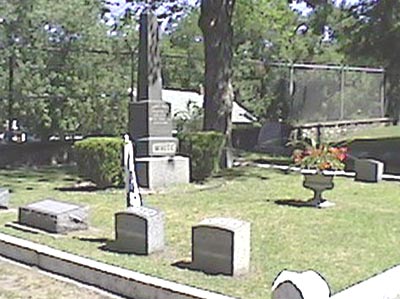
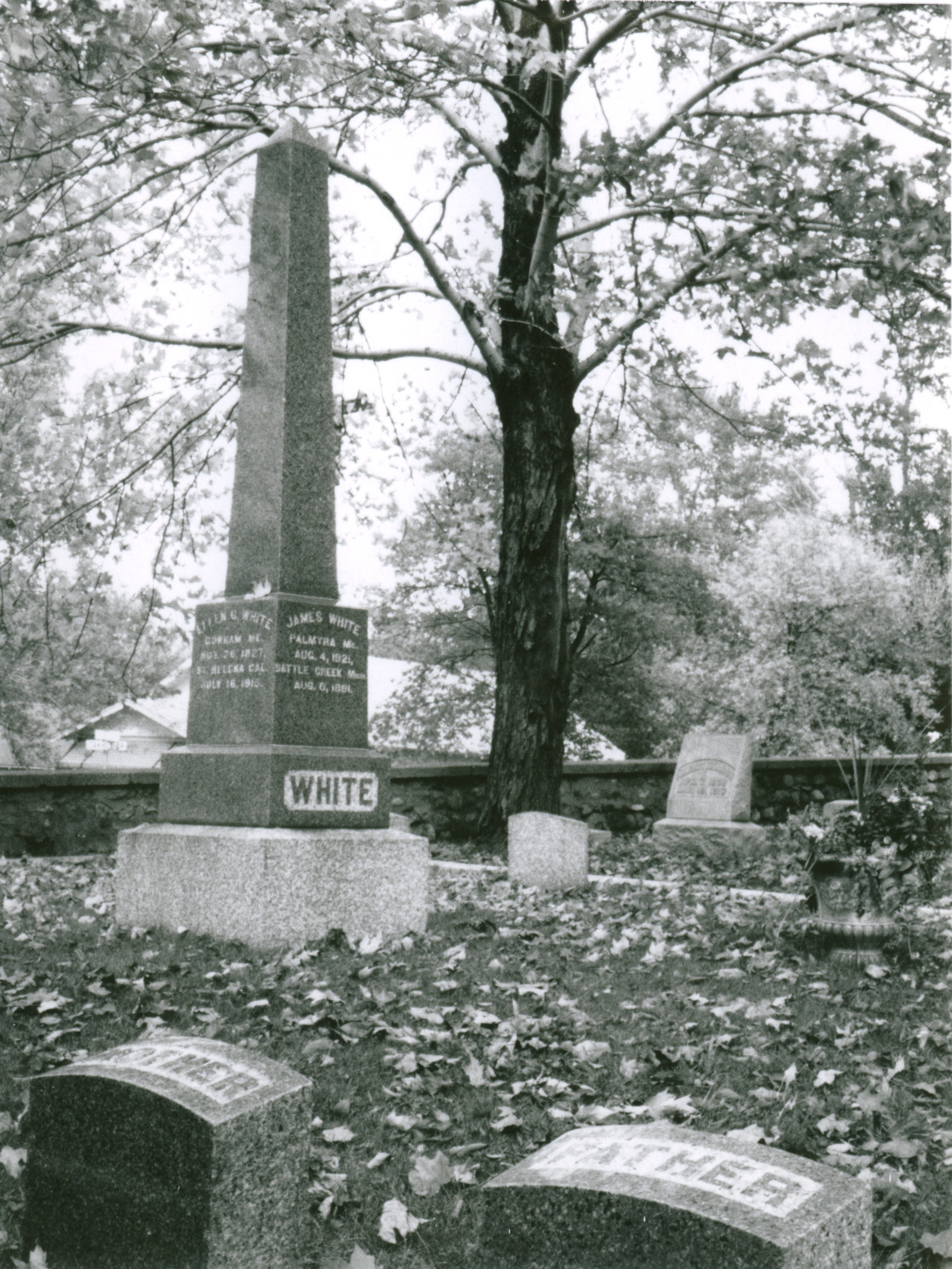
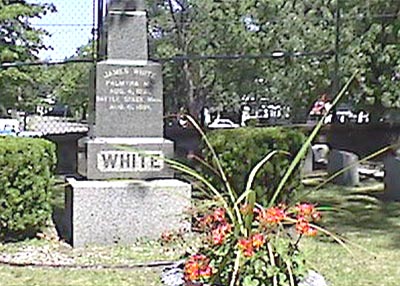
His grave marker still stands today, plainly inscribed, a quiet witness to a life spent in print, organization, and labor for the Advent cause.
"As John the Baptist heralded the first advent of Jesus, and prepared the way for his coming, so also, Wm. Miller and those who joined him, proclaimed the second advent of the Son of God."Ellen G. White, The Great Controversy (1858), p. 129
Ellen White's Loss
Ellen White described her own physical and emotional state plainly: her "physical strength had been prostrated by the blow," yet she testified that "the power of divine grace" sustained her "in that great bereavement." She had buried children before this loss, but the death of her husband and thirty-five-year partner in ministry was, by her own account, a singular grief — one she met, in her words, by finding Christ "more precious" to her than at any previous hour of her life.
Read more about their partnership and her own life story on Ellen White's biography page.
His Children
James and Ellen White had four sons. Two died young; two lived to serve the movement their parents had built.
Henry Nichols White
The eldest son, born in 1847 in Gorham, Maine. He died of pneumonia in his sixteenth year, in 1863, while away at school in Maine — a loss that struck the family hard in the middle of James White's most demanding publishing years.
James Edson White
Born in Rocky Hill, Connecticut, while his parents traveled. Married Emma McDearmon in 1870; they had no children. Became a publisher and self-supporting missionary in his own right, best remembered for organizing steamboat mission work carrying literature and education to Black communities along the lower Mississippi River in the 1890s.
Read His Biography →William Clarence White ("W. C. White")
Born in Rochester, New York. Became his mother's closest literary assistant and traveling companion after his father's death in 1881, and later secretary of the Ellen G. White Estate. He married Mary Kelsey in 1876 (she died in 1890), then Ethel "May" Lacey White in 1895. He died in Battle Creek, Michigan, and was buried with his family in Oak Hill Cemetery.
Read His Biography →John Herbert White
The youngest son, born and died in Battle Creek, Michigan, in 1860, living only about three months. He was the first family member buried in the White family plot — the "White Lot" — at Oak Hill Cemetery, Battle Creek, the same plot where James and Ellen White themselves were later laid to rest.
What James White Left Behind
James White left a movement with durable institutions: The Present Truth and its successor, the Advent Review and Sabbath Herald; a formally organized Seventh-day Adventist Church (1863); and the beginnings of Battle Creek College (1874). He left published tracts and periodical articles that are still read today, a widowed co-laborer who would continue writing and traveling for more than three decades after his death, and children who carried the family's legacy of service into the next generation of the movement.
Explore his writings directly: The Present Truth, the periodical he founded in 1849, and Brother Miller's Dream, with his explanatory notes, first printed in The Present Truth in May 1850.
Baptism, Death and Burial
James White's tract presses baptism back to the apostolic picture: the sinner dies to self, is buried with Christ in baptism, and rises to walk in newness of life. Read it in full online.
Read Baptism, Death and Burial →The Prophecy Charts He Helped Carry Forward
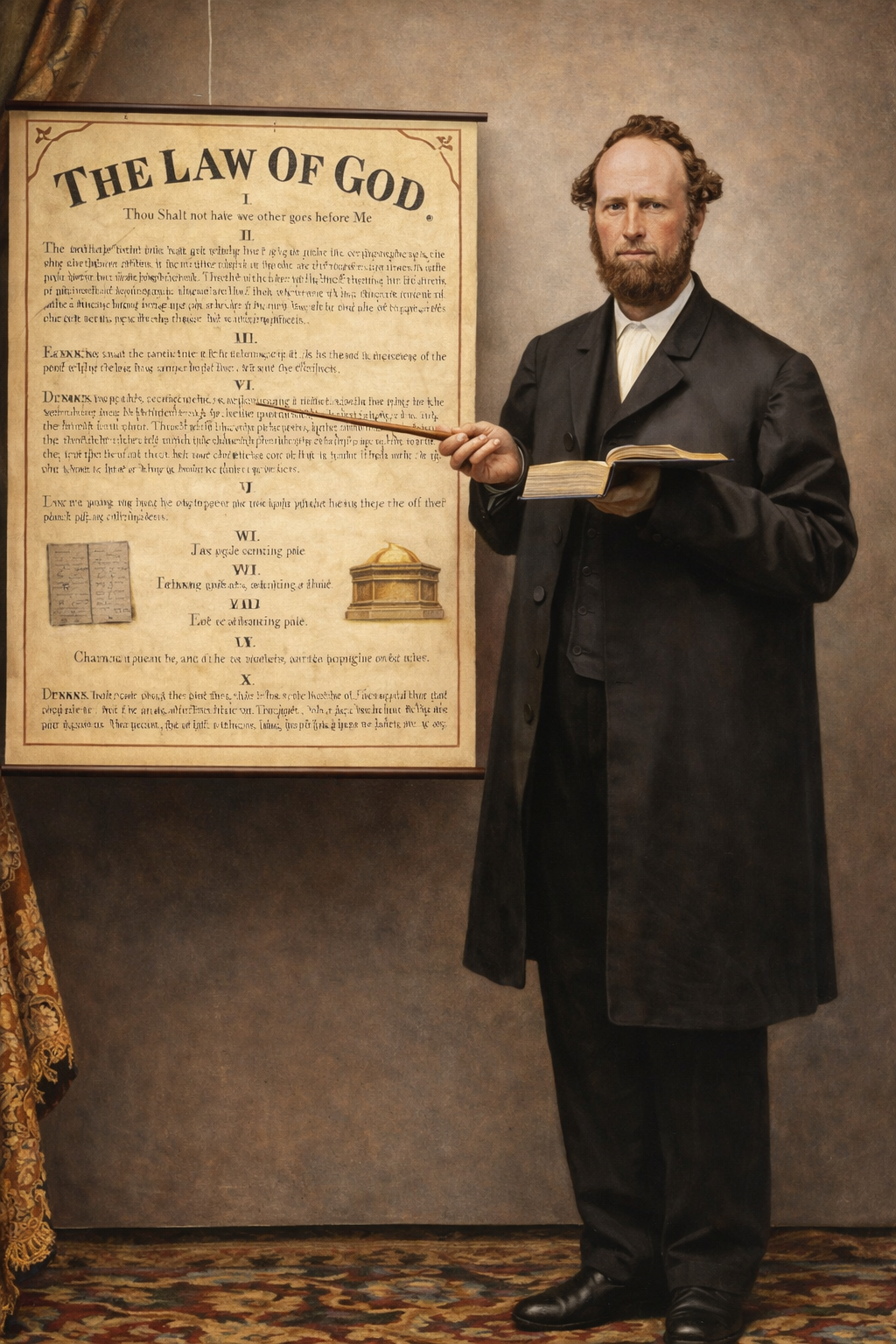
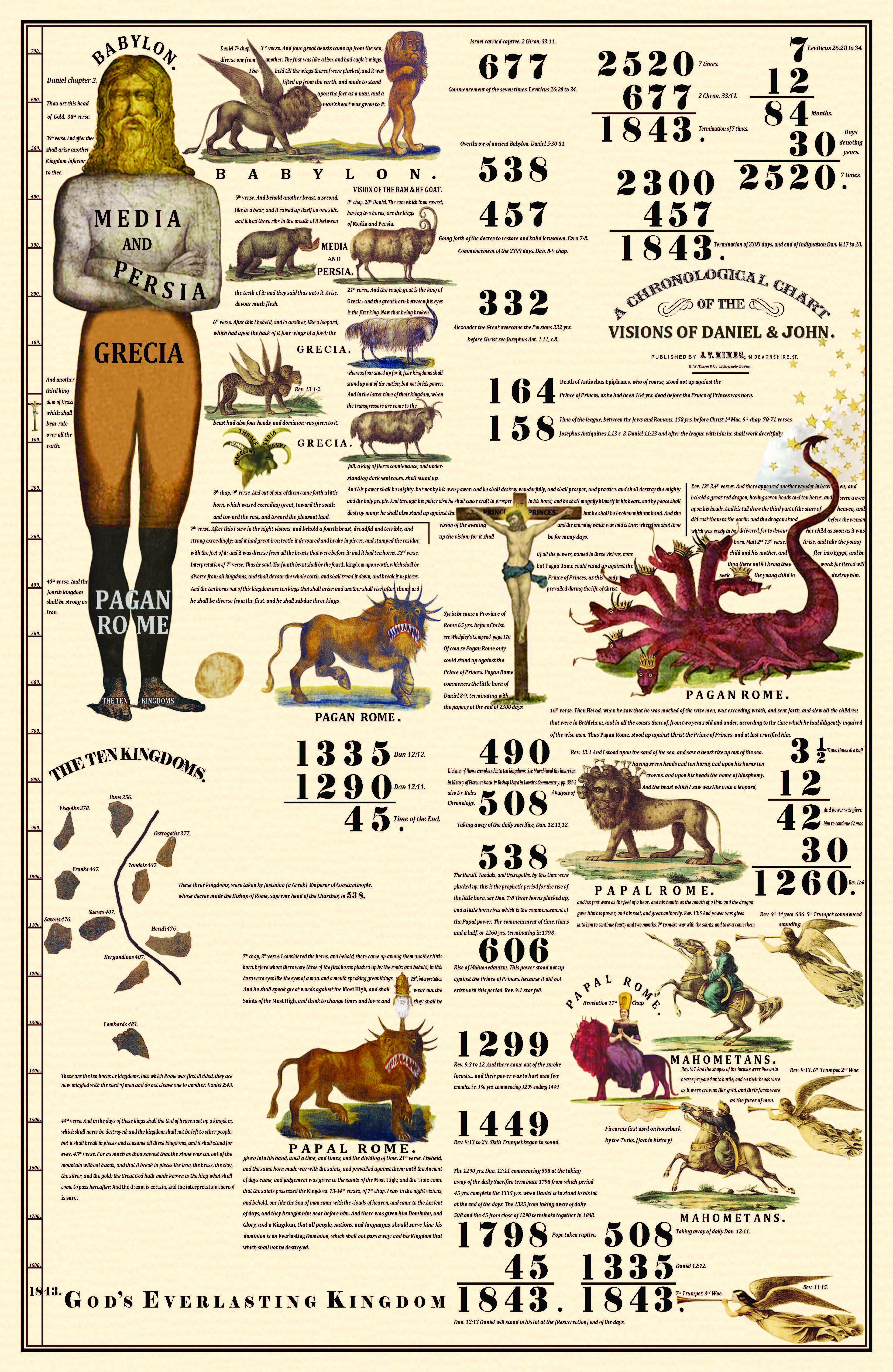
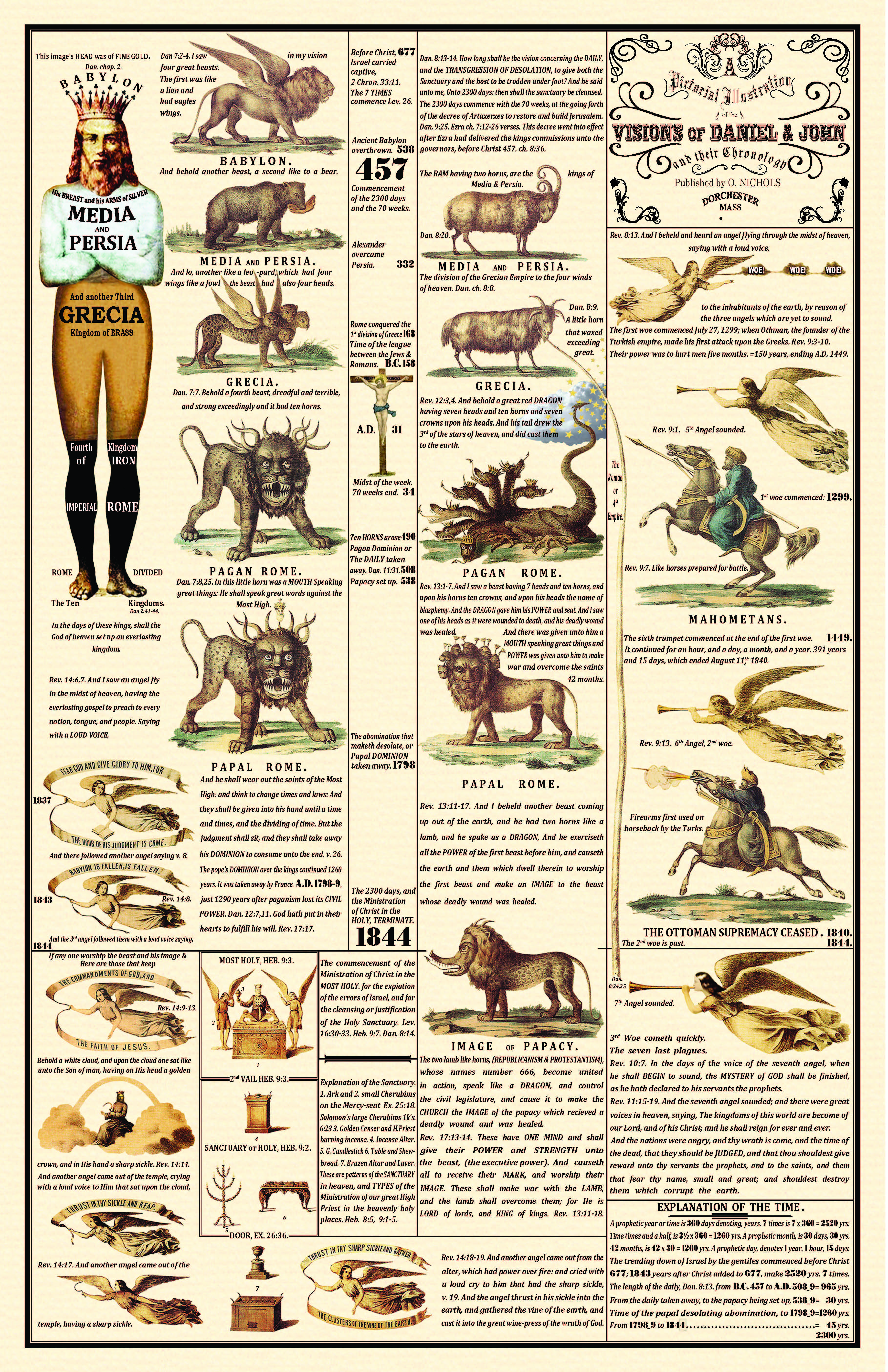
James White's publishing work was not limited to periodicals. He helped present and carry forward the great prophetic charts that gave the Advent message its visual language, including the Law of God chart shown below — the Ten Commandments held up as the unalterable standard of the final judgment. These charts are still preserved, downloadable, and readable in full today.

Timeline of His Final Days
- Monday, Aug. 1, 1881James White is struck with a severe chill, the onset of his final illness.
- Tuesday, Aug. 2, 1881Ellen White is "attacked" by a related illness; both are taken to the Battle Creek Sanitarium for treatment.
- Friday, Aug. 5, 1881Ellen White's symptoms improve; the attending doctor tells her that James is inclined to sleep and that danger is apprehended.
- Sabbath, Aug. 6, 1881James White dies at the Battle Creek Sanitarium, two days after his sixtieth birthday, at the age of 60.
- Following daysA funeral service is held in Battle Creek and James White is buried at Oak Hill Cemetery.
Frequently Asked Questions
How did James White die?
James White died of an acute fever at the Battle Creek Sanitarium. Ellen White's published account describes a severe chill followed by unconsciousness; later Adventist historians have commonly identified the illness as malarial fever, though her own account does not use that term.
When did James White die?
James White died on Sabbath, August 6, 1881 — two days after his sixtieth birthday.
Where did James White die?
He died at the Battle Creek Sanitarium in Battle Creek, Michigan, where he and Ellen White had both been taken for treatment in the days before his death.
How old was James White when he died?
He was sixty years old, having been born August 4, 1821, in Palmyra, Maine, and having died August 6, 1881.
Where was James White buried?
According to Ellen White's own account in Life Sketches, he was laid to rest at Oak Hill Cemetery in Battle Creek, Michigan, "until the morning of the resurrection."
What illness did James White have?
Ellen White's account describes a severe chill that led to unconsciousness and death within days. Historical Adventist accounts have since identified this acute fever as malarial fever, a common and often fatal illness in that era, though this is a later historical identification rather than a term Ellen White used herself.
What were James White's final years like?
His final years were marked by recurring weakness following a paralytic stroke in 1865, but also by continued labor: preaching, editing, and serving multiple terms as president of the original Seventh-day Adventist General Conference Association (organized 1863) until his death in 1881. That original Association never became Babylon. Rather, a wholly new organization was created on April 15, 1904 (see 1SM 204) that, by its very inception of joining church and state in a civil corporation, produced the antichrist system of Babylon that James White never lived to see.
Ellen White on James White
"Many of the pioneers, who shared with us these trials and victories, remained true till the close of life, and have fallen asleep in Jesus. Among these is the faithful warrior who for thirty-six years stood by my side in the battle for truth. God used him as a teacher and leader to stand in the front ranks during the severe struggles of those early days of the message; but he has fallen at his post, and, with others who have died in the faith, he awaits the coming of the Lifegiver, who will call him from his gloomy prison-house to a glorious immortality."Ellen G. White, "The Cause in Vermont," Review and Herald, November 20, 1883
He gave the Advent cause a printed voice. Read what he printed.
"The history of the early experiences in the message will be a power to withstand the masterly ingenuity of Satan's deceptions." James White's own periodical, The Present Truth, is the original record of that early experience — the Sabbath, the sanctuary, and the sealing message carried in print to a scattered people. Step into the paper itself and read the pioneer witness in its own words.
Read The Present Truth → Ellen G. White, Letter 99, 1905; and "Notes of Travel," Review and Herald, November 20, 1883, par. 6."The truth is the same as it ever has been, and not a pin or a pillar is to be removed from the structure of truth. That which was sought for out of the Word in 1844, 1845, and 1846 remains the truth in every particular."Ellen G. White, Letter 38, 1906
"As John the Baptist heralded the first advent of Jesus, and prepared the way for his coming, so also, Wm. Miller and those who joined him, proclaimed the second advent of the Son of God."Ellen G. White, The Great Controversy (1858), p. 129
James White Compared With Moses
"In a vision given me at Bordoville, Vermont, December 10, 1871, I was shown that the position of my husband has been a very difficult one. A pressure of care and labor has been upon him. His brethren in the ministry have not had these burdens to bear, and they have not appreciated his labors. The constant pressure upon him has taxed him mentally and physically. I was shown that his relation to the people of God was similar, in some respects, to that of Moses to Israel. There were murmurers against Moses, when in adverse circumstances, and there have been murmurers against him."Ellen G. White, Testimonies for the Church, vol. 3, p. 85 (1872)
"He received a commendation that few others have attained. God has permitted the precious light of truth to shine upon His word and illuminate the mind of my husband. He may reflect the rays of light from the presence of Jesus upon others by his preaching and writing."Ellen G. White, Testimonies for the Church, vol. 3, p. 502
"My husband, Elder Joseph Bates, Father Pierce, Father Andrews, Elder Edson, and others who were keen, noble, and true, were among those who, after the passing of the time in 1844, searched for the truth as for hidden treasure."Ellen G. White, Selected Messages, book 1, p. 206
"He has also given my husband great light upon Bible subjects, not for himself alone, but for others. I saw that these things should be written and talked out, and that new light would continue to shine upon the word."Ellen G. White, Testimonies for the Church, vol. 3, p. 85
Scripture describes Moses at the end of his life this way: "His eye was not dim, nor his natural force abated" (Deuteronomy 34:7, KJV) — a picture of unfailing strength given to the last. James White's own final hours looked different: a chill, then unconsciousness, then a quiet death (see above). The Moses comparison Ellen White drew was about his life's labor and calling, not a claim that his final illness mirrored Moses' physical vigor at death.
Ancient Moses did not lead Israel out of Egypt and then leave the people without a memory. He gathered them, rehearsed the wilderness, and placed the history of deliverance before the next generation:
"And it came to pass in the fortieth year, in the eleventh month, on the first day of the month, that Moses spake unto the children of Israel, according unto all that the LORD had given him in commandment unto them."Deuteronomy 1:3, KJV
"And thou shalt remember all the way which the LORD thy God led thee these forty years in the wilderness, to humble thee, and to prove thee, to know what was in thine heart, whether thou wouldest keep his commandments, or no."Deuteronomy 8:2, KJV
James White did the same for the Advent people. Through The Present Truth, he gathered scattered believers around the documents of their own escape: the Midnight Cry, the sanctuary, the Sabbath, the sealing message, and the faith of Jesus. Egypt is the bondage of dead formalism and inherited tradition; the Exodus is the Advent cry that Christ is coming and Babylon is fallen; the sanctuary is the call to follow Christ by faith into the Most Holy Place; and the New Jerusalem is the city prepared for a people gathered and made ready. Read that history in his own words — The Present Truth — then follow the thread into the New Jerusalem study.
The man who carried the burden of an unorganized people
Ellen White compared James White's leadership directly to Moses leading Israel — the man who bore the complaints, organized the structure, and carried the burden so a scattered flock could become an ordered people. Read the full pioneer-era pamphlet that draws out that comparison in detail.
Read Modern Moses →James White's Rejection of the Trinity
James White was an avid and vehement anti-trinitarian from his earliest writings until his death — a position shared by fellow pioneers including Joshua Himes, Captain Joseph Bates, Uriah Smith, J. N. Loughborough, and J. H. Waggoner. According to compiled surveys of his periodical writings, he called the trinity doctrine unscriptural repeatedly across more than three decades — in The Day Star (1846) and in the Review and Herald (1852, 1854, 1855, 1856, 1877, and 1881).
"Here we might mention the Trinity, which does away the personality of God, and of his Son Jesus Christ, and of sprinkling or pouring instead of being 'buried with Christ in baptism,' 'planted in the likeness of his death:' but we pass from these fables to notice one that is held sacred by nearly all professed Christians, both Catholic and Protestant."James White, "Preach the Word," Advent Review and Sabbath Herald, December 11, 1855, vol. 7, no. 11, p. 85
"Those who seek to remove the old landmarks are not holding fast; they are not remembering how they have received and heard. Those who try to bring in theories that would remove the pillars of our faith concerning the sanctuary or concerning the personality of God or of Christ are working as blind men. They are seeking to bring in uncertainties and to set the people of God adrift without an anchor."Ellen G. White, Manuscript Release No. 760, pp. 9-10
James White's colleague J. S. Washburn wrote in 1939, warning in similar terms about ministers who had adopted the trinity doctrine:
"However kindly or beautiful or apparently profound his sermons or articles may be, when a man has arrived at the place where he teaches the heathen Catholic doctrine of the Trinity, and denies that the Son of God died for us, is he a true Seventh-day Adventist? Is he even a true preacher of the Gospel?"J. S. Washburn, letter, 1939
Ellen White never rebuked her husband for this position; she held him up as an example to follow. Read his fuller writings on the subject on his biography page.
Primary and Historical Sources
- Ellen G. White, Life Sketches of Ellen G. White (1915), p. 203–204 — the primary eyewitness account of James White's final chill, decline, death, and burial. Read page 207 / Read page 208
- In Memoriam: A Sketch of the Last Sickness and Death of Elder James White, Who Died at Battle Creek, Michigan, August 6, 1881 — a period pamphlet documenting his final illness. Consult the Adventist Archives document collection for accessible copies of this and related nineteenth-century Review and Herald obituary notices.
- James White's own periodical writings, preserved in full on his biography page and in The Present Truth, provide primary-source context for his life's work leading up to 1881.
Continue Studying James White
From a sickly Maine boy to the organizer who built the Advent movement's presses and institutions.
Read the BiographyThe small paper James White launched after Ellen White's Dorchester vision, which grew into the Advent Review and Sabbath Herald.
Read the HistoryJames White's own explanatory notes on William Miller's dream, first printed in The Present Truth.
Read the FeatureThrilling testimonies from the Second Advent movement, gathered in the periodical that merged with The Present Truth.
Read the TestimoniesEllen White's own comparison of James White to Moses — the organizer who carried the burden of a scattered people toward an ordered movement.
Read Modern MosesJames White's wife and thirty-five-year partner in ministry, whose own account preserves his final hours.
Read Ellen White's BiographyThe Advent preacher whose dream James White interpreted, and whose 1843 proclamation set the movement in motion.
Read William Miller's BiographyThe Sabbath reformer who labored beside James and Ellen White in the earliest Sabbatarian Advent conferences.
Read Bates' BiographyThe chart James White helped carry forward, linking the prophetic periods to the advancing sanctuary message after 1844.
Open the 1850 ChartJames White's apostolic argument for immersion: buried with Christ, raised to walk in newness of life.
Read the BookContinue through the full library of pioneer biographies, books, tracts, and prophecy charts.
Open the Pioneer Library