The voice of the Creator
“Remember the sabbath day, to keep it holy.” The commandment points back to creation and calls the worshipper to remember who made all things.
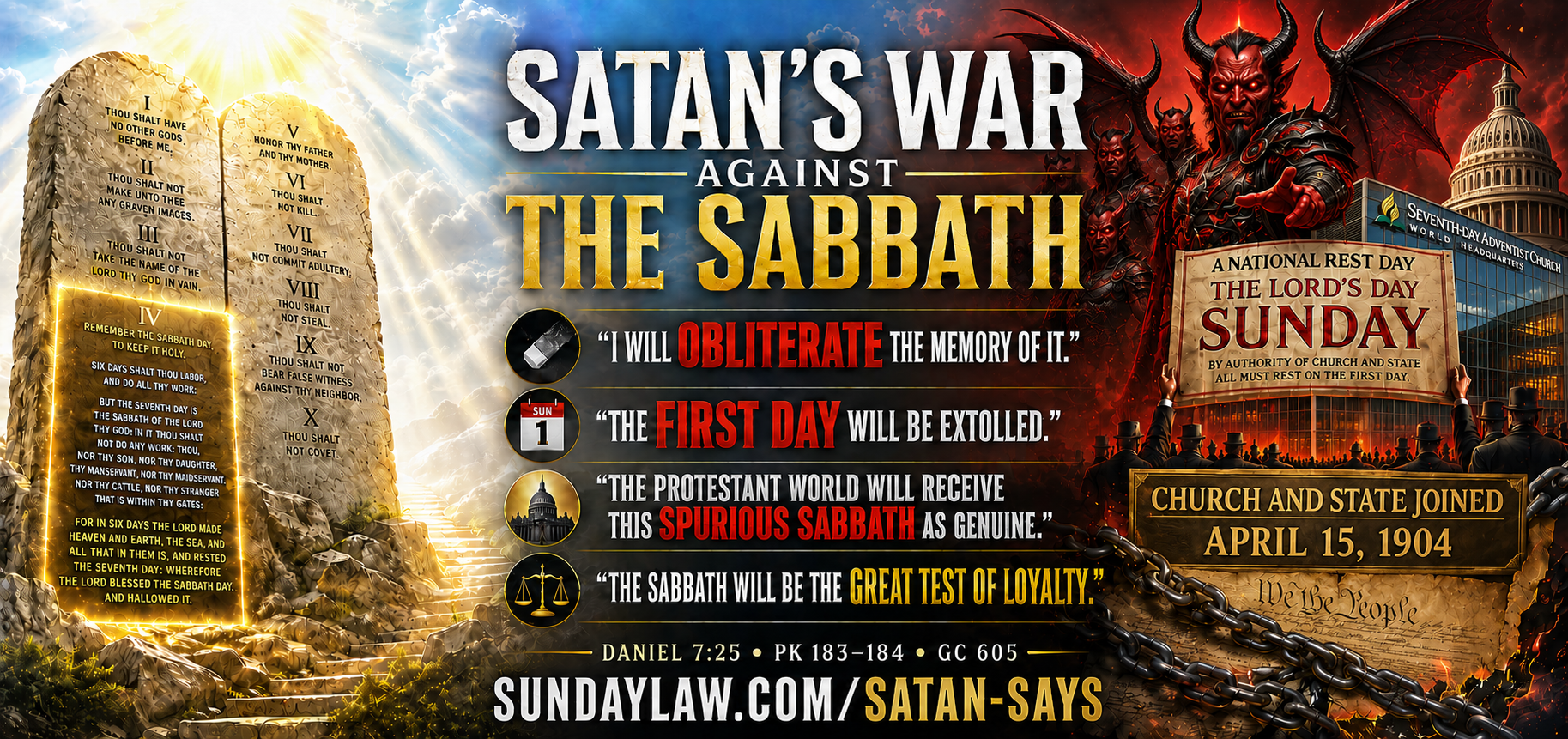
God says, “Remember the sabbath day, to keep it holy.” Satan's design is to make forgotten what God commanded us to remember. The conflict is not merely about a day, but whether the Creator's word will govern the conscience, or whether human authority can claim the place that belongs to God alone.
The Bible does not call believers to fear the future. It calls them to see it. The promise of God is larger than every threat, convenience, or demand for compromise.
“But as it is written, Eye hath not seen, nor ear heard, neither have entered into the heart of man, the things which God hath prepared for them that love him.”God has prepared more than this world can offer to those who love Him.
“If ye love me, keep my commandments.”Jesus Christ
The fourth commandment calls the seventh day “the sabbath of the LORD thy God.” It is a memorial of creation, a sign of the One who made heaven and earth. A counterfeit can only succeed when the original is obscured.
The supplied passage describes an intentional strategy: displace the day God blessed, attach sacred authority to another day, and make obedience to God's command appear dangerous or disloyal. Whether pressure arrives through custom, commerce, or law, the question in the conscience remains the same: who has the right to command worship?
“I will work at cross purposes with God. I will empower my followers to set aside God’s memorial, the seventh-day Sabbath. Thus I will show the world that the day sanctified and blessed by God has been changed. That day shall not live in the minds of the people. I will obliterate the memory of it. I will place in its stead a day that does not bear the credentials of God, a day that cannot be a sign between God and His people. I will lead those who accept this day to place upon it the sanctity that God placed upon the seventh day.Ellen G. White, The Story of Prophets and Kings (1917), chapter 14, “The Spirit of Prophecy,” pp. 183-184; PK 183.2-184.2. See the source at WhiteEstate.org.
“Through my vicegerent, I will exalt myself. The first day will be extolled, and the Protestant world will receive this spurious sabbath as genuine. Through the nonobservance of the Sabbath that God instituted, I will bring His law into contempt. The words, ‘A sign between Me and you throughout your generations,’ I will make to serve on the side of my sabbath.
“Thus the world will become mine. I will be the ruler of the earth, the prince of the world. I will so control the minds under my power that God’s Sabbath shall be a special object of contempt. A sign? I will make the observance of the seventh day a sign of disloyalty to the authorities of earth. Human laws will be made so stringent that men and women will not dare to observe the seventh-day Sabbath. For fear of wanting food and clothing, they will join with the world in transgressing God’s law. The earth will be wholly under my dominion.’”
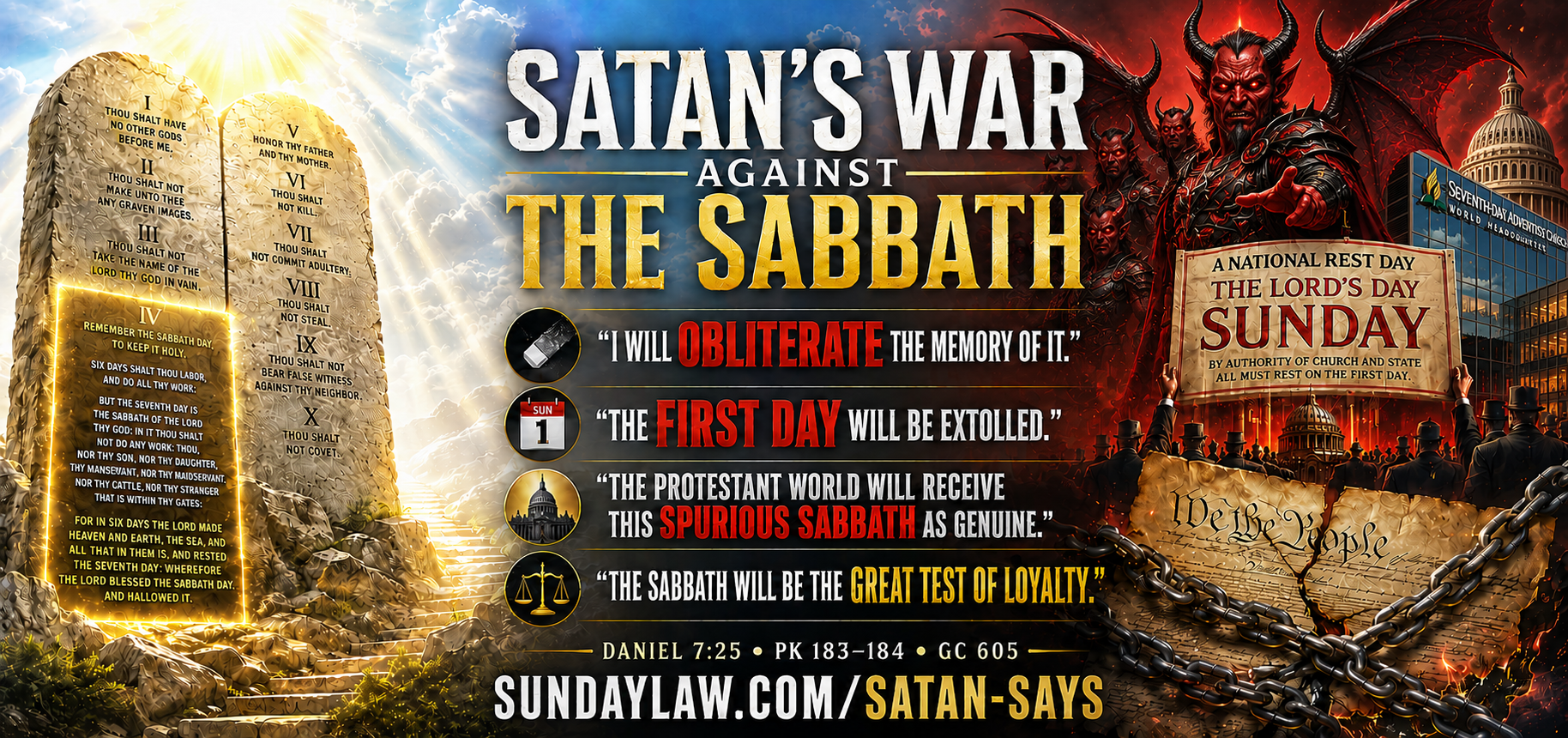
Mara had never wanted to be noticed. She kept a small bakery, greeted every customer by name, and closed her doors at sundown on Friday. Her neighbors knew why: the seventh day was sacred to her, a weekly appointment with the Creator. At first, it was simply part of the rhythm of her life.
Then the town adopted a worship ordinance. Businesses were required to open on the seventh day for the civic service and to close on the first day of the week, Sunday. The mayor called it unity. A newspaper called it patriotism. Mara's landlord called it a condition of keeping the lease.
When she refused, she was summoned to court. The magistrate did not mock her faith. He made the pressure sound reasonable. “No one is asking you to abandon God,” he said. “We are asking you to respect the law and keep the peace.” The room waited for an easy concession.
Mara looked at the order on the table and remembered the words of Jesus: “If ye love me, keep my commandments.” Her voice trembled, but it did not break. “I will respect every person in this room,” she said. “But I cannot give any human law the obedience that belongs to God.”
Her choice cost her the shop. The court sentenced her to death and confined her to await execution. Public voices blamed her for the judgments they claimed were falling upon the nation, because she would not violate her conscience. Yet persecution did not change her allegiance. She counted it better to lose her life than to lose her soul.
Stephen was brought before the council on charges of blasphemy. Scripture records no lawful verdict or sentence before the crowd drove him from the city and stoned him. His trial reveals the cost of speaking faithfully when religious power rejects truth.
“Then they cried out with a loud voice, and stopped their ears, and ran upon him with one accord, And cast him out of the city, and stoned him: and the witnesses laid down their clothes at a young man's feet, whose name was Saul. And they stoned Stephen, calling upon God, and saying, Lord Jesus, receive my spirit. And he kneeled down, and cried with a loud voice, Lord, lay not this sin to their charge. And when he had said this, he fell asleep.”See also Acts 6:8-15 and Acts 7:1-56 (KJV).
Stephen, the foremost of the seven deacons, was a man of deep piety and broad faith. Though a Jew by birth, he spoke the Greek language and was familiar with the customs and manners of the Greeks. He therefore found opportunity to preach the gospel in the synagogues of the Greek Jews. He was very active in the cause of Christ and boldly proclaimed his faith. Learned rabbis and doctors of the law engaged in public discussion with him, confidently expecting an easy victory. But “they were not able to resist the wisdom and the spirit by which he spake.” Not only did he speak in the power of the Holy Spirit, but it was plain that he was a student of the prophecies and learned in all matters of the law. He ably defended the truths that he advocated and utterly defeated his opponents. To him was the promise fulfilled, “Settle it therefore in your hearts, not to meditate before what ye shall answer: for I will give you a mouth and wisdom, which all your adversaries shall not be able to gainsay nor resist.” Luke 21:14, 15. AA 97.1
As Stephen stood face to face with his judges to answer to the charge of blasphemy, a holy radiance shone upon his countenance, and “all that sat in the council, looking steadfastly on him, saw his face as it had been the face of an angel.” Many who beheld this light trembled and veiled their faces, but the stubborn unbelief and prejudice of the rulers did not waver.
When Stephen was questioned as to the truth of the charges against him, he began his defense in a clear, thrilling voice, which rang through the council hall. In words that held the assembly spellbound, he proceeded to rehearse the history of the chosen people of God. He showed a thorough knowledge of the Jewish economy and the spiritual interpretation of it now made manifest through Christ. He repeated the words of Moses that foretold of the Messiah: “A Prophet shall the Lord your God raise up unto you of your brethren, like unto me; Him shall ye hear.” He made plain his own loyalty to God and to the Jewish faith, while he showed that the law in which the Jews trusted for salvation had not been able to save Israel from idolatry. He connected Jesus Christ with all the Jewish history. He referred to the building of the temple by Solomon, and to the words of both Solomon and Isaiah: “Howbeit the Most High dwelleth not in temples made with hands; as saith the prophet, Heaven is My throne, and earth is My footstool: what house will ye build Me? saith the Lord: or what is the place of My rest? Hath not My hand made all these things?”. AA 99.1-AA 99.2
When Stephen reached this point, there was a tumult among the people. When he connected Christ with the prophecies and spoke as he did of the temple, the priest, pretending to be horror-stricken, rent his robe. To Stephen this act was a signal that his voice would soon be silenced forever. He saw the resistance that met his words and knew that he was giving his last testimony. Although in the midst of his sermon, he abruptly concluded it.. AA 100.1
Suddenly breaking away from the train of history that he was following, and turning upon his infuriated judges, he cried: “Ye stiff-necked and uncircumcised in heart and ears, ye do always resist the Holy Ghost: as your fathers did, so do ye. Which of the prophets have not your fathers persecuted? and they have slain them which showed before of the coming of the Just One; of whom ye have been now the betrayers and murderers: who have received the law by the disposition of angels, and have not kept it.”
At this, priests and rulers were beside themselves with anger. Acting more like beasts of prey than human beings, they rushed upon Stephen, gnashing their teeth. In the cruel faces about him the prisoner read his fate; but he did not waver. For him the fear of death was gone. For him the enraged priests and the excited mob had no terror. The scene before him faded from his vision. To him the gates of heaven were ajar, and, looking in, he saw the glory of the courts of God, and Christ, as if just risen from His throne, standing ready to sustain His servant. In words of triumph Stephen exclaimed, “Behold, I see the heavens opened, and the Son of man standing on the right hand of God.” AA 100.2-AA 100.3
As he described the glorious scene upon which his eyes were gazing, it was more than his persecutors could endure. Stopping their ears, that they might not hear his words, and uttering loud cries, they ran furiously upon him with one accord “and cast him out of the city.” “And they stoned Stephen, calling upon God, and saying, Lord Jesus, receive my spirit. And he kneeled down, and cried with a loud voice, Lord, lay not this sin to their charge. And when he had said this, he fell asleep.”
No legal sentence had been passed upon Stephen, but the Roman authorities were bribed by large sums of money to make no investigation into the case. AA 101.1-AA 101.2
The persecution that came upon the church in Jerusalem resulted in giving a great impetus to the work of the gospel. Success had attended the ministry of the word in that place, and there was danger that the disciples would linger there too long, unmindful of the Saviour’s commission to go to all the world. Forgetting that strength to resist evil is best gained by aggressive service, they began to think that they had no work so important as that of shielding the church in Jerusalem from the attacks of the enemy. Instead of educating the new converts to carry the gospel to those who had not heard it, they were in danger of taking a course that would lead all to be satisfied with what had been accomplished. To scatter His representatives abroad, where they could work for others, God permitted persecution to come upon them. Driven from Jerusalem, the believers “went everywhere preaching the word.” AA 105.1-AA 105.2
By the ministration of the Holy Spirit the Lord brought him into touch with one who could lead him to the light. AA 107.3
“Remember the sabbath day, to keep it holy.” The commandment points back to creation and calls the worshipper to remember who made all things.
When any institution demands that conscience set aside a command of God, it asks for an authority it does not possess.
Jesus said, “If ye love me, keep my commandments.” Love for Christ is not reduced to profession; it is expressed in obedience.
Exodus 20:8-11 identifies the seventh day as the Sabbath of the Lord thy God, grounding it in creation.
It is presented in Scripture as a memorial of the Creator and a sign of relationship between God and His people.
Seek God, study His word, treat others with grace, and refuse to surrender conscience where God has spoken.
For every nation, kindred, tongue, and people: these free pioneer books and primary documents invite readers to test the Bible's weekly seventh-day Sabbath for themselves. Open a book, read the record, and weigh its claims by Scripture.
Start with the site’s leading historic pioneer books and study resources.
Open LibraryJ. N. Andrews’s historic study of the Sabbath and first day of the week.
Read Book PageCaptain Joseph Bates’s foundational 1849 Sabbath study.
Read Book PageRead the complete original Joseph Bates PDF online.
Open PDFThe complete featured guide to the Bible Sabbath and its enduring sign.
Read Book PageJoseph Bates’s 1846 edition of A Perpetual Sign.
Open PDFThe 1847 expanded 63-page edition by Joseph Bates.
Open PDFJoseph Bates’s explanation of the sanctuary, 1850.
Open PDFEllen G. White’s Great Controversy, 1858 edition.
Open PDFExplore all featured editions of Ellen G. White’s Great Controversy.
Read Book PagePioneer books, tracts, and documents on Revelation 14.
Open CollectionHistoric resources on conscience, Sunday legislation, and religious liberty.
Explore LibraryCharles Fitch’s 1843 call to examine Babylon by the Word of God.
Read Book PageJ. N. Loughborough’s historic account of the Advent movement.
Read Book PageRead the 1843 and 1850 prophetic charts and their explanations.
Open ChartsThe struggle over worship reaches beyond a calendar. It reaches the heart. Choose the One who created you, redeemed you, and has prepared things beyond sight for those who love Him.
Read the Ellen G. White devotional source