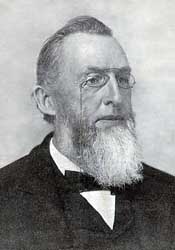
Uriah Smith (1832–1903): A Life Written in Ink, Woodcut, and Prophecy
Uriah Smith’s life began in West Wilton, New Hampshire, in a Millerite household and moved through disappointment, disability, recovery, controversy, invention, and more than half a century of Adventist publishing. The story is not only the story of a theologian. It is the story of a boy who lost a leg, a young man who found a calling at a printing press, an editor who became a pastor to isolated believers, and an author whose prophetic books still sit beside the original charts of the Advent awakening.
The most useful way to read Smith is alongside the sources he served. Start with the Key to the 1843 Prophetic Chart, then compare the 1843 and 1850 Prophetic Charts. The online key preserves the page-by-page explanation associated with the chart tradition and gives the reader the visual and textual setting for Smith’s prophetic work.
The Boy Who Lived Through 1844
Smith’s family accepted the Millerite message. At twelve years old he lived through the 1844 disappointment, a crisis that marked an entire generation. Around that same time, an infection led to the amputation of his left leg above the knee. The disability did not end his usefulness. It became part of the strange physical and inventive history of a man who would later design an artificial leg with flexible knee and ankle joints.
The later biographical record also places him at Phillips Exeter Academy. In December 1852 he accepted the Sabbatarian Adventist message. Early in 1853 he joined James and Ellen White in publishing work at Rochester, New York. That decision turned a young man who might have entered ordinary teaching into one of the most consequential editors in the early Advent movement.
Annie, Harriet, and the Smith Household
Uriah’s older sister, Annie R. Smith, was an early Adventist poet and hymn writer. Their family’s literary and religious gifts ran together: Annie’s poems and hymns helped give the young movement a singing voice, while Uriah’s prose, editorials, engravings, and prophetic books gave it an argumentative and visual vocabulary.
Uriah married Harriet Newell Stevens Smith. The biographical sources reviewed for this page identify Harriet as his wife but do not provide a sufficiently documented list of children. Rather than manufacture a family tree from unsourced genealogy pages, this biography records the wife and sister who can be responsibly identified and leaves the children’s names open for a future archival confirmation.
The 35,000-Word Beginning
In 1853 the Review and Herald published Smith’s first major contribution, a poem of approximately 35,000 words, “The Warning Voice of Time and Prophecy.” Two years later, when the Review moved to Battle Creek, the twenty-three-year-old Smith became editor. For much of the next fifty years he served either as editor or as a member of the editorial staff.
That role was larger than preparing copy. The Review was a traveling pulpit for believers scattered across a continent. Smith’s editorials, letters, humor, scholarship, and public speaking helped isolated Adventists feel that they belonged to a people with a message. The White Estate describes him as a teacher, writer, editor, poet, hymn writer, inventor, and engraver; the combination explains why his influence reached beyond the books carrying his name.
The Prophetic Chart and the Habakkuk Vision
Smith’s name is now inseparable from the explanatory tradition around the 1843 Prophetic Chart. The chart gave ordinary believers a visible map of Daniel and Revelation; the Key gave them a page-by-page verbal guide. Read the Key to the 1843 Prophetic Chart online and then visit the Prophetic Charts study to see the 1843 and 1850 chart witness together.
Read the Key of Explanation
Key to the 1843 Prophetic Chart — Uriah Smith
The chart was made plain so that the reader could run with the vision. The online edition restores the source page by page, including the time prophecy, the sanctuary explanation, the prophetic periods, and the chart’s closing appeal.
Smith’s chart work belongs to a wider publishing history. The Internet Archive preserves The Prophecy of Daniel: The Four Kingdoms, the Sanctuary, and the 2300 Days (1859), a 112-page Battle Creek volume printed by the Review and Herald Steam Press. Read the locally hosted 1904 scan of Daniel and the Revelation, whose title page identifies Uriah Smith as author and describes the work as a response of history to the voice of prophecy.
An Editor Who Also Invented
Smith’s hands were not confined to the composing room. He engraved illustrations for early Sabbatarian Adventist publications and patented mechanical ideas. Patent records associated with him include an artificial-leg improvement and an unusual early automobile design remembered as “Horsey Horseless,” a proposal that placed a false horse head at the front of a motor vehicle in the hope of preventing real horses from bolting.
These inventions are not curiosities detached from his ministry. They show the practical intelligence of a nineteenth-century publisher who worked with type, metal, wood, diagrams, mechanical parts, and arguments. The same mind that arranged a prophetic page also tried to solve the physical problems of movement and mobility.
Secretary, Treasurer, Teacher, and Builder
When the General Conference organized in 1863, Smith was elected its first secretary. He later held that office five additional times and served as General Conference treasurer for one year. In 1874 he was ordained to gospel ministry, helped co-found Battle Creek College, taught Bible classes and ministerial workshops, and chaired the college board.
His work therefore crossed the boundaries modern biographies often separate. He was an editor who taught, a theologian who administered, an inventor who engraved, and a public leader whose daily labor moved between manuscript, classroom, press, and church administration.
Daniel and the Revelation: From Thoughts to a Classic
Smith’s best-known work began as Thoughts, Critical and Practical, on the Book of Daniel and expanded into the commentary commonly called Daniel and the Revelation. The 1859 Daniel volume shows the earlier stage of the project: four kingdoms, the sanctuary, and the 2300 days. The later editions expanded the work into a verse-by-verse study of Daniel and Revelation and became one of the defining reference books of early Adventism.
The original publication trail can be followed through the local 1904 scan of Daniel and the Revelation, while the 1843 Chart Key reader brings the chart explanation into a searchable local edition. The Uriah Smith book and chart library gathers the book, the Key, and the 1850 chart explanation for study together.
The Minneapolis Crisis and a Broken Heart Made Right
Smith’s story also includes a painful chapter. At the 1888 Minneapolis General Conference, he stood with leading figures who resisted the Jones-Waggoner message of righteousness by faith. Ellen White later wrote directly about the spiritual and practical damage caused by Smith’s course. Her 1890 letter describes his treatment of Professor Bell and tells Smith that he had worked at cross-purposes with God.
The story did not end with the rebuke. In January 1891, Ellen White recorded that Smith made a straightforward confession to Professor Bell, confessed his Minneapolis course, and told her, “Sister White, will you forgive me for all the trouble and distress that I have caused you?” She wrote that he had “fallen on the Rock and was broken.” That scene belongs in a serious biography because it shows both the cost of leadership and the possibility of repentance.
In 1899, Ellen White wrote that Thoughts on Daniel and the Revelation had “done a great work in this country,” placing the book alongside The Great Controversy and Patriarchs and Prophets as works of consequence. Her endorsement does not erase the controversy; it gives the reader a more complete portrait of a fallible worker whose books continued to serve a public purpose.
The Last Walk to the Review Office
Smith died in Battle Creek in 1903 after suffering a stroke on his way to the Review office. The White Estate preserves the last words he wrote to the General Conference: “I am with you in the endeavor to send forth in this generation this gospel of the kingdom, for a witness to all nations. And when this is completed, it will be the signal for the coronation of our coming King.”
He was buried in Oak Hill Cemetery in Battle Creek, Michigan. The grave is a fitting end to a life spent in the city where the Review press, college, publishing house, and church institutions had gathered around the Advent message. His work did not survive because he was never controversial; it survived because his books, pages, charts, and editorial labor became part of the archive through which later readers could still examine the movement’s arguments.
What Remains to Be Read
Uriah Smith’s legacy is best approached through primary sources: the 1859 Prophecy of Daniel, the later Daniel and the Revelation, the Review and Herald files, the 1843 Chart Key, his engravings and patents, and the letters that record both his resistance and his repentance. His family story includes Annie’s poetry and hymn writing and Harriet Newell Stevens Smith as his wife; the names of children remain unverified in the sources reviewed here.
The invitation is simple: read the Key of Explanation for the 1843 Prophetic Chart, study the 1843 and 1850 charts, and then open the 1904 publication of Daniel and the Revelation. Smith spent his life trying to make prophecy readable. The best tribute is to read the sources closely enough to test every claim against Scripture, history, and the printed witness.
“Books of a New Order” — Examine the Investigation
The Changed study traces the controversy around the Testimonies, early republication decisions, and the later book record in which Uriah Smith appears. The 78-page investigation reproduces the 1882 testimony dispute involving Smith and examines changing Spirit of Prophecy books. Follow the cited documents alongside the original publications.