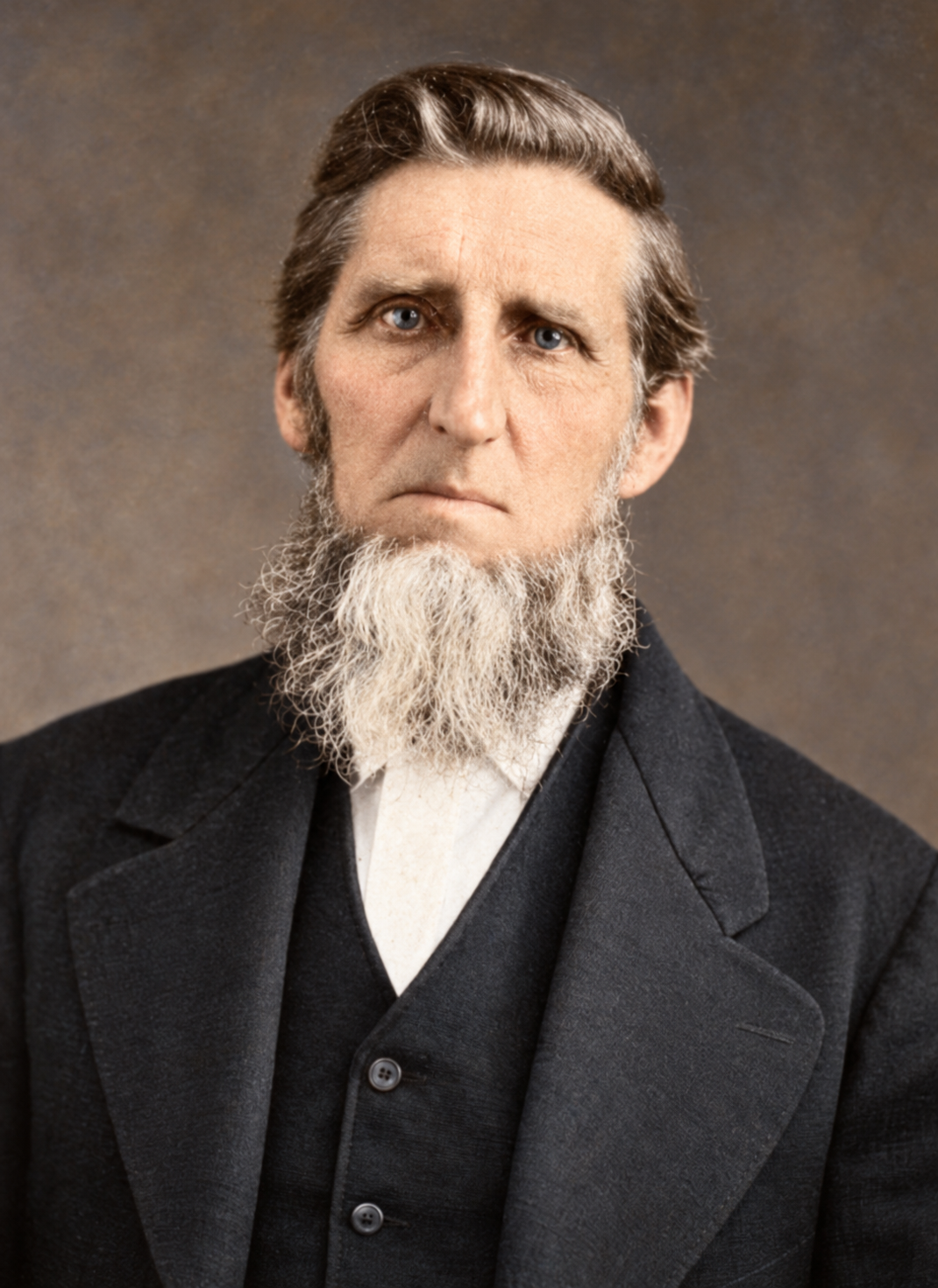
Heman Stetson Gurney (1818–1896) — Died at Age 78
Picture the road before there were polished institutions, professional platforms, or comfortable offices: a blacksmith traveling with a Bible, a song, and a message burning in his heart. That was Heman Stetson Gurney. He was an early Millerite believer, Sabbatarian Adventist, writer, publisher, hymn writer, and close friend of Captain Joseph Bates. The Encyclopedia of Seventh-day Adventists biography records his place in the first generation that carried the Advent message from the Millerite awakening into the Sabbath and sealing movement.
He is remembered as the “singing blacksmith,” a joyful, practical worker whose hands could shape iron and whose voice could carry the Advent hope. His story brings the early movement down from abstract dates and doctrines into homes, roads, workshops, hymn singing, family prayer, printing bills, and long journeys taken because people needed to hear that Christ was coming.
Millerism and the Sabbath
Gurney encountered William Miller's writings in 1838. Joseph Bates later shared a copy of Signs of the Times with him, and Gurney traveled with Bates in 1844 to preach Christ's soon return. In spring 1845, Bates shared T. M. Preble's Sabbath tract with Gurney. Gurney and William and Mary Gifford became among Bates's first converts to the seventh-day Sabbath, before James White and Ellen White had accepted the Sabbath.
A Witness Connected to the Sealing Message
Captain Joseph Bates's A Seal of the Living God connected the seventh-day Sabbath with the sealing of the 144,000 and the sanctuary message. Bates's account places Heman Stetson Gurney among the earliest believers through whom that Sabbath-and-sealing light was received and carried forward. The primary source is preserved here: Open Bates's A Seal of the Living God PDF.
H. S. Gurney's Hymn — “The Seal”
The sealing message was also carried in song. The original hymn is credited “BY H. S. GURNEY” and appears with the title “The Seal.” Its Sabbath-and-sealing imagery gives a musical voice to the message featured in Bates's tract:
BY H. S. GURNEY.
Behold a light appears,
The holy Sabbath day,
And magnified so clear,
That none may need to stray;
Though small at first as sun beam's ray,
Its strength ascends to perfect day.
It is the message clear
Ascending from the East,
God's servants now appear
Who will not worship “BEAST;”
Four angels hold the winds revealed,
Until God's servants all are sealed.
Hebrews in Egypt's land
Must all receive a sign,
When forth from Pharaoh's hand
Deliverance was designed;
A sign, a token, thus shall be,
Before the earth and heavens flee.
The Sabbath is a sign,
A mark which all may see,
And sure will draw a line
When servants all are sealed,
And while destruction's in the land
This mark will guard the waiting band.
Then wrath in vengeance comes,
The great and dreadful day!
God's voice in thunder tones,
Shakes heaven and earth and sea;
Ye living saints who faithful be,
No plague shall e'er come nigh to thee.
O God, the living God,
Do thou the seal apply,
And from destruction's rod,
Oh! keep us lest we die;
And while the storm of wrath descends,
Oh hide us, till the earth be cleansed.
Read the full A Seal of the Living God book page beside this hymn witness.
Supporter of Ellen and James White
Gurney heard Ellen White describe her first vision, investigated the reports, and became convinced that God had called her to an important work. He traveled with James White and Ellen Harmon on an early circuit of Advent believers and helped arrange the printing of 250 copies of Ellen's first broadside, To the Little Remnant Scattered Abroad, agreeing to pay half the cost. His wife, Anne “Eliza” Elizabeth Gurney, also belonged to this early Advent household and later published a short report in the Review and Herald.
The remembered account of that printing sacrifice makes the moment even more personal. Heman is said to have gone quietly to an account holding $100, withdrawn the money, and paid the printing fee without announcing what he had done. He did not wait for public recognition or ask the scattered believers to carry the burden first. He saw that the testimony needed to reach them, and he placed his own means behind the work.
In 1846, $100 was not a casual gift. A careful modern comparison cannot be exact because prices, wages, and household costs have changed differently, but $100 then represents roughly $4,000–$5,000 in 2026 purchasing power. Another way to feel the scale is to compare it with ordinary labor: it could represent several weeks or months of a working man's earnings, not a spare afternoon's spending. Heman's quiet withdrawal was therefore a meaningful personal sacrifice to help put 250 copies into the hands of believers.
That hidden act belongs beside Christ's words: “thy Father, which seeth in secret himself shall reward thee openly” (Matthew 6:4). It also recalls the widow who gave two small coins: Jesus measured the gift not by its public size but by what it cost the giver (Mark 12:41–44; Luke 21:1–4). Heman's name eventually became part of the record, but the spirit of the act was the opposite of self-display: he gave in secret so the message could be made public.
Gurney's first-hand memory is unusually vivid. During one 50-mile journey with James and Ellen Harmon, Ellen settled down in the bottom of the carriage to keep warm. After they had ridden for some time, Gurney and his companions heard her speaking with the angels. Her voice rang out clearly as she told what the angels were teaching her. She was in vision. Gurney later wrote that she did not need an exciting meeting in order to receive a vision; the heavenly messenger met her on the road.
He saw another vision during a trip to West Island to visit the Hall family, when Ellen described a boat in a raging storm. That experience strengthened his conviction that her visions were not the product of mesmerism. His support was not casual admiration: he investigated, traveled, paid for printing, and stood beside the young publishing work while it was still fragile.
The 250 copies of the broadside were a small beginning with a long reach. A blacksmith and lay worker helped place the early testimony into the hands of the scattered remnant. That is the kind of hidden faithfulness from which a movement grows.
Family and Later Work
Gurney married Anne “Eliza” Elizabeth Randall on May 15, 1853. Eliza brought her daughter, Louisa Bessie Randall (born October 6, 1849), into the household. Louisa died of typhoid at fifteen. Heman and Eliza then had three children together: Lydia Gurney (1854–1950), Charles Herbert Gurney (1856–1945), and Carrie L. Gurney (1864–1934).
The family moved to Jackson, Michigan, in late 1856 and later to Memphis, Michigan. Their home carried the ordinary burdens of pioneer life alongside the public work: children, health reform, church questions, travel, business, worship, and the pressure of persecution. In 1878 Heman and his son Charles Herbert were arrested for working in the fields on Sunday; Heman was released, while Charles appealed his case.
Gurney continued writing and preaching. He served one term as president of the Michigan Conference in 1869, traveled through Michigan with J. B. Lamson in 1871–1872, encouraged health reform and systematic benevolence, and urged believers to hold to sound doctrine and the plain, literal Word of God. He died in Riley, Michigan, on August 4, 1896. Eliza died in Memphis on January 20, 1921.
The Singing Blacksmith
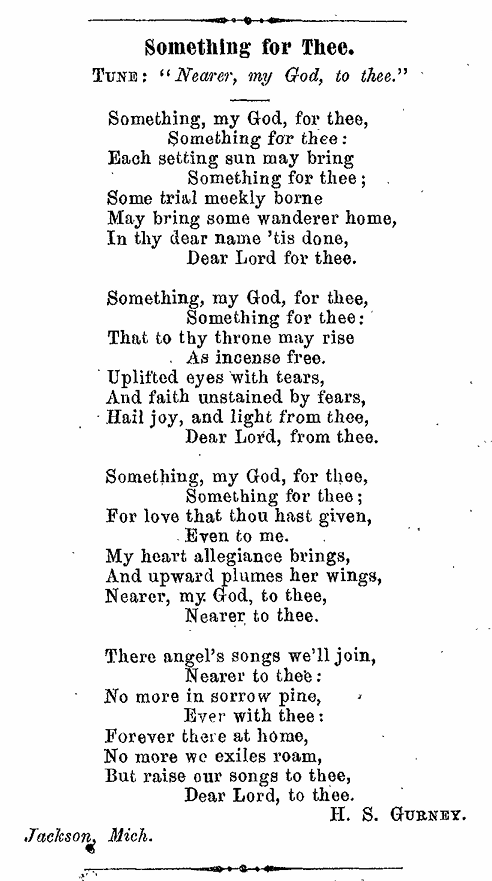
Anne’s husband became known as the “singing blacksmith.” The name fits the man: iron in one hand, a hymn in his heart, and the Advent hope on his lips. Music was part of Gurney's theology of joy. He composed at least two hymns, including “Lo! An Angel Loud Proclaiming” and “Something for Thee.” His singing and practical ministry gave the early movement a human warmth: the same man who defended present truth could also put the Advent hope into song.
The hymn “Lo! An Angel Loud Proclaiming” preserves a glimpse of that musical witness. It belongs beside the articles, sermons, charts, and letters because the pioneers did not merely debate truth; they sang it, carried it, printed it, and lived it.
Original Heman S. Gurney Hymn Scans
- Open the original 1849 scanned hymnal — Hymns for God's Peculiar People, PDF page 4, where “Lo! An Angel Loud Proclaiming” originally appeared as “Second Advent History,” Hymn 2. View the complete archive record.
- Open the original 1864 Review and Herald scan — PDF page 7, where “Something for Thee” appears on page 183 and is signed H. S. GURNEY.
- View the original “Something for Thee” scan.
Primary Sources
- ESDA biography: Heman Stetson Gurney and Anne Eliza Gurney
- Captain Joseph Bates: A Seal of the Living God
- A Seal of the Living God PDF
- Ellen White's To the Little Remnant Scattered Abroad broadside
- Anne Eliza Gurney biography
- Heman Gurney, “Remarks on the Law of God,” Review and Herald, January 13, 1852
- Heman Gurney, “The Promise,” Review and Herald, March 6, 1856
- Heman Gurney, “The Dietic Reform,” Review and Herald, November 8, 1864
- Heman Gurney, “The Work of the Lord,” Review and Herald, June 8, 1869
- Heman Gurney, “Second Advent Experience,” Review and Herald, October 31, 1871
- Anne “Eliza” Gurney, “From Sr. Gurney,” Review and Herald, August 8, 1871, pp. 62–63
- Early Advent hymn: “Lo! An Angel Loud Proclaiming”