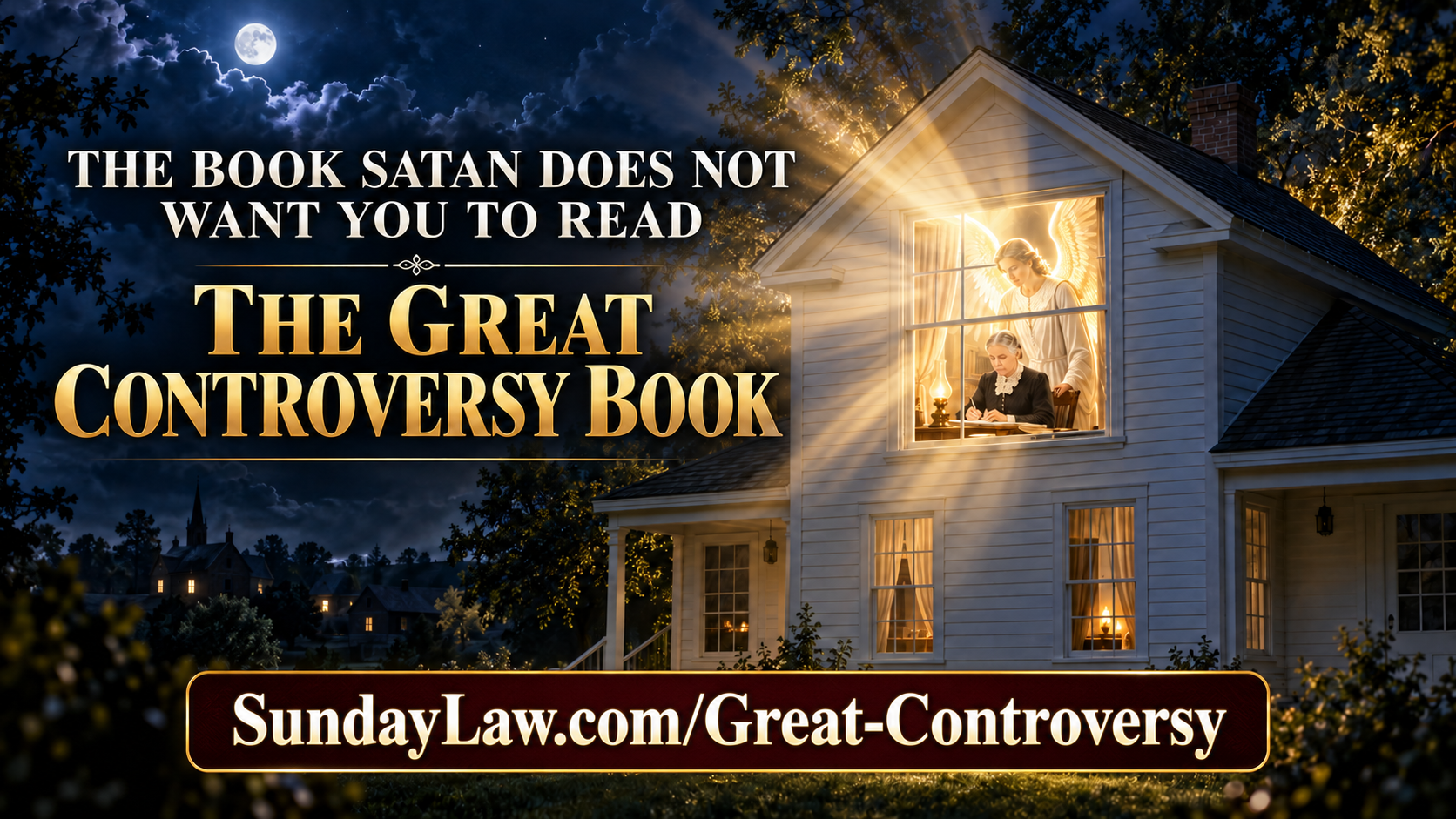
How The Great Controversy Was Written
Before it was a 678-page book translated into more than 200 languages, The Great Controversy began as a two-hour vision given to a young woman in front of a congregation gathered for a funeral in a country schoolhouse. What happened between that Sunday in March 1858 and the finished manuscript five months later is a story most readers never hear — a story of a public vision, a paralytic stroke, a small home on Wood Street in Battle Creek, and fifty-three years of careful revision that produced the book millions now call simply “the Great Controversy.”
A Public Vision at a Country Funeral
The story does not begin in a quiet study. On Sunday, March 14, 1858, James and Ellen White were holding meetings at Lovett’s Grove, Ohio, when a funeral was held in the local schoolhouse. James was asked to speak, and partway through the service Ellen felt moved to bear her testimony to the mourners. In the middle of that testimony — in front of the whole congregation, not in the privacy of her own room — she was taken into a vision that lasted about two hours.
What she saw was not entirely new. Most of it, she said, was a repetition of a much larger view of the conflict between Christ and Satan that had first been opened to her ten years earlier, in 1848. This time, however, she was given a specific instruction: she must write it out.
“In this vision at Lovett’s Grove [in 1858], most of the matter of the Great Controversy which I had seen ten years before, was repeated, and I was shown that I must write it out.”
The Stroke That Nearly Stopped the Book
The very next day, on a train heading home, James and Ellen began making plans for writing and publishing the book. Then, at a stopover along the way, Ellen suffered a stroke of paralysis — an affliction that made the very act she had just been charged to do, writing, seem almost impossible.
For several weeks she could not feel pressure on her hand, or even cold water poured over it. She began anyway: one page in a day, then three full days of rest before attempting the next. As she persisted, her strength slowly returned, and by the time the manuscript was finished, every effect of the stroke had disappeared. The book was completed by mid-August 1858 — roughly five months from vision to finished manuscript — and published that year as Spiritual Gifts, Volume 1: The Great Controversy Between Christ and His Angels, and Satan and His Angels. It is written almost entirely in the first person, present tense — the phrase “I saw” appears 161 times.
The Home on Wood Street
James and Ellen White wrote most of that first manuscript inside the only home they had ever owned to that point: a house built in 1856 on Wood Street in Battle Creek. It was the family’s first home, and they lived in it for seven years, until 1863. Still standing in its original location, the house is preserved today at the heart of the Historic Adventist Village.
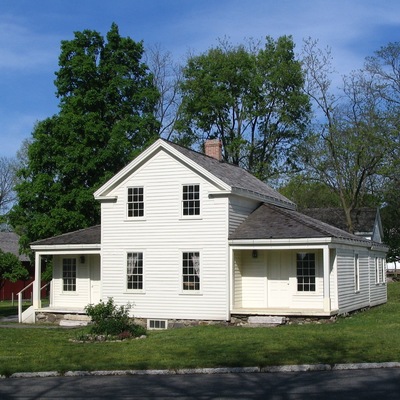
Built in 1856, this was the first home James and Ellen White ever owned. It was here, following the March 1858 vision at Lovett’s Grove, that Ellen White wrote Spiritual Gifts, Volume 1 — the first edition of The Great Controversy. Use the + / − controls or scroll to zoom, and drag to pan across the photograph.
Photo: White Home, 1856 — Andrews University, Historic Adventist Village, James White 200 Years exhibit.
A Light No Lamp Could Explain
Ellen White herself said she was rarely alone in that work. Writing decades later about the experience of composing the manuscript, she described an awareness of unseen company in the room — and family members recorded something visible from the outside as well.
“While writing the manuscript of The Great Controversy, I was often conscious of the presence of the angels of God. And many times the scenes I was describing were so vividly impressed upon my mind that I seemed to be an eyewitness to the events.”
“When Mother wrote at night, the light in her room was so bright that it could be seen through the windows, and on at least one occasion neighbors noticed the unusual brightness and inquired about it the following morning, unaware that any lamp could produce such an effect.”
From One Small Book to a Global Message
The 219-page seed of 1858 grew across more than half a century into the standard 1911 edition read around the world today. Every stage of that growth is documented.
Spiritual Gifts, Vol. 1
219 pages. The seed form — the whole controversy from Lucifer’s fall to the earth made new, written in five months at the White home in Battle Creek.
The Spirit of Prophecy Series
Expanded into four volumes for Adventist readers. Volume 1 (Old Testament history) appeared in 1870; two more volumes covering the New Testament followed in 1877 and 1878.
First Edition Titled “Great Controversy”
Volume 4 of the series was published in two bindings — an olive edition titled The Great Controversy, and a black edition titled Spirit of Prophecy, Vol. 4 — and sold to Adventists and the general public alike. Fifty thousand copies were distributed within three years.
The European Revision
Written and revised in part while Ellen White lived in Europe, this expanded edition added chapters on Huss and Jerome, enlarged the material on Zwingli and Calvin and the sanctuary, and was translated into French and German alongside the English text.
The Standard Edition
Worn printing plates forced a full reset at Pacific Press. Ellen White used the occasion to add full source citations, sharpen wording, and add appendix notes — without changing the book’s doctrine.
Rare Facts Behind the Familiar Book
The Controversy Continues: A Later Call to Review the Record
Years after The Great Controversy was written, Ellen White recorded a separate vision about testing present teaching against the documented history of the movement. It is not part of the story of how the book itself was written, but it echoes the same conviction that runs through it: truth stands up to an honest review of the record.
“I saw that they were in terrible conflict as to whether to take their stand for or against the light that God has permitted me to bear to the world. It seemed to me like a life-and-death question. I cannot describe it, but the conflict was a terrible one. The seductive presentations framed by satanic agencies were presented by subtle reasoning, and their minds had well-nigh become overwhelmed when a heavenly messenger let light shine forth.
There came to them the thought, ‘Review the past experience of the people of God; review the history of the work from the first, as if you were beholding it in a mirror. Has this work been what it has been represented to you to be?’ Then another and still another scene was presented before them by the heavenly messenger, until they saw truth bearing the signature of the heavenly in the past, then present, and still more decidedly in the future.
The words were spoken, ‘Strait is the gate, and narrow is the way, that leadeth unto life, and few there be that find it. Broad is the road and wide is the gate that leadeth to destruction, and many there be which go in thereat.’”
Read alongside the story of how The Great Controversy came to be written, this later counsel asks the same question the book itself was written to answer: does this teaching, this movement, this claim hold up when set beside the documented record from the beginning? Continue that study on the pioneer record pages below.
The Black Banner and the White Banner
The 1858 book this page tells the story of contains its own vision of steadfastness under pressure: two companies, two banners, and a call to hold the true banner high no matter how many fall or fall away.
“It was presented before me in the following manner: A large company of heathen idolaters bore a black banner upon which were figures of the sun, moon and stars. The company seemed to be very fierce and angry. I was then shown another company bearing a pure white banner, and upon it was written Purity, and Holiness unto the Lord. Their countenances were marked with firmness and heavenly resignation. I saw the heathen idolaters approach them, there was a great slaughter. The Christians melted away before them; and yet the Christian company pressed the more closely together, and held the banner more firmly. As many fell, others rallied around the banner and filled their places.”
“I saw the company of idolaters consulting together. They failed to make the Christians yield, and they agreed to another plan. I saw them lower their banner, and they approached that firm Christian company, and made propositions to them. At first their propositions were utterly refused. Then I saw the Christian company consulting together. Some said that they would lower the banner, accept the propositions, and save their lives, and at last they could gain strength to raise their banner among those heathen idolaters. But some would not yield to this plan, but firmly chose to die holding their banner, rather than lower it. Then I saw many of that Christian company lower the banner, and unite with the heathen; while the firm and steadfast seized the banner, and bore it high again. I saw individuals continually leaving the company of those bearing the pure banner, and joining the idolaters, and they united together under the black banner, to persecute those bearing the white banner, and many were slain; yet the white banner was held high, and individuals were raised up to rally around it.”
“The book should go everywhere. Let it be scattered like the leaves of autumn. It contains the story of the past, of the present, and of the future. In its outline of the closing scenes of this earth’s history, it bears a strong, decided witness to the truth.”
“And they overcame him by the blood of the Lamb, and by the word of their testimony; and they loved not their lives unto the death.”The Great Controversy is the extended testimony of those who overcame — the record of the blood-sealed witness of the Protestant Reformation and the 1840–1850 original Advent movement.
Frequently Asked Questions
When was The Great Controversy written?
The first edition was written between March and mid-August 1858, following the vision Ellen White received at Lovett’s Grove, Ohio, on March 14, 1858.
Where was it written?
Mainly at the White family’s first home, built in 1856 on Wood Street in Battle Creek, Michigan — now preserved at the Historic Adventist Village.
What’s the difference between the 1858, 1884, 1888, and 1911 editions?
Each edition expanded and refined the last: 1858 was the 219-page seed; 1884 was the first book actually titled The Great Controversy; 1888 added Reformation-era chapters and sanctuary material while Ellen White lived in Europe; 1911 added full source citations and clarified wording without changing the book’s doctrine.
Is there a free PDF of The Great Controversy?
Yes — every major edition is available free to read or download on this site. See the full book and edition library.