
Public Record and Doctrinal Charge
Ángel Manuel Rodríguez was a Seventh-day Adventist theologian and Biblical Research Institute director. His published Sonship argument belongs in the record because it challenges the literal Father-Son faith proclaimed by the Adventist pioneers.
Public record
Wikipedia’s biographical summary identifies Rodríguez as a Seventh-day Adventist theologian, records his Doctor of Theology from Andrews University, and states that he served as director of the Biblical Research Institute from 2001 through 2011. The official Elders’ Digest author page identifies him as a retired BRI director and links his published articles.
THE SONSHIP EVIDENCE IS ON THIS PAGE
Rodríguez does not merely “question” Christ’s Sonship. He plainly says:
“The Son is not the natural, literal Son of the Father.”
And then:
“The term ‘Son’ is used metaphorically when applied to the Godhead.”
— Ángel Manuel Rodríguez, “A Question of Sonship,” Adventist World, November 2015, p. 42.
There it is.
God says:
“This is my beloved Son.” — Matthew 3:17, KJV
Rodríguez says:
METAPHOR.
How many theological degrees does it take before “Son” no longer means son?
The entire article is reproduced below. Read it for yourself.
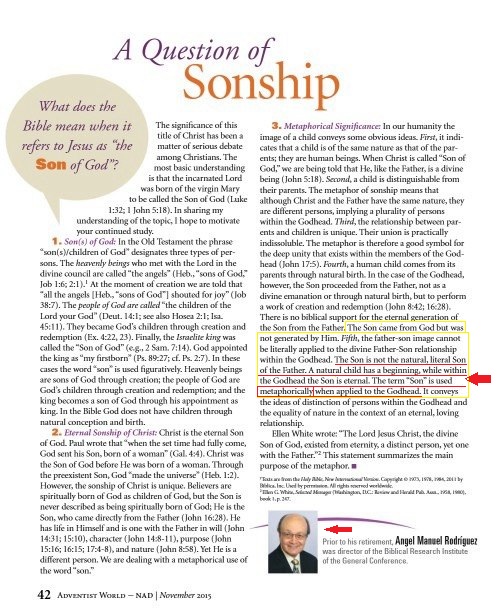
The page image identifies Rodríguez as the author and identifies him as director of the Biblical Research Institute before retirement. The exhibit is direct evidence of a published doctrinal argument: it places a metaphorical Sonship formulation against the pioneers’ literal, begotten Son of the Father. The connected Sonship study and If Thou Be the Son of God study preserve the same article page beside the 1872 pioneer principles and the 1980 Fundamental Beliefs formulation.
What this does to the Son of God and salvation
This is not a harmless change of vocabulary. It strikes at the foundation of the gospel. The Bible does not present a make-believe son, a ceremonial title, or a metaphor wearing the name “Son.” It presents the real Son of the real Father: the One who was with the Father before the world was made, the One whom the Father sent, the One who came forth from God, the One who died at Calvary, rose again, and now ministers for the human family.
If “Son” is emptied of its literal Father-Son meaning, then the central gift of the gospel is emptied with it. What did God give at Calvary if He did not give His actual Son? What did heaven surrender? What did Christ reveal about the Father? A theological system that turns the Son into a metaphor does not merely rename the Godhead; it severs the very relationship Scripture places at the heart of salvation. It makes the Fatherhood of God figurative, the Sonship of Christ figurative, and the sacrifice of the cross doctrinally detached from the Father who “spared not his own Son.”
Isaiah stated the promise in plain KJV language:
“For unto us a child is born, unto us a son is given: and the government shall be upon his shoulder: and his name shall be called Wonderful, Counsellor, The mighty God, The everlasting Father, The Prince of Peace.” — Isaiah 9:6, KJV
That is the real proclamation: a Son is given. Not a title assigned to a divine role. Not a metaphor invented to describe a relationship. A Son is given.
Here is the theological substitution exposed by the contrast:
Metaphorical rendering: “Unto us a child is born, and unto us a divine role is assigned. The ‘Son’ is not the natural, literal Son of the Father; ‘Son’ is a metaphor for distinction of persons within the Godhead.”
That paraphrase is not Isaiah 9:6. It is what the biblical sentence becomes when the word Son is stripped of its literal Father-Son meaning. The KJV says a son is given; the metaphorical system says the Son is only a name for a relationship. The difference reaches directly into Calvary and the salvation of every believer.
That attack reaches the believer directly. Scripture says that God sent “the Spirit of his Son” into our hearts, that the Son brings us to the Father, and that “he that hath the Son hath life.” The pioneers proclaimed a living chain of salvation: the Father gave His literal Son; the Son gave Himself; the risen Son ministers in the heavenly sanctuary; and the Spirit of the Son brings Christ’s life into the believer. Break the first link and the whole chain is threatened.
This is why the pioneers treated the Trinity as more than an abstract theory. James White said it “does away the personality of God, and of his Son Jesus Christ.” Captain Joseph Bates defended the plain personal Father and Son against the creeds of Rome. The issue is therefore not intellectual taste. It is whether the church will keep the faith of Jesus as the pioneers preached it, or replace the real Son of God with a doctrinal construction that cannot bear the weight of Calvary, the sanctuary, or the believer’s hope of eternal life.
James White stated the consequence without soft language:
“Here we might mention the Trinity, which does away the personality of God, and of his Son Jesus Christ…”
— James White, “Preach the Word,” Advent Review and Sabbath Herald, December 11, 1855, vol. 7, no. 11, p. 85. Read the archival source.
White later placed the Trinity among the marks the Reformers failed to remove:
“The greatest fault we can find in the Reformation is, the Reformers stopped reforming. Had they gone on, and onward, till they had left the last vestige of Papacy behind, such as natural immortality, sprinkling, the trinity, and Sunday-keeping, the church would now be free from her unscriptural errors.”
— James White, “The Word,” Advent Review and Sabbath Herald, February 7, 1856, p. 148. Read the archival source.
Captain Joseph Bates carried the same Protestant, anti-Roman burden into the Sabbath and sealing message: test every doctrine by Scripture, reject the creeds that displaced the plain Word, and stand with the commandments of God and the faith of Jesus. The issue is therefore salvation-centered, not academic. A doctrine that removes the personal Father and the real Son obscures the One whom Scripture says was sent, died, rose again, ministers for His people, and brings believers to the Father.
Read the connected Modern Moses source, then compare the pioneer witness with the present doctrinal record. The choice is not between two harmless labels; it is between the plain Son of God proclaimed by the pioneers and a later formulation they explicitly identified as part of the unfinished Reformation.